Meituan Open-Sources LongCat-Video: A Foundation Model for Long Video Generation

Meituan open-sources LongCat-Video, a long-form video generation model with 8,700+ GitHub stars.
Meituan's LongCat team has open-sourced LongCat-Video on GitHub, quickly amassing over 8,700 stars and 1,500 forks. The model focuses on long-form video generation — a core industry challenge where most models break down after a few seconds. The release positions video generation as a pathway to world models with value for autonomous driving and robotics. Open weights enable community fine-tuning and distillation, lowering the bar for video AI development. Actual generation quality, supported duration, and hardware requirements still need real-world validation.
Meituan Enters the Video Generation Race
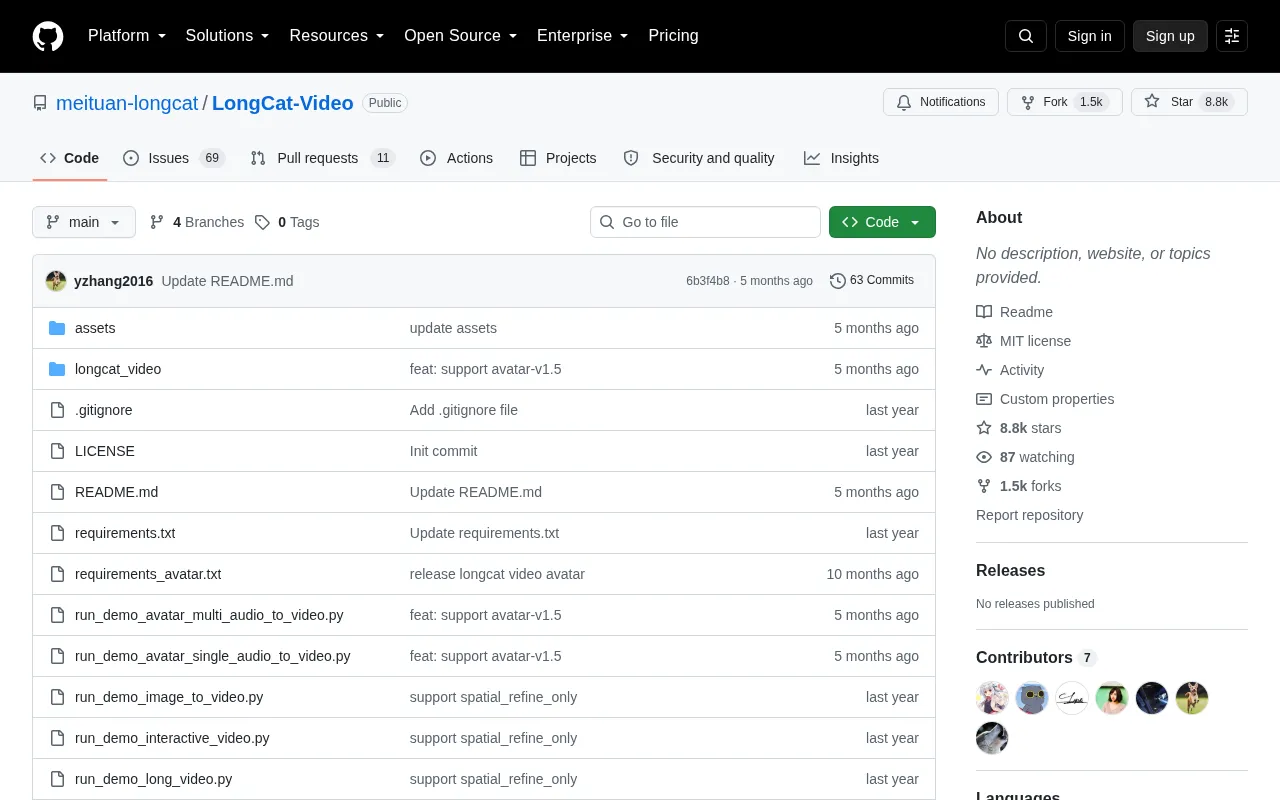
Meituan's LongCat team has open-sourced a video generation model called LongCat-Video on GitHub. The project attracted immediate attention after launch, surpassing 8,700 stars, gaining 44 new stars in a single day, and accumulating over 1,500 forks. For a company primarily known for local lifestyle services, making a serious push into video generation foundation models is a noteworthy signal — it suggests that top-tier internet companies are accelerating their investments in general-purpose AI capabilities.
The name LongCat-Video continues Meituan's LongCat series technical brand. Built with Python, the project targets video generation — one of the most closely watched and technically demanding frontiers in generative AI today. Compared to text and image generation, video requires handling temporal coherence, placing significantly higher demands on both computing resources and model architecture.
Why Video Generation Is a Must-Win Battlefield
Since Sora ignited the imagination around video generation, both domestic and international players have rushed in, forming a competitive landscape centered on text-to-video, image-to-video, and video continuation. Video models are not just content creation tools — they are increasingly seen as a critical pathway toward world models. Such models must understand physical laws, temporal logic, and spatial relationships, and the capabilities developed along the way have spillover value for autonomous driving, robotics, simulation, and beyond.
Meituan's decision to open-source a video model at this moment is both a demonstration of technical capability and a pragmatic move to gain influence within the developer ecosystem. The open-source strategy can rapidly rally community momentum and accelerate model iteration — something already evidenced by the project's high engagement in a short time.
What is a World Model? A world model is an AI system capable of internally modeling the physical laws, causal relationships, and temporal logic of the real world. Unlike pure content generation, a world model needs to "understand" what consequences follow from a given action — for example, that a thrown ball will travel along a parabolic arc and land, rather than floating randomly. Video generation is considered an important training pathway for world models because high-quality video generation requires the model to implicitly grasp physical principles like object motion, lighting changes, and occlusion — otherwise outputs will exhibit obvious clipping, floating objects, or motion inconsistencies. When OpenAI launched Sora, it explicitly emphasized its potential as a "simulator of the physical world," a framing that greatly expanded the imaginative scope of video generation models — extending them from pure creative tools into industrial applications like autonomous driving scenario prediction and robotic manipulation simulation.
LongCat-Video's Positioning and Features
The "Long" in the project's name suggests a particular emphasis on long-form video generation. This is one of the core challenges facing the industry today: most models can only reliably generate clips of a few seconds, and as duration increases, outputs tend to suffer from content drift, character inconsistency, and physical logic breakdown. Maintaining consistency over longer time spans is often considered a key indicator of a video foundation model's maturity.
Practical Value of Open-Sourcing
For developers and researchers, access to an open video foundation model opens up a wide range of possibilities. With open weights, the community can fine-tune, distill, and build on top of the model to fit specialized use cases — without having to train a foundation model from scratch, which typically demands enormous computational resources. This lowers the barrier to building video AI applications and provides reproducible baselines for academic research.
Using Python as the primary language aligns with the conventions of mainstream AI frameworks like PyTorch, making it easy for researchers to get started and integrate quickly. For teams evaluating or deploying video generation capabilities, projects like this offer a meaningful option worth considering.
Model Distillation and Fine-Tuning Explained Model distillation is a technique for transferring knowledge from a large model into a smaller, more efficient one. In practice, the outputs of a large model (the teacher) are used to guide the training of a smaller model (the student), allowing the latter to retain strong generation quality with far fewer parameters. For compute-intensive tasks like video generation, distillation is especially valuable — it allows developers to take an open-source large-parameter foundation model and distill it into a lightweight version that can run on consumer-grade GPUs, truly bridging the gap between research and deployment. Fine-tuning, on the other hand, involves continuing to train a pre-trained model on domain-specific data to adapt it to particular styles, scenarios, or industry needs — for example, adapting a general-purpose video model into a specialized tool for generating e-commerce product showcase videos. Both approaches depend on access to open weights, and they are the core pathways through which the community can rapidly build applications on top of foundation models.
China's Continued Push in Video Models
The release of LongCat-Video is yet another chapter in the collective push by Chinese AI companies into video generation. From closed-source commercial products to active open-source communities, the domestic industry is rapidly closing the gap with international state-of-the-art. The open-source approach deserves particular recognition — it promotes technical transparency and knowledge sharing, and gives smaller teams the opportunity to participate in cutting-edge research.
That said, a model's real-world capabilities still need to be validated through actual testing and community feedback. Star counts reflect attention, not quality. The specific generation performance, maximum supported duration, visual consistency, and controllability all remain to be verified by developers in practice.
Dimensions Worth Tracking
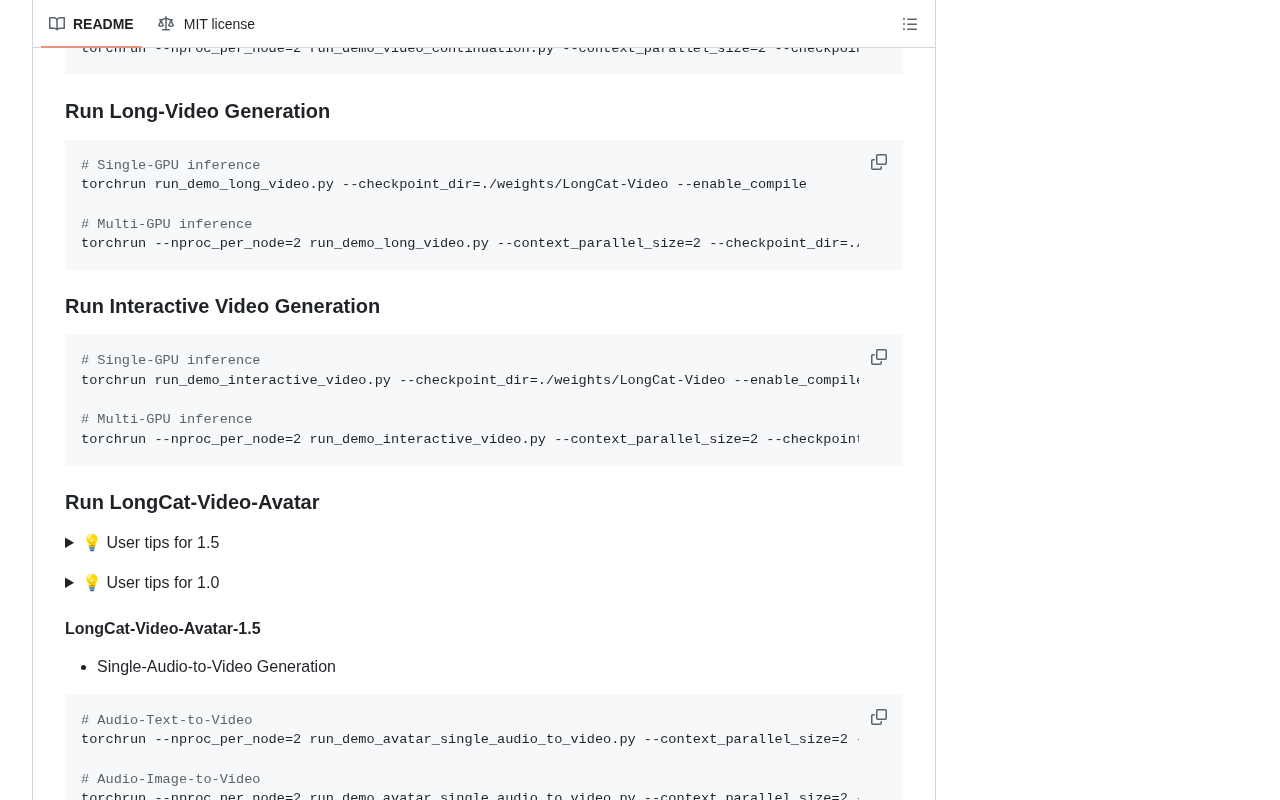
For practitioners following AI video generation, there are several angles worth monitoring as this project evolves: the generation modes supported (text-to-video, image-to-video, video continuation), the maximum clip length achievable in a single pass, hardware resource requirements, and the toolchains and applications the community builds around it. These factors will collectively determine whether LongCat-Video can grow from a high-attention open-source release into a production tool that sees widespread real-world adoption.
Related articles

Chain of Thought Isn't Just for AI: How Humans Can Use CoT to Improve Thinking Quality
Chain of Thought isn't just a prompt trick for large models. Starting from a Hacker News discussion, this article analyzes why CoT works for human thinking too, breaks down actionable ways to transfer it, and highlights the key differences between human CoT and machine CoT.
Cloudflare Teams Up with OpenAI: Closi…
Cloudflare Teams Up with OpenAI: Closing the Loop from Vulnerability Discovery to Defense with AI
Cloudflare uses OpenAI Daybreak to investigate security vulnerabilities and generate reviewable remediation plans, while developers use Codex to boost coding efficiency and quality.

Orca Multi-Agent Orchestration in Practice: A Guide to Parallel Collaboration with Claude and Codex
Orca is Stable AI's free open-source agent workbench supporting 34 agents like Claude Code and Codex in parallel. Learn its Git worktree isolation, multi-model orchestration, and mobile management.