Melete: An Always-On Personal AI Agent With Its Own Computer

Melete is an always-on AI agent with persistent memory that keeps working even when you're offline.
Melete is an always-on personal AI agent launched by developer Yashas Gunderia, earning 74 upvotes on Product Hunt. It targets a core pain point for heavy AI users — having to re-explain project context every session — with a combination of dedicated compute, persistent memory, and offline autonomous execution. Melete remembers ongoing projects, continues unfinished tasks while users are away, and resumes seamlessly weeks later. The product comes in two tracks: Melete Cloud for individuals (currently waitlisted) and a Team Workspace for organizations (limited pilot). While the direction aligns well with the broader AI Agent trend, key questions around memory accuracy, execution reliability, data privacy, and security remain to be answered once the product opens more widely.
When AI Starts to Have Its Own Memory
Opening a new chat and re-explaining your entire project context from scratch — this is a near-universal frustration among heavy AI users. The more you use it, the more you have to teach it all over again, and that repetitive context-setting drains both time and patience.
Melete was built specifically to address this problem. It positions itself as an Always-On Personal Agent — with one core promise: let AI remember what you're working on, and keep things moving even when you step away.
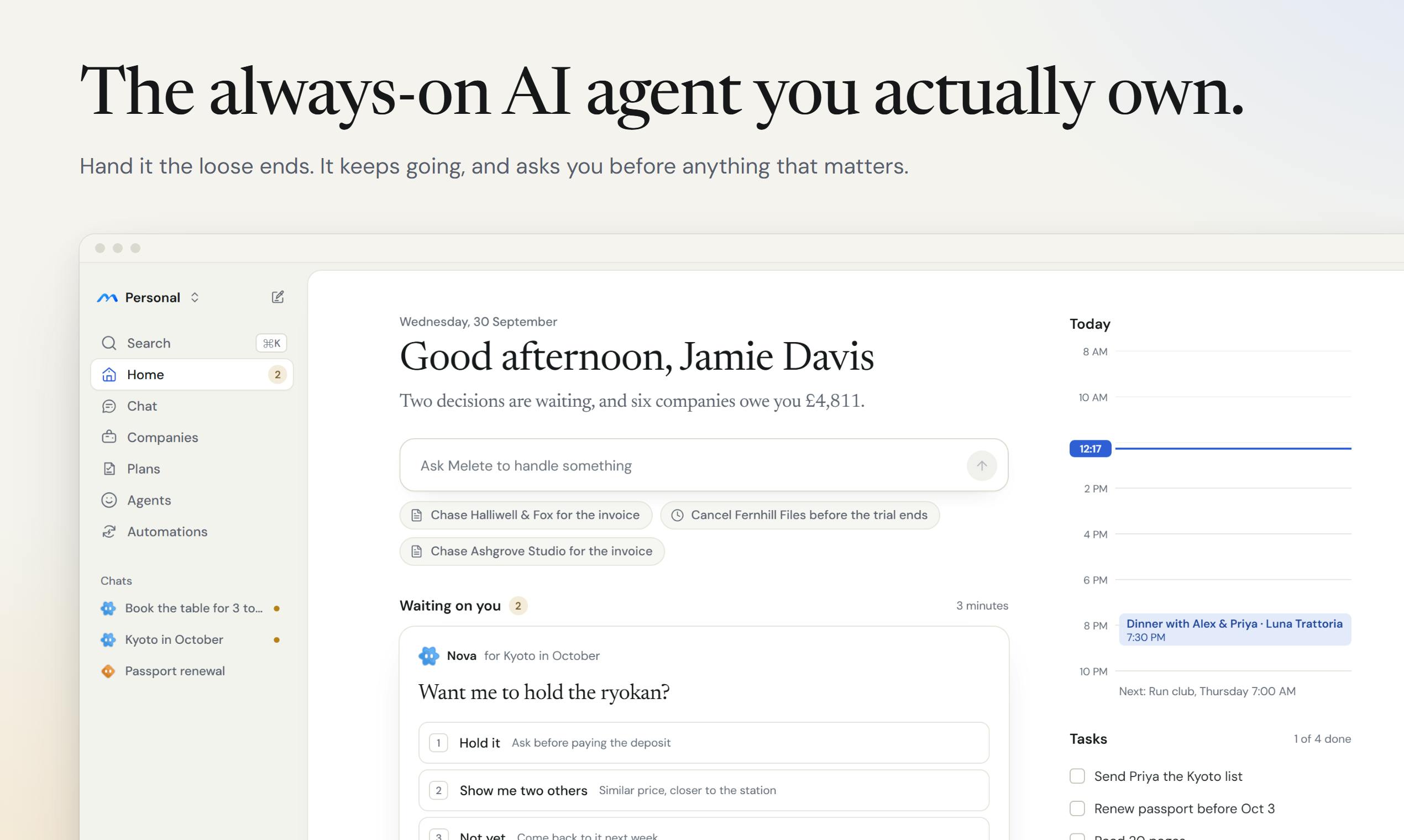
Melete recently appeared on Product Hunt with 74 upvotes, landing at #17 on the daily rankings. It's listed under categories including Productivity, Artificial Intelligence, and GitHub, and was launched by developer Yashas Gunderia.
The Core Concept: An AI With Its Own Computer
Melete's most distinctive design choice is that it has "its own computer." This means it isn't just a chat window — it's an agent running inside a dedicated compute environment, with the ability to operate continuously and execute tasks autonomously.
Based on the official description, it aims to solve three core problems:
Persistent Memory — No More Re-Explaining
Melete remembers your ongoing projects. Whether you're doing technical development, organizing documentation, or conducting long-term research, it retains the context and state of each project. Come back weeks later, and you don't have to start from scratch — it simply picks up where you left off.
Offline Continuity — Tasks Keep Running Without You
The standard AI interaction model is transactional: ask a question, get an answer, close the window, everything stops. Melete's difference is that it keeps unfinished jobs moving while you're away. This shifts AI from a passive response tool toward an active execution agent.
Cross-Session Project Continuity
For longer-horizon work, Melete emphasizes the ability to "seamlessly resume weeks later." For developers, researchers, and creators who manage projects over extended timeframes, that's a compelling promise.
A Dual-Track Product for Individuals and Teams
Melete isn't designed exclusively for solo users. Its product offering runs on two tracks:
- Melete Cloud: A waitlist is currently open, offering individual users a cloud-hosted always-on agent.
- Team Workspace: A limited number of pilot team spots are available for organizations looking to explore multi-user agent collaboration.
This individual-plus-team structure signals that Melete isn't aiming to be a single-player tool. It wants to bring "memory-enabled, autonomously running" agent capabilities into collaborative environments — where team members can share a continuously active, shared work context.
What Problem Is It Really Solving?
From an industry perspective, Melete targets a structural weakness in today's AI assistants: the lack of persistent context and task autonomy.
Most mainstream large model chat products rely on single-session context windows. They have no real long-term memory across sessions or time, and they certainly can't push tasks forward while users are offline. Melete's combination of a dedicated compute environment, continuous operation, and persistent memory is an attempt to upgrade the AI assistant from a "chat box" to a "digital coworker."
This direction aligns closely with the industry's broader exploration of AI Agents — moving from passive Q&A toward active, stateful, long-running task executors.
AI Agent is a paradigm that has surged in industry attention over the past two years. Unlike traditional large model conversations (user input → model output → session ends), the defining characteristics of an AI Agent are goal-driven behavior, autonomous planning, and tool use. An agent can decompose a complex task into multi-step subtasks, invoke external tools like web search, code execution, and file I/O, and self-correct when intermediate steps fail — all until the goal is achieved. OpenAI's Operator, Anthropic's Computer Use, and Google's Project Mariner are all prime examples.
Persistent Memory is one of the core unsolved challenges in deploying agents at scale. While most modern models now support context windows of hundreds of thousands of tokens, that's essentially short-term working memory — it vanishes the moment a session ends. True long-term memory requires structured storage (vector databases, knowledge graphs, etc.) and precise retrieval in future conversations, which places high demands on how memory is organized and how well it can be recalled. Melete claims to address this layer, though the specific implementation has not been publicly disclosed.
Observations and Caveats at This Stage
It's worth being candid: Melete is still early. The Cloud version is waitlist-only, the team product has only a handful of pilot slots, and the actual performance — memory accuracy, reliability of autonomous execution, and real-world usability — all require long-term validation from real users.
"An AI with its own computer" is a compelling narrative, but always-on operation also introduces higher demands around compute resources, data privacy, and security boundaries. These critical questions haven't been fully addressed in the publicly available information, and they're worth examining carefully before joining the waitlist.
For anyone who's been frustrated by the "re-explain everything every session" problem, Melete clearly speaks to a genuine pain point. Whether it can truly deliver on the promise of remembering, running, and resuming — that verdict will have to wait until a wider release.
Always-on agents introduce several systemic risks worth keeping in mind. On compute costs: an agent running continuously in the background consumes cloud resources — how the long-term subscription pricing covers that cost, and whether users will find it affordable, is a central question for commercial viability. On data privacy: for an agent to truly "know you," it needs continuous access to your project files, communications, and operational history — meaning large volumes of sensitive data end up hosted on third-party servers. Encryption standards, access control isolation, and regulatory compliance (e.g., GDPR) all require transparent disclosure. On security boundaries: an agent capable of autonomous task execution carries far greater potential for harm than a passive chat tool if it's compromised by prompt injection or makes a faulty decision. Users need clear mechanisms to define and limit the agent's authorization scope — ensuring it doesn't execute unintended actions in an unsupervised state.
Related articles

ChatGPT Space Launches: Team Collaboration and New Pages Features Explained
ChatGPT Space is OpenAI's new team collaboration feature with Pages, real-time collaboration, and Slack/Google Drive sync. We break down its privacy design, multi-platform integration, and the full workflow from conversation to document.

Migrating Apache Spark UDFs to GPU Acceleration with AI Agents
NVIDIA developer blog explains how AI Agents rewrite Apache Spark UDFs for GPU acceleration, covering migration criteria, agent rewriting and verification workflows, plus pitfalls like result consistency and CPU-GPU transfer overhead.

Zed Editor v0.40.4-rc2 Released: Usage Credits Now Available Without Upgrading
Zed editor releases v0.40.4-rc2, allowing users to use usage credits for AI features without upgrading to a paid plan, lowering the trial barrier.