Mellos Mapping: Give Claude Code a "Map" — Plan First, Then Code

Mellos Mapping gives Claude Code a DAG-based task map so AI coding tasks can be planned, parallelized, and verified before execution.
Mellos Mapping is a Claude Code plugin that replaces linear to-do lists with a layered dependency node graph (DAG). It addresses structural flaws through three mechanisms: explicit dependency mapping enabling same-layer parallel execution; a "downward-only" constraint that rejects reverse or circular dependencies at planning time; and validation gates that require evidence-backed confirmation before downstream nodes unlock. Progress is visualized in real time throughout execution, representing a broader evolution from AI "writing code" to AI "managing task structure."
From "Making a List" to "Drawing a Map"
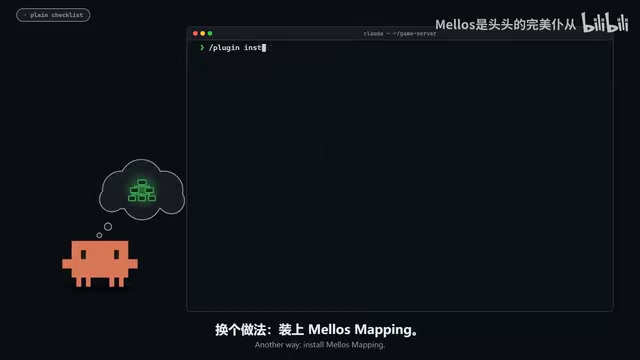
When faced with a large task, most people instinctively write a to-do list and work through it top to bottom. The problem is that a list is inherently linear — it tells you nothing about which steps depend on each other, and it gives no indication of which tasks could actually run in parallel.
This leads to all-too-familiar headaches: you reach step eight only to discover it depends on step five, which isn't done yet. Several tasks that could have run simultaneously end up queued one after another simply because the list didn't say otherwise. Worst of all, when everything is checked off but the tests blow up, tracing back to find where things went wrong becomes a disorienting exercise in scrolling through history.
The fundamental flaw of a linear list is that it discards the actual structural relationships between tasks. Mellos Mapping, a Claude Code plugin, offers a different approach — breaking tasks into a "layered dependency map" so you draw the map first, then write the code.
Making Dependencies Explicit: Breaking Tasks Into a Layered Map
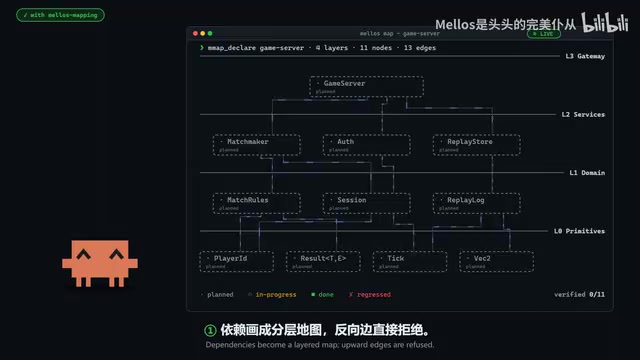
The core idea behind Mellos Mapping is decomposing a large task into a node graph with explicit dependencies, rather than a flat task list. Each node represents a concrete unit of work, and the edges between nodes represent dependencies — which tasks must complete before others can begin.
This layered structure makes parallelism immediately obvious: nodes on the same layer with no dependencies between them can start simultaneously, rather than waiting in line. For complex tasks, this translates to meaningful gains in overall execution efficiency.
The map format also solves the perennial "where are we?" problem. Because each node has a fixed position and status on the graph, progress is no longer a linear log you have to scroll through — it's a structured view of the entire task at a glance.
This kind of node graph has a formal name in computer science: a Directed Acyclic Graph (DAG). "Directed" means dependencies flow in a specific direction (A must come before B); "acyclic" means circular dependencies are forbidden (no situations where A depends on B and B depends on A). DAGs are the mathematical foundation underlying build tools (like Make and Gradle), CI/CD pipelines, and workflow systems like Apache Airflow. Mellos Mapping brings this proven engineering concept into the world of AI-assisted conversational coding. The DAG constraint is precisely what lets the tool automatically determine which nodes sit on the same "topological layer" — meaning they share no dependency path and can safely execute in parallel.
"Only Downward": Reverse Dependencies Are Rejected Outright
The plugin enforces a strict constraint: dependencies may only flow downward. Any attempt to wire a dependency in reverse is rejected immediately.
This might look like a limitation, but it's actually a safeguard. Reverse dependencies typically signal a problem with the task decomposition itself — you've placed work that should come first somewhere later, or you've inadvertently created a circular dependency. Rather than letting this structural error lurk in execution and surface only when tests fail, the tool catches it hard at the mapping stage.
"Alright, only downward" — a wry but apt observation that captures the design philosophy here: use rules to enforce structural soundness, spending extra effort at planning time rather than planting landmines for execution time.
Validation First: Dependencies Must Pass Before Work Begins
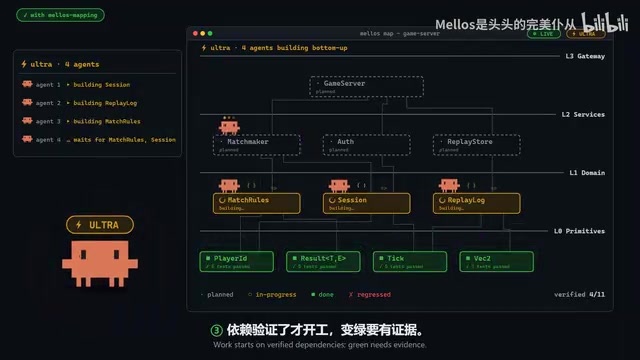
Another key mechanism is dependency validation. A node doesn't start just because it's been drawn on the map — it only begins once all its prerequisite nodes have been validated, and validation requires actual evidence rather than a simple checkbox.
This heads off the classic "everything's checked off, but the tests explode" scenario. In layered map mode, completing a node requires producing verification evidence; only after that confirmation does the downstream node unlock. Errors are contained within individual nodes and don't cascade down the dependency chain.
The plugin also features an Ultra Mode that combines same-layer parallel execution with dependency validation — multiple nodes on the same layer advance simultaneously, but each must pass its validation gate, balancing speed with reliability.
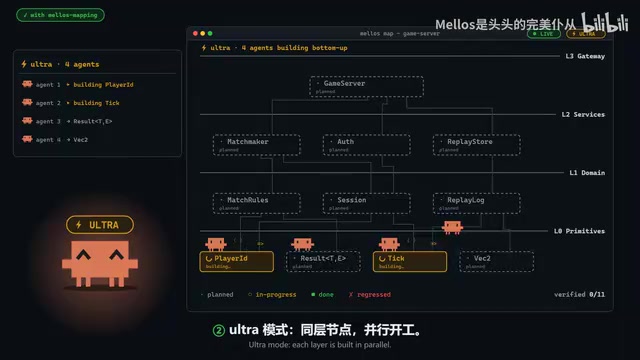
The same-layer parallel + dependency validation combination described in Ultra Mode corresponds to what engineering practice calls Parallel Task Orchestration. The core challenge: parallelism improves speed, but when a node fails, you need coordination mechanisms to avoid wasting compute on sibling nodes that are already running, and to ensure precise rollback. Traditional CI systems (like GitHub Actions' needs field) solve exactly this class of problem — declaring dependencies while the system automatically handles parallel scheduling and failure propagation. Mellos Mapping brings this logic into Claude Code's conversational context, meaning the AI is no longer just "generating code in one shot" but advancing through complex tasks as a controlled state machine.
Real-Time Progress Visualization: No More Scrolling Back
During execution, Mellos Mapping renders progress in real time alongside the conversation. At any moment, you can see which nodes are complete, which are in progress, and which are still waiting on dependencies — the full task state at a glance.
This addresses the anxiety of "where are we?" that keeps coming up. With a linear list, tracking progress means mentally reconstructing history; with a map, status is displayed live, eliminating the cognitive overhead of backtracking.
In practice, an 11-node task can run from "map drawn" to "all nodes validated" as a fully traceable, verifiable closed loop.
What Problem Does This Class of Tool Actually Solve?
Zooming out, Mellos Mapping represents an evolution in AI-assisted programming: from "helping you write code" to "helping you manage task structure."
As the tasks AI handles grow more complex, raw code generation is no longer enough. The real bottlenecks tend to live in planning and execution orchestration — unclear dependencies, unused parallelism, unisolated errors, opaque progress. Giving Claude Code a "map" is fundamentally about adding structured workflow management to the AI's process.
"Draw the map first, then write the code" is a precise summary of the idea. For developers accustomed to grinding through to-do lists, this represents a workflow shift worth trying: invest more time upfront to clarify dependencies, and execution becomes more stable, faster, and far less prone to rework.
This evolution is commonly called Agentic Orchestration in AI engineering circles. When large language models need to complete long-horizon tasks spanning multiple steps and tool calls, a single prompt is no longer sufficient to maintain contextual consistency and execution reliability. A range of frameworks have emerged to address this — LangGraph, AutoGen, CrewAI — all centered on introducing explicit state management and flow control into AI action sequences. Mellos Mapping, as a Claude Code plugin, follows the same path: constraining execution order through a dependency graph, preventing error propagation through validation gates. In essence, it's transplanting the methodology of reliable software engineering into AI workflow design.
Related articles

From Photons to Production: An Open-Source Computer Vision Engineering Reading Path
Reddit user open-sources a computer vision engineering reading path with 16 chapters from image formation to production deployment, emphasizing primary sources, dependency order, and reproducible benchmarks to help engineers understand why models fail and build reliable vision systems.

Prompt Failures? The Truth About Why AI Agents Struggle in Production—and How to Fix It
A Reddit developer built Agents with Copilot and Gemini but faced unstable behavior. This article analyzes three gaps in prompt engineering for Agent scenarios and offers three practical paths to reliable Agent deployment, including structured prompts, workflow-first approaches, and building an evaluation loop.

Tesla Robotaxi to Open Private Vehicle Access Next Year: Promise or Pipe Dream?
At its Q3 earnings call, Tesla said owners can add their cars to the Robotaxi fleet next year. We analyze the technical basis, Musk's missed deadlines, business logic, and competition.