Mem Agent: A Deep Dive into the AI Assistant That Proactively Follows Up on Your To-Dos

Mem Agent is an AI assistant that proactively identifies and follows up on to-dos hidden in your notes.
Mem Agent is a Product Hunt top-10 AI assistant that shifts task management from passive recording to proactive follow-up. Using NLU to extract implicit to-dos from notes and meeting records, it persistently reminds users until tasks are completed. Its zero-friction Push-to-Remember feature enables instant capture without workflow interruption. While facing challenges in accuracy, reminder balance, and data privacy, its focused "wedge strategy" of ensuring things get done positions it uniquely in the crowded AI productivity space.
An AI Assistant That Cures "Forgetfulness"
In an age of information overload, we generate massive amounts of to-do items, fleeting ideas, and spontaneous thoughts every day: an important project delivery milestone, a follow-up task casually mentioned during a meeting, or even that pizza place you wanted to bookmark for a future trip to Italy. These pieces of information scatter across notes, chat logs, and our brains—and ultimately fall through the cracks.
Cognitive science research shows that human working memory capacity is extremely limited. Psychologist George Miller's classic study demonstrated that the brain can only process 7±2 chunks of information simultaneously. When to-do items exceed this threshold, forgetting isn't a willpower problem—it's a physiological limitation. This is precisely why we need external systems to offload this cognitive burden.
Mem Agent was built to solve this exact pain point. This product, which landed at #10 on Product Hunt, sums up its positioning with a straightforward tagline: "The AI that refuses to let you drop the ball." Its core value lies not in "recording" but in "proactive follow-up."
Product Hunt is one of the world's most influential tech product launch platforms, founded in 2013 and now a key channel for startups to validate Product-Market Fit. Ranking in the top 10 means the product received significant attention from the tech community that day. The platform's user base consists primarily of tech professionals, early adopters, and investors, and its voting data is often seen as an early signal of a product's potential.
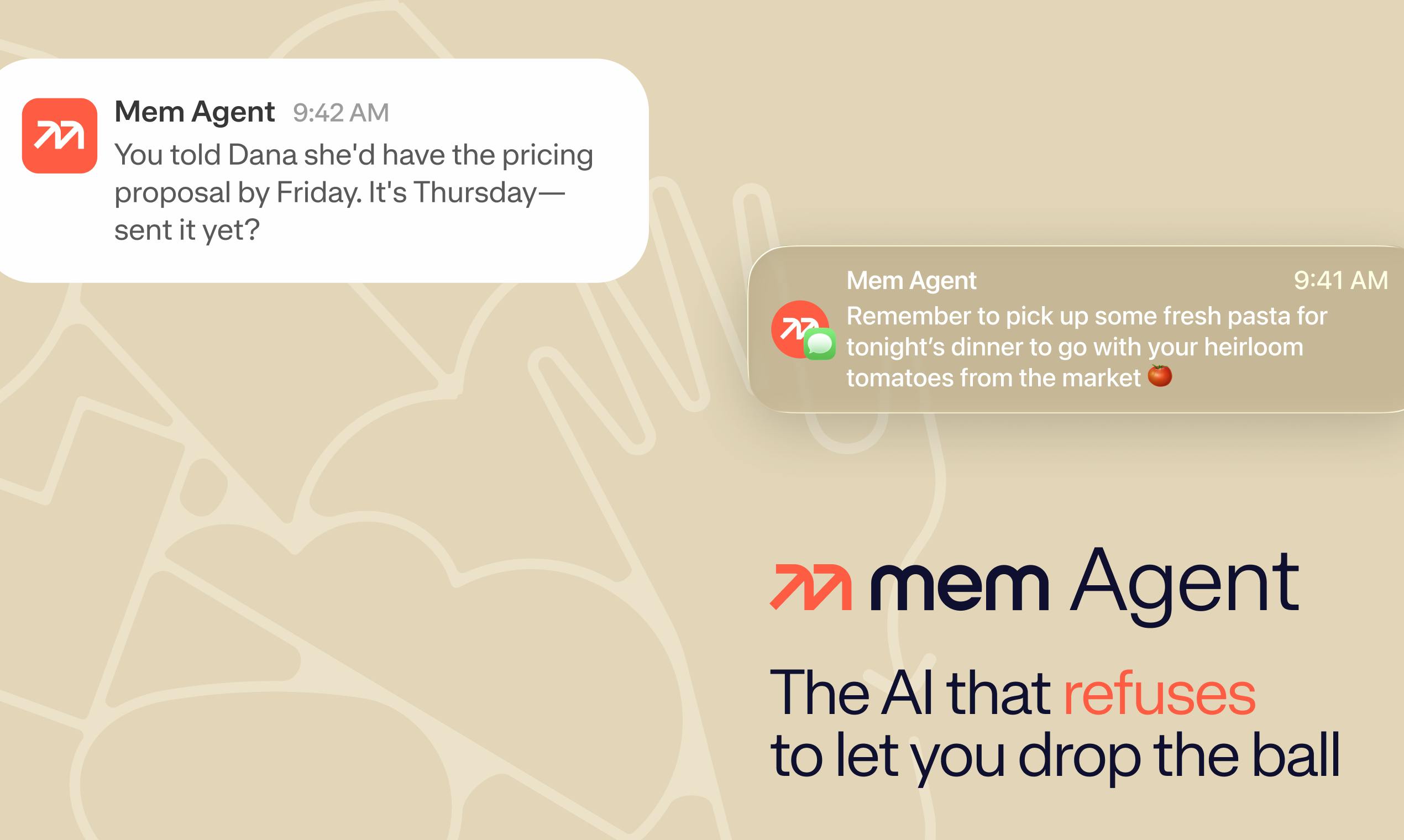
How Mem Agent Evolves from Passive Recording to Proactive Follow-Up
Most note-taking and to-do tools on the market are passive: you write something down, it stores it, and whether you actually follow through depends entirely on whether you remember to check back. In information management tool design, this is called the Pull model (user-initiated retrieval)—the system is merely a static storage container, with all driving force coming from the user. The counterpart is the Push model (system-initiated delivery), which transfers the responsibility of "not forgetting" from the user to the system. This design philosophy aligns with the "trusted external system" concept in David Allen's GTD (Getting Things Done) methodology—only when users fully trust that the system won't miss anything can the brain truly release its cognitive load and focus on creative work.
Mem Agent's differentiation lies precisely in choosing the Push model, playing the role of a "relentlessly persistent assistant."
Intelligently Tracking To-Dos Hidden in Your Notes
According to official descriptions, Mem Agent doesn't just record things you explicitly tell it—it also identifies and tracks implicit to-do items scattered throughout your notes and meeting records. This means even if you casually jot down "need to contact the supplier next week to confirm the quote" in meeting minutes, it can capture that task and remind you to complete it at the appropriate time.
This capability relies on Natural Language Understanding (NLU)—the AI needs to extract actionable items from unstructured text. Specifically, this involves multiple subtasks in natural language processing: Named Entity Recognition (NER) for identifying people, times, and locations; Semantic Role Labeling (SRL) for understanding "who needs to do what" in a sentence; and Temporal Expression Parsing for converting vague time descriptions like "next week" or "by end of month" into specific dates. Current mainstream technical approaches leverage the powerful contextual understanding of large language models, combined with Prompt Engineering or task-specific Fine-tuning to achieve high-precision intent extraction.
This is exactly the direction that current AI Agent products are trying to break through: evolving from "storing information" to "understanding intent and driving action." An AI Agent (intelligent agent) differs from traditional passive-response AI tools by possessing a complete capability loop of environmental perception, autonomous decision-making, and action execution. In personal productivity scenarios, a qualified Agent needs core capabilities including task decomposition, contextual memory, time awareness, and proactive triggering. This concept originated from academic research in reinforcement learning and multi-agent systems, and has only recently become feasible as a product thanks to the maturation of large language models like GPT-4.
Continuously Following Up Until the Task Is Actually Done
Mem Agent emphasizes "sharply following up so it actually happens." Compared to traditional reminder tools' one-time notifications, this continuous follow-up mechanism more closely resembles how a human assistant works, effectively reducing the probability of tasks being forgotten or abandoned midway.
From a behavioral psychology perspective, this design leverages the "commitment-consistency" principle—when an external system continuously asks about your progress on a task, you feel a social commitment pressure that makes you more inclined to complete it. This is similar to the effectiveness of an "Accountability Partner": research shows that when people make commitments to others and report progress regularly, goal achievement rates can increase from 25% to 95%. Mem Agent essentially uses AI to simulate this interpersonal accountability mechanism.
Push-to-Remember: Zero-Friction Capture and Recall
Another core feature of Mem Agent is Push-to-Remember. Users can press a single button to quickly save a thought to Mem or retrieve previously saved content—without leaving their current workflow.
The value of this design lies in reducing the friction cost of "recording." "Zero Friction" is a core principle in UX design, originating from behavioral economists' research on "transaction costs." In product design, every additional step—opening an app, selecting a notebook, entering a title—significantly decreases the probability of task completion, known as the "funnel effect." Apple's "Hey Siri" voice activation and iPhone's Quick Note gesture are classic examples of reducing interaction friction. For information capture tools, friction cost is particularly deadly because ideas and thoughts have an extremely short "half-life"—cognitive science research shows that unrecorded thoughts often fade from working memory within 20-30 seconds.
Many good ideas are lost simply because recording them requires switching apps and interrupting current work. Push-to-Remember aims to make capturing information as natural as muscle memory—save the moment you think of it, retrieve the moment you need it.
For knowledge workers, this "zero-friction" input/output experience often matters more than feature richness in determining whether a tool truly integrates into daily workflows. This also explains why functionally simple tools (like Apple Notes) often have higher daily active users than powerful but complex tools (like early OneNote)—in the productivity tool space, "actually using it" always trumps "being able to do it."
Mem Agent's Product Positioning and Market Competition Analysis
Mem Agent is categorized in three domains: Productivity, Task Management, and Artificial Intelligence. On Product Hunt, it received 93 votes and ranked #10, indicating market interest in the "AI-driven task follow-up" niche.
Opportunities and Challenges for AI Task Management Products
The competitive landscape in Mem Agent's space is fierce—from Notion AI to various AI note-taking tools (such as Reflect, Capacities, and Tana), all are competing for the same efficiency-seeking knowledge workers. Notion AI leverages its massive existing user base on its document collaboration platform by layering AI capabilities on top, forming a competitive moat; while vertical AI note-taking tools attempt to enter through specific scenarios, offering more specialized experiences. Mem Agent's differentiation bet is on "proactive follow-up"—it doesn't try to be your all-in-one workspace but focuses specifically on "making sure things get done." If it can truly achieve intelligent to-do identification and well-timed reminders (without being overly intrusive), this will be a compelling selling point.
But the challenges are equally apparent:
- Information identification accuracy: Extracting to-do items from natural language requires extremely high accuracy—both false positives and missed items erode user trust. In NLP, evaluation metrics for such tasks typically include Precision and Recall. Low precision means users are overwhelmed by irrelevant reminders; low recall means important items are missed. Both rapidly destroy user trust in the system. For a product that promises to "never let you drop the ball," even 99% accuracy means that 1% of missed items could have serious consequences.
- The right balance of reminders: Overly frequent follow-ups may feel intrusive. How to balance "persistence" with "not being annoying" is key to the product experience. This is essentially an "Exploration vs. Exploitation" problem from recommender systems—the system needs to learn each user's preferences for reminder frequency and timing, finding a personalized balance between sufficient persistence and appropriate restraint. "Notification Fatigue" caused by excessive notifications has been proven to cause users to disable all reminders or even uninstall apps.
- Data privacy: AI needs to read users' notes and meeting records, making privacy and security a primary concern. Especially in the post-GDPR era, user sensitivity to personal data continues to rise. Meeting records may contain trade secrets, customer information, and internal decision discussions. Storage methods (local vs. cloud), encryption standards, whether data is used for model training, and data deletion policies will all directly impact enterprise purchasing decisions.
Conclusion: Can Mem Agent Stand Out in the AI Assistant Race?
Mem Agent represents a pragmatic exploration direction for AI Agents in the personal productivity space: rather than pursuing a grand "all-capable assistant" narrative, it focuses on a specific and universal pain point—"don't let things fall through the cracks."
This product strategy is particularly wise at the current stage of AI application development. Since 2024, the industry has gradually recognized that attempting to build omnipotent general-purpose AI assistants (like the early visions for Siri and Cortana) often results in a "can do everything but does nothing well" predicament due to insufficient depth of experience. By contrast, vertical AI products that focus on a single scenario and go deep are actually more likely to establish user habits and reputation—this is called the "Wedge Strategy" for AI products: entering the market with one exceptional single-point feature, then gradually expanding capability boundaries.
In an era where the AI assistant concept is everywhere, whether a product can solve real, high-frequency user pain points is what ultimately determines its viability. Mem Agent offers its answer with two core features: "proactive follow-up" and "zero-friction capture." Whether it can stand out in a crowded market requires longer-term market validation, but its product philosophy—anchoring AI's value in "driving action" rather than "providing information"—is worth studying for similar tools.
Key Takeaways
Related articles

Felix Rieseberg Personal Homepage
Felix Rieseberg's personal homepage sparks attention on Hacker News. This article covers the Slack engineer's technical background, the rise and fall of nativefier, and the value of a developer homepage as a tech calling card.

@ai-sdk/vue 3.0.306 Patch Release Syncs with [email protected] Update
@ai-sdk/vue 3.0.306 released, synced with [email protected]. A routine patch release for the Vercel AI SDK ecosystem with no public API changes; the Vue adapter layer stays version-aligned with the core package.

Gemini 4 Argon API Launches: The Era of Million-Token Output Begins
Google launches Gemini 4 Argon with sparse MoE architecture, up to 1M output tokens, and a 68.90% Vals Index score, available across API, AI Studio, and the Gemini app.