Memanto Cloud: Give Your AI Agent a Shared Memory

Memanto Cloud gives coding agents a cross-tool, user-owned external persistent memory layer.
Memanto Cloud launched on Product Hunt as an external "companion memory" layer for coding agents, letting them continuously read and write experience during coding so memory persists across sessions and compounds over time. It offers hosted support for Claude Code, Cursor, Codex, and 31 other tools with log-in-and-go access and no Docker or API key required. Its key differentiator is user ownership of what the agent learns, plus open source categorization. However, public feedback is limited (81 votes, 5 comments, #17 for the day), and memory selection strategy and long-term noise issues remain undisclosed; the author suggests validating cross-session coherence with a small project before migrating core workflows.
The Agent Memory Problem Finally Gets Serious Attention
Anyone who has written code with Claude Code or Cursor has probably had this experience: on the same project, the coding conventions you taught the agent today are completely forgotten tomorrow; switch to another tool, and all the context you had built up has to be fed in from scratch. The agent is smart, but its memory is fragmented, temporary, and tied to the session.
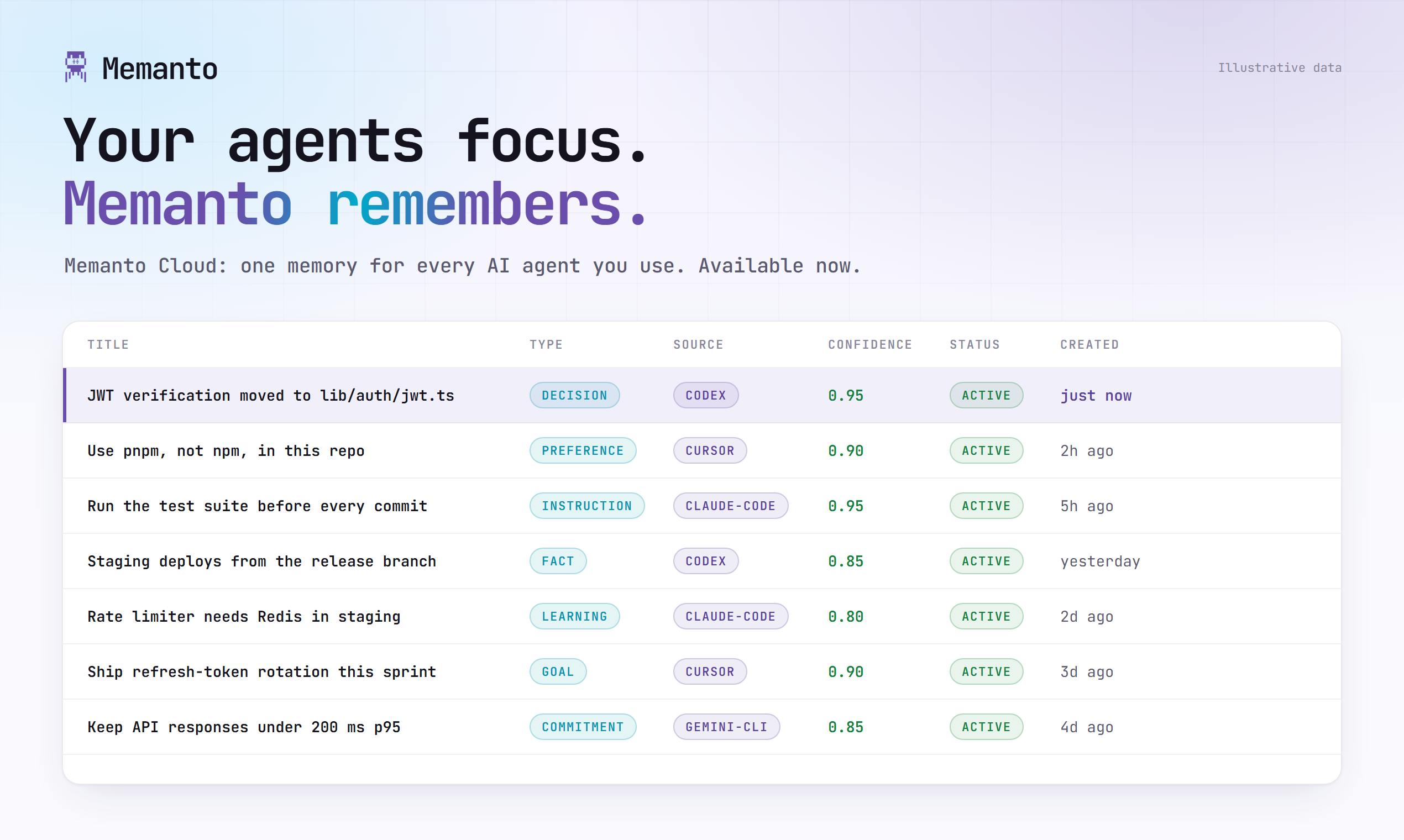
Memanto Cloud's offering on Product Hunt is to equip agents with "companion memory" — your agent accumulates experience as it works, and ownership of that experience always stays with you. It currently offers hosted support for Claude Code, Cursor, Codex, and 31 other tools. Log in once to use it — no Docker, and no need to bring your own API key.
What It Actually Solves
From "Starting Over Every Time" to "Getting Better with Use"
Most coding agents have session-level memory: close the window, and the context resets to zero. Developers who want to preserve experience can only hand-write rules files or maintain a prompt document — high maintenance cost and easy to let go stale. Memanto Cloud positions itself as externalizing that memory into an independent layer. The agent continuously writes to and reads from it while working, and the longer it's used, the better it understands project conventions, code style, and historical decisions.
"Make your agent better while you work" — this tagline is really about the compounding effect of memory: the agent's improvement no longer depends on model version updates, but on the context it accumulates itself on the front lines.
Coding agent "memory" generally falls into two categories: implicit knowledge within the model parameters, which is fixed after training; and context within the session window, which is constrained by the token limit and lost when the window closes. The so-called external memory layer persists the second category to external storage and retrieves and injects it back into context on demand — essentially giving the agent a readable/writable "project notebook." The technical difficulty of such solutions isn't storage but retrieval: when retrieving, it must judge which old experience is relevant to the current task. Injecting too much crowds the context window and introduces noise; injecting too little is as good as not remembering at all. Therefore, the retrieval strategy, deduplication, and conflict resolution mechanisms of the memory layer often determine the actual experience more than storage itself.
Ownership Is the Differentiating Selling Point
The official emphasis is that "you retain ownership of everything your agent learns." That statement carries a lot of weight in the current environment. Most hosted agent memory services are essentially black boxes: data goes in but can't come out, and migration costs are extremely high. Memanto puts ownership front and center, meaning memory data can in theory be exported, audited, and carried with you as you switch tools.
For a project with an open source background, this promise is relatively more credible — the product is categorized under both Open Source and Developer Tools, indicating that at least the code level is open and inspectable.
In products like agent memory, "data ownership" usually involves three levels: first, whether data can be exported in a common format to avoid vendor lock-in; second, whether users can view, edit, and delete specific entries the agent has recorded; third, how data is handled if the service shuts down. Most commercial memory services store memories as vectors or in proprietary structures, which often lose their semantics after export, limiting migration value. Open source solutions are more credible on this point because the protocol and storage format can be independently audited, and third parties can implement compatible read/write endpoints. Note, however, that an open source client and an open source server are two different things — if the hosted portion isn't open source, the actual binding force of the ownership promise still depends on whether the export feature truly works.
Onboarding Cost Has Been Pushed Very Low
Log In and Go, Bypassing Configuration Hell
Self-hosting a memory service usually means a string of prerequisites: running Docker, configuring a database, applying for an API key, writing connection configs. Memanto Cloud folds all of this into a hosted service — users only need to log in once. For individual developers and small teams, this is a real lowering of the barrier.
Support covers Claude Code, Cursor, Codex, and 31 other tools, indicating it's not a vertical solution locked to a single ecosystem, but an attempt at a cross-tool universal memory layer. This is crucial: developers' tool stacks are constantly switching, and if memory can't flow across tools, its value is greatly diminished.
The implementation difficulty of a cross-tool universal memory layer lies in interface adaptation: different coding agents inject context in very different ways. Some support project rules files, some provide tool-calling protocols like MCP (Model Context Protocol), and others only accept a system prompt at startup. The claim of "supporting 31+ tools" may mean actual capabilities vary by tool — deep integration (automatic read/write, on-demand retrieval) versus shallow compatibility (one-time import of rule text) differ greatly in memory coherence. When evaluating such products, it's worth confirming one by one which integration level your commonly used tools are at, and whether memory is updated in real time during the session or only synced at the end of the session.
A Measured View: There's Still Distance Between Hype and Maturity
On Product Hunt, 81 votes, 5 comments, and a #17 ranking for the day — this result shows it has attracted attention but is far from explosive. Five comments mean publicly available usage feedback is very limited; stability in actual use, accuracy of memory retrieval, and data bloat after long-term use currently lack enough third-party voices to corroborate.
Another point to watch is the boundary of "companion memory." The more memory an agent automatically accumulates, the more noise there may be — what should be remembered, what should be forgotten, and how to resolve conflicting information. How well such strategies are designed directly determines whether the product is a helper or a burden. The official team has not disclosed details on this so far.
For developers planning to try it, a more pragmatic approach is to first run the process through with a small project, observe whether the agent truly maintains coherence across multiple sessions, and then decide whether to migrate core workflows over.
Long-running memory systems face two typical degradation problems. The first is data bloat: as entries increase, retrieval relevance declines, and latency and cost rise, requiring summarization, tiering, or decay mechanisms to control scale. The second is memory conflict: after project conventions change, old memories may still be retrieved and contradict current rules; without version tags or freshness weighting, the agent will give self-contradictory suggestions. These two problems are almost impossible to expose in short-term trials and usually only emerge after months across multiple project cycles. This is also the practical basis for the advice to "first run it through with a small project before migrating core workflows."
Who Should Pay Attention
Developers who use multiple coding agents simultaneously and are troubled by repeatedly feeding in context are the most direct target audience for this product. If you only use a single tool and your project cycles are short, the benefits may not be obvious right now; but if you maintain long-term projects and multiple people on a team share agents, the value of a portable, controllable memory layer will amplify over time and with the number of tools.
Its open source nature and ownership promise are what distinguish it from purely commercial solutions, and it's worth adding to your watchlist.
One-line Summary
Memanto Cloud provides coding agents with an external persistent memory layer that is cross-tool and user-owned.
Paragraph Summary
Memanto Cloud launched on Product Hunt, positioning itself as an external "companion memory" layer for coding agents: the agent continuously writes and reads experience while writing code, and memory no longer resets when a session ends, creating a compounding effect of getting better with use. The product offers hosted support for Claude Code, Cursor, Codex, and 31 other tools, with log-in-and-go access and no Docker or self-supplied API key required. Its core differentiator is that users retain ownership of what the agent learns, and the project is categorized as open source with inspectable code. However, public feedback is currently limited — 81 votes, 5 comments, and a #17 ranking for the day. The official team has not disclosed its memory selection strategy or long-term noise issues, and the author recommends first validating cross-session coherence with a small project before considering migrating core workflows.
Related articles

ChatGPT Plus Subscription Pitfall Guide: Go/Plus/Pro Tier Comparison and Quick Activation
A complete ChatGPT Plus subscription guide based on a Bilibili tutorial: from registering an account, comparing Go/Plus/Pro tiers, to the practical steps for quickly completing your subscription.

GPT-6.2 Sol/Astra Released! A Step-by-Step ChatGPT Plus Subscription Guide and Tier Comparison
GPT-6.2 Sol/Astra is out—here's a ChatGPT Plus subscription guide: register an account, compare Go/Plus/Pro tiers, and subscribe in a minute.

Comparing Three Channels for Subscribing to GPT Plus in China: Is Website Top-Up the Easiest?
How to subscribe to GPT Plus in China? This article compares website top-up, credit card, and mobile top-up channels—process, cost, and risk—with steps and tips to help you choose wisely.