MEMIG: Building Indexable Quantitative Memory for Antibody Optimization

MEMIG proposes an indexable, quantitative, and structured agent memory framework to address the shortcomings of free-text memory in scientific optimization.
The article notes that existing self-evolving LLM agents represent experience as free-form natural language and maintain memory through rewriting—effective for narrative tasks but losing indexing, substituting descriptions for measurements, and failing to express interactions between interventions in scientific optimization. Researchers propose the MEMIG framework, arguing that agent memory in biomolecular optimization should be indexable, quantitative, and structured, built around domain-anchored identifiers, quantitative effect accumulation, and epistatic effect measurement. On in silico antibody optimization tasks, MEMIG improves performance in most settings, supporting the argument that memory should shift from "description" to "measurement" and from "rewriting" to "accumulation."
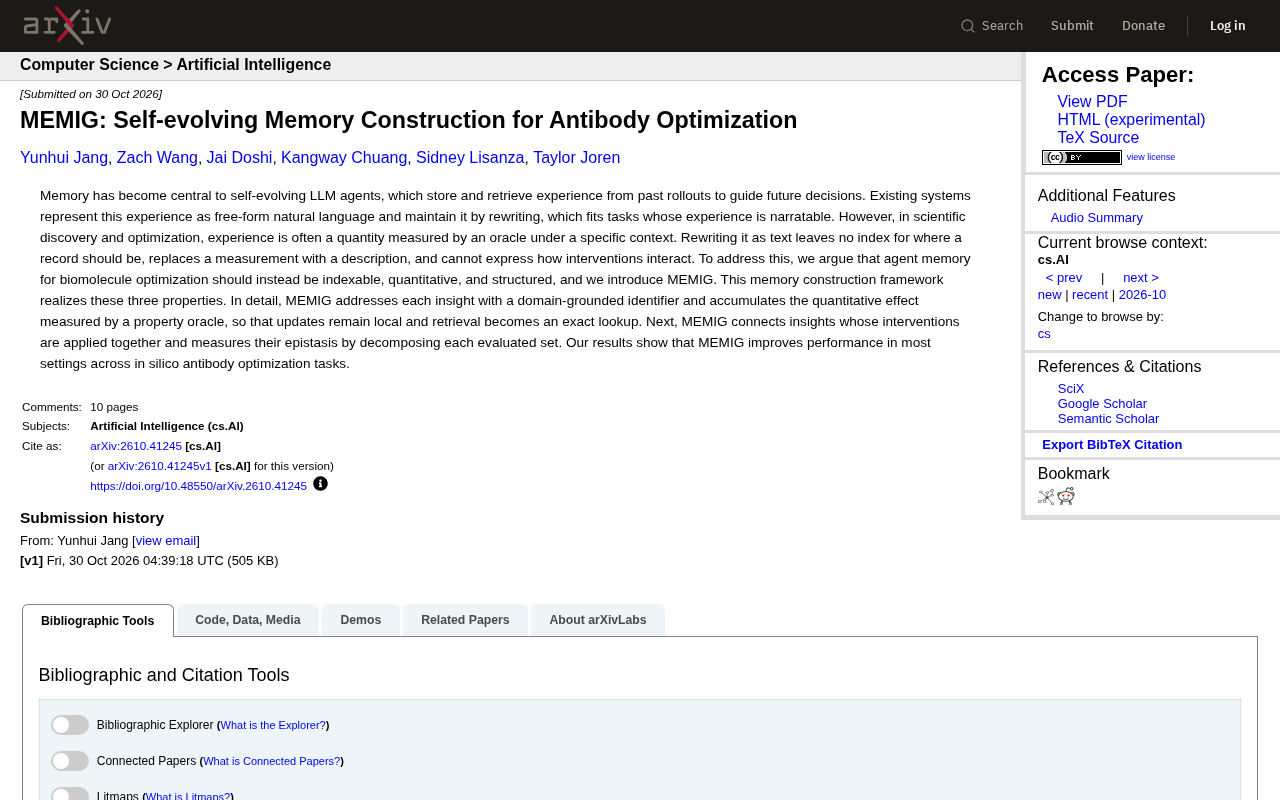
In self-evolving LLM agents, memory mechanisms play a central role—they store and retrieve experiences from past rollouts to guide future decisions. However, most existing systems represent experience as free-form natural language and maintain memory through rewriting. This approach works well for tasks where experience is narratable, but in scientific discovery and optimization, experience is often a quantity measured by an oracle under specific contexts. Rewriting it into text loses indexing, substitutes descriptions for measurements, and fails to express interactions between interventions. To address this, researchers propose the MEMIG framework, arguing that agent memory in biomolecular optimization should be indexable, quantitative, and structured.
Limitations of Existing Memory Systems
Current mainstream self-evolving LLM agents treat experience as free-form natural language and update memory through rewriting. This design performs well in narrative tasks because experience can be fully conveyed through language descriptions. But in scientific discovery and optimization scenarios, the core of experience is a quantity measured by an oracle in a specific context. For example, in antibody optimization, the effect of a mutation on binding affinity is a specific numerical value, not a piece of text. Rewriting measurements into text means losing the position where records should be indexed—the system cannot precisely locate the specific conditions corresponding to an experience, nor can it reuse them through exact lookup. More importantly, text descriptions cannot express interaction effects between different interventions, which is precisely the key information in combinatorial optimization.
Three Core Designs of MEMIG
MEMIG builds its memory framework around three properties: indexability, quantitativeness, and structure.
Domain-Anchored Identifiers
MEMIG assigns each insight a domain-anchored identifier and accumulates quantitative effects measured by property oracles. This design keeps memory updates local—only affecting the relevant identifier entries—while retrieval becomes exact lookup, eliminating the need for fuzzy matching across large amounts of natural language text.
Accumulation of Quantitative Effects
Rather than substituting text descriptions for measurements, MEMIG directly stores quantitative effect values. This means every record in memory is comparable and computable, providing a precise basis for subsequent optimization decisions.
Measurement of Epistatic Effects
MEMIG connects insights where interventions are applied together, measuring their epistatic effects by decomposing each evaluation set. This enables the system to capture interactions between different interventions—something pure text memory cannot express.
Epistasis originally refers to the phenomenon in genetics where the expression of one gene is affected by another—i.e., non-additive interactions between different genetic loci. In combinatorial optimization and intervention design, epistatic effects describe the degree to which the joint effect of multiple interventions applied simultaneously deviates from the simple sum of their individual effects. If two mutations individually bring affinity improvements of Δa and Δb, and their actual improvement when present together is Δab, then the epistatic effect can be expressed as Δab − (Δa + Δb). A non-zero value means there is synergy or antagonism between the interventions. Measuring epistasis requires decomposing the evaluation set—evaluating single interventions and combined interventions separately—to separate the interaction term from the overall effect. This is structured quantitative information that pure text memory struggles to carry.
Performance on Antibody Optimization Tasks
Researchers evaluated MEMIG on in silico antibody optimization tasks. Results show that MEMIG improves performance in most settings. This supports the researchers' core argument: for tasks like biomolecular optimization where experience is quantitatively measured, indexable, quantitative, and structured memory representations are more effective than free-text memory.
In silico antibody optimization refers to designing and screening antibody sequences in a computer-simulated environment rather than synthesizing and testing them one by one in wet-lab experiments. A typical pipeline includes: defining a space of variable amino acid positions or mutation combinations, using a predictive model (such as a structure model or affinity predictor) as an oracle to give quantitative scores like binding affinity for candidate sequences, and then having an optimization algorithm search the sequence space for high-scoring variants. The oracle here can be a physical simulation, a machine learning surrogate model, or a combination of both. Since each evaluation returns an explicit numerical value, experience naturally exists in the form of "context—measurement," which is exactly the form of experience MEMIG targets, making it a suitable testbed for validating whether quantitative memory mechanisms are effective.
Implications for AI-Driven Scientific Discovery
MEMIG's design points to a broader question: whether the memory mechanisms of self-evolving agents need to be designed differently depending on the nature of the task. In narrative tasks, the flexibility of free-text memory is an advantage; but in scientific optimization tasks, precise quantitative records and structured indexing relationships are key. Shifting memory from "description" to "measurement," and from "rewriting" to "accumulation," may be an important prerequisite for AI agents to play a role in scientific discovery. This framework provides a memory construction paradigm that can be borrowed for other quantitative optimization tasks beyond biomolecular optimization.
One-line Summary
MEMIG proposes an indexable, quantitative, and structured agent memory framework that addresses the shortcomings of free-text memory in scientific optimization.
Paragraph Summary
The article points out that existing self-evolving LLM agents generally represent experience as free-form natural language and maintain memory through rewriting. This works for narrative tasks but in scientific discovery and optimization loses indexing, substitutes descriptions for measurements, and cannot express interactions between interventions. To address this, researchers propose the MEMIG framework, arguing that agent memory in biomolecular optimization should be indexable, quantitative, and structured, built around three designs: domain-anchored identifiers, accumulation of quantitative effects, and measurement of epistatic effects. On in silico antibody optimization tasks, MEMIG improves performance in most settings, supporting the core argument that memory should shift from "description" to "measurement" and from "rewriting" to "accumulation."
Related articles

64 Releases in 40 Days: How Strata Uses Release Velocity to Define Its AI Local Inference Roadmap
Strata shipped 64 releases in 40 days with 460k+ characters of notes. From 0.1.0 to 0.2.10, a three-step path: make it run, make it fast, make it trustworthy.

Ripple-65B Open-Source Model Tops Community Charts
Ripple-65B open-source LLM debuts atop community charts, using a self-recursive architecture to slash long-context KV cache for low-latency hundred-billion-scale inference on ordinary GPUs, with preview weights, quantized files, and one-click Olema & VLM deployment.

Deploy Open-Source Video Model MiniMax H3 Locally in 5 Minutes and Skip Cloud Generation Fees
Bilibili creator tests local deployment of open-source video model MiniMax H3: three-step ComfyUI install, 5-minute setup, no coding. Same prompt generates in 2 minutes locally vs 4 minutes online with queuing, saving about 30 RMB per 15-second 720P video. Includes VRAM requirements and RTX 5080 test results.