Tencent Open-Sources 770B-Parameter Hy4 Model; Chinese Open-Source Models Account for 41% of Global Downloads

Tencent open-sources Hy4 with enhanced vision and computer operation; Chinese open-source models hit 41% of global downloads; multi-agent systems accelerate deployment.
Tencent releases open-source large model Hy4, scaling from sub-300B to 770B parameters and adding vision understanding and computer operation capabilities for the first time, moving from image Q&A to tool invocation and continuous task execution. The company claims it outperforms models like DeepSeek on code editing and automation benchmarks, though a gap remains versus GPT 6.1 and Claude Opus 5.5. Hugging Face's 2026 spring report shows Chinese open-source models account for 41% of global downloads, ranking first, but downloads don't equal production performance—licenses, hardware costs, and Chinese-language fit still need verification. The Chengdu multi-agent conference released 100 new products and completed 5 cooperation signings, with Academician Chai Tianyou proposing integration of large models, agents, and industrial automation, marking multi-agent systems' transition from concept demos into industrial and terminal product competition.
Open-Source Models Enter the "Vision + Automation" Era
Tencent has officially released its open-source large model Hy4, scaling up from the Hy3 series' sub-300B parameter count to 770B, and adding vision understanding and computer operation capabilities for the first time. According to the company, Hy4 can analyze charts, operate command lines and graphical interfaces, and has received specialized training for software such as Blender and CAD. It outperforms models like DeepSeekAd, V4.1, and Flash on code editing and automation benchmarks, and the company claims it now ranks among the world's strongest open-source models.
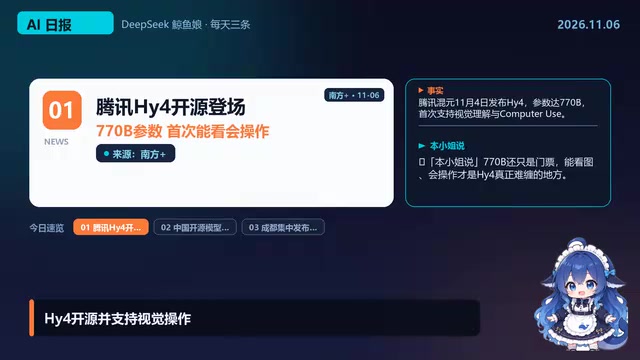
The key to this upgrade isn't parameter stacking but the migration of capability boundaries. For developers, the model moving from "answer questions about an image" to "invoke tools and execute tasks continuously" means the barrier to deploying agents drops further; for enterprises evaluating options, the assessment dimension of plain-text chat is giving way to production-process validation of "vision + automation." That said, a gap remains versus closed-source flagships like GPT 6.1 and Claude Opus 5.5, so selection decisions shouldn't rely on marketing claims alone.
Vision understanding and computer operation capabilities refer to a model's ability not only to recognize image content but also to parse screenshots, interface controls, and document layouts, and based on that generate operation instructions such as clicks, inputs, and keyboard shortcuts to drive command lines or graphical interfaces through multi-step tasks. Compared with pure text models, these capabilities require spatial localization, state tracking, and error recovery mechanisms, typically necessitating additional GUI operation datasets and reinforcement learning training. Tencent's specialized training for professional software like Blender and CAD is precisely aimed at enabling the model to understand domain-specific menu structures and operation logic, thereby reducing manual intervention in automated workflows.
Chinese Open-Source Models Account for 41% of Downloads, Ecosystem Advantages Emerge
At the 2026 World Internet Conference Wuzhen Summit, large models, agents, and robots became the focus of displays. According to Hugging Face's 2026 spring report, open-source models developed in China account for 41% of global downloads, ranking first. The Wuzhen Summit also showcased models such as DeepSeek and Qwen, as well as interactive applications including AI short dramas, robots, and calligraphy.
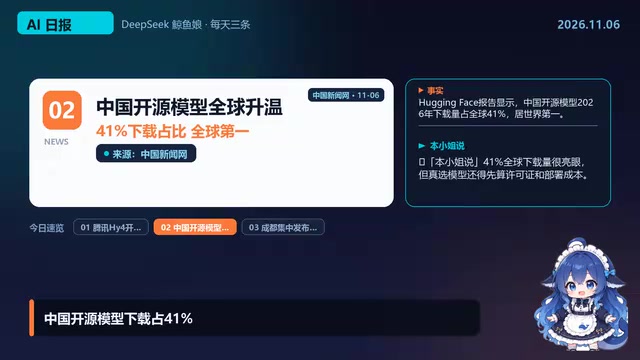
Open source is moving from developer communities to the industrial frontline, which will directly affect enterprises deploying and customizing models. In the past, adopting an open-source foundation allowed fine-tuning according to local data, regulatory, and business requirements without being fully locked into closed-source APIs; for overseas developers, Chinese models have also become a cost-effective alternative.
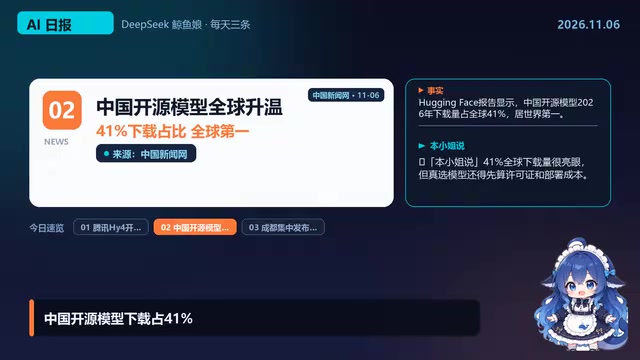
What needs to be viewed calmly is that downloads don't equal production performance. License terms, hardware costs, and Chinese-language scenario fit still need to be verified item by item. The 41% share shows ecosystem activity but cannot directly translate into leadership in engineering reliability.
Open-source model licenses are a key factor determining whether enterprises can safely use models commercially. Common licenses such as Apache 2.0 and MIT are relatively permissive, allowing closed-source commercial use; while some custom licenses may limit monthly active users, require attribution, or prohibit specific uses. When selecting models, enterprises need to check license terms against their own business scenarios item by item to avoid subsequent legal risks. In addition, download statistics typically include duplicate downloads and CI pipeline pulls, and cannot be directly equated with actual deployment volume or production adoption rates.
Chengdu Multi-Agent Conference: The Signal Behind 100 New Products
The 2026 China Multi-Agent Application Conference was held in Chengdu, where 100 new intelligent terminal and agent products from Chengdu were released, and an industry-finance cooperation innovation laboratory was launched, completing 5 cooperation signings around platforms, talent, capital, scenarios, and computing power. Academician Chai Tianyou proposed integrating large models, agents, and industrial automation to drive autonomous learning and optimization of production systems.

The concentrated release of 100 new products indicates that multi-agent systems are moving from concept demonstrations into the competitive stage of industrial and terminal products. For manufacturing enterprises, industrial parks, and startup teams, the opportunity lies in connecting with ready-made scenarios, capital, and computing power; the risks are equally obvious—product quantity doesn't equal commercial validation, and deployment costs, data security, and ongoing maintenance capabilities still need to be verified before procurement.
Multi-agent systems refer to multiple agents with autonomous decision-making capabilities collaborating to accomplish complex goals through communication, negotiation, and task allocation. In industrial scenarios, different agents can separately handle equipment monitoring, production scheduling, and quality inspection, achieving autonomous optimization of production systems through shared state. Compared with single agents, multi-agent systems place greater emphasis on role division, conflict resolution, and global consistency, imposing higher requirements on communication protocols and computing power scheduling. The integration direction proposed by Academician Chai Tianyou is essentially to use large models as the reasoning core of agents, interfacing with the event-driven mechanisms of industrial automation systems, thereby enabling production systems to possess continuous learning and adaptive capabilities.
Related articles
 Tech Frontiers
Stylome Bot Slammed as Useless Junk: Why Do AI Detection Tools Keep Failing?
Reddit users test the Stylome AI detection bot: Gemini-rewritten text judged human-written, consistently low confidence. An analysis of AI text detection's technical dilemmas, privacy concerns, and credibility crisis in community governance.
 Tech Frontiers
When AI Becomes a Productivity Divide: Clarity or "AI Psychosis"?
A civil engineer's deep use of agentic AI boosted efficiency but bred contempt for peers who refuse to learn. Is this clarity or AI psychosis? An analysis of the cognitive and psychological challenges behind the AI productivity divide.
 Tech Frontiers
Opus 5.5 Benchmark Scores Climb, Community Says Its "Weights Are Blessed"
Reddit community discusses Opus 5.5's rising scores on the Benchmaxxing Bench, with users describing its performance as "weights are blessed." This article interprets the community reaction and cautions against conflating benchmark scores with real capability.