Memory Chess: A Memory Training App for Reproducing Chess Positions

Memory Chess trains visual working memory with minimal gameplay, upgraded to a complete training system in 2.0.
Memory Chess is a memory app that skips chess skill training—players observe a position for seconds, then rebuild the board from memory. It strips tactics and openings, keeping only the structured visual memory challenge. Version 2.0 adds daily boards, bidirectional rating, a memory span dashboard, replay sharing, and 24 languages, plus a redesigned interface. Free, no account, with social features via Telegram and replays. It earned 95 upvotes and 7th place on Product Hunt. Sitting between a memory game and a cognitive training tool, it's extremely accessible, but the link between memory and real chess skill is unclear.
As chess training tools grow increasingly specialized, an app called Memory Chess has taken a completely different approach from traditional chess skill training: it doesn't teach you how to play chess, but rather trains you to remember chess positions. This product, which earned 95 upvotes on Product Hunt and ranked 7th for the day, enters the niche of memory training with an extremely minimal mechanic.
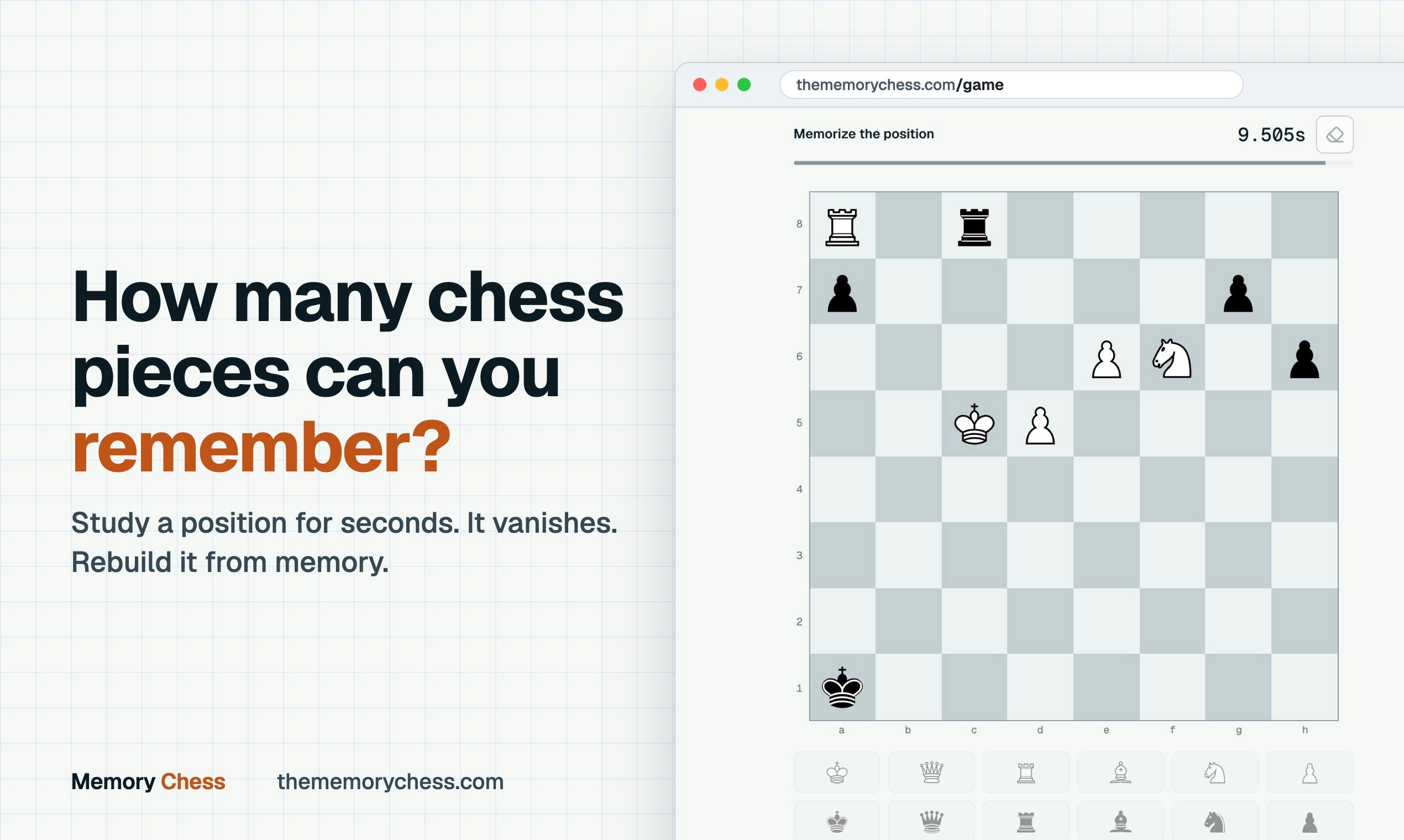
Core Gameplay: A Few Seconds of Memory, One Complete Reproduction
Memory Chess's mechanic can be summed up in one sentence: you're shown a chess position for a few seconds, the board is cleared, and then you need to place all the pieces back in their original positions.
This design strips away all advanced elements of chess—tactics, opening theory, endgame technique—leaving only the purest visual memory challenge. For those familiar with chess, piece positions on a board are inherently highly structured information—each piece's coordinates, color, and type together form an encodable visual pattern. Memory Chess leverages this structured information to test and train working memory capacity.
The app's official website emphasizes "free, no account required," making the barrier to entry almost zero. You don't need to be a chess player—just knowing the pieces is enough to start playing.
Working memory is a core concept in cognitive psychology, referring to an individual's ability to maintain and manipulate information over a short period (typically seconds to tens of seconds) while performing cognitive tasks. Unlike long-term memory, its capacity is extremely limited—classic research suggests adults can simultaneously hold only about 4 to 7 information chunks at a time. Memory Chess trains precisely this ability: players need to encode piece positions on the board into visual-spatial information within seconds, then reproduce them after the board is cleared. The combination of piece coordinates, colors, and types forms individual "chunks," and experts' advantage often comes from bundling multiple pieces into a single meaningful unit for memorization.
Version 2.0: From a Standalone Tool to a Complete Training System
According to the developer, 2.0 is the largest update since Memory Chess's launch, adding multiple features designed around "continuous training" and "social comparison."
Daily Board and Bidirectional Skill Rating
The daily board gives all players the same puzzle, creating a natural benchmark for score comparison. A companion skill rating system dynamically adjusts your rank based on performance, and ratings can move in both directions—meaning the system attempts to establish a long-term ability tracking mechanism with both rises and falls, rather than simply accumulating points.
Bidirectional skill rating means the rating can both increase and decrease, similar to the Elo rating system used in chess or MMR mechanics in esports. Such systems continuously update scores based on wins and losses or performance—winning adds points, losing subtracts them—thereby dynamically reflecting a player's current level. This contrasts with "experience point" designs that only increase. The significance of bidirectional rating is that it keeps ranks genuinely differentiated, prevents players from climbing to positions that don't match their actual ability through sheer time investment, and more easily motivates sustained training.
Memory Span Dashboard and Replay Sharing
The new dashboard displays your memory span and historical progress curve, transforming the vague feeling of "I think I remembered it" into quantifiable data. Shareable round replays let players showcase their highlight performances or review their mistakes.
24 Languages and a Brand-New Design
Version 2.0 also completed an interface overhaul and supports 24 languages. For an app with extremely simple mechanics, multilingual coverage means it was targeting a global market from the start, which aligns well with Product Hunt's user base.
Positioning Considerations for Memory Training Apps
Memory Chess essentially belongs to the "cognitive training" category, but its approach differs markedly from common brain training apps on the market.
Most cognitive training products use abstract task designs (such as memorizing number sequences or pattern matching), while Memory Chess borrows chess as a concrete vehicle. The advantage of this choice is that the information itself has inherent logic—pieces aren't randomly arranged but form reasonable positions following chess rules, allowing the memorization process to leverage chess principles for assisted encoding.
Another way to understand it is that it's closer to a "memory game" than a serious training tool. The data of 95 upvotes and 5 comments also indicates that it attracted some attention on Product Hunt but hasn't yet generated large-scale discussion.
Cognitive training is a class of interventions aimed at improving mental abilities such as attention, memory, and executive function through specific tasks, often packaged as "brain fitness." In recent years, there has been academic debate over whether such products can truly deliver improvements that transfer to daily life. Critics argue that training effects tend to be limited to the task itself and difficult to generalize to other abilities; supporters emphasize positive evidence in specific populations and tasks. Memory Chess swaps the training vehicle for chess positions, which conveniently sidesteps some of the "abstract tasks are boring" problem, but it equally faces the question of "what exactly does practicing this improve?"
Social Design: Telegram Group and Score Exchange
The developer directs player communication to a Telegram group (t.me/TheMemoryChess), encouraging users to share scores and compare with each other. This lightweight community management approach suits early-stage products—rather than building a standalone forum, it gathers core users directly on an existing social platform.
For a free app with no account system, the existence of social features is somewhat counterintuitive: no accounts means it's hard to establish persistent friendships or leaderboard systems. The daily board and replay sharing features are, in a sense, the best social solution possible under the no-account constraint.
Directions Worth Watching
Memory Chess demonstrates a clear idea: combining a mature cognitive training mechanism with a culturally rich game vehicle, using minimal interaction to lower the barrier to use. Its limitations are equally obvious—the correlation between chess position memory ability and actual chess skill is unclear, which will limit its ability to attract serious chess learners.
But from a product design perspective, using a few seconds of observation time and one complete reproduction to quantify visual working memory is a mechanic that's simple enough, verifiable, easy to spread, and fun enough. For users who want to do some brain activity in spare moments without being blocked by complex rules and paywalls, it offers a nearly barrier-free option.
One-line Summary
Memory Chess trains visual working memory with minimal memory gameplay, upgraded to a complete training system in version 2.0.
Paragraph Summary
Memory Chess is a memory app that doesn't follow the chess skill training path—its core gameplay has players observe a chess position for a few seconds and then reconstruct the board from memory. It strips away tactics and opening theory, keeping only the memory challenge for structured visual information. Version 2.0 adds a daily board, bidirectional skill rating, memory span dashboard, replay sharing, and 24 language support, along with an interface overhaul. The app is completely free, requires no account, and implements social features through a Telegram group and replay sharing. It earned 95 upvotes on Product Hunt and ranked 7th for the day. Sitting between a memory game and a cognitive training tool, it has an extremely low barrier to entry, but the correlation between memory ability and actual chess skill remains unclear.
Related articles

Random Pruning of the DPO Computation Graph: 1.4x Training Speedup and Lower Peak Memory
DPO training too slow and memory-hungry? This paper proposes a random pruning framework for the DPO computation graph, sampling independently across position, sequence, and branch dimensions; branch pruning achieves a 1.426x step-time speedup and cuts training time by about 30%, with in-depth attribution of memory and time gains.

Why Does JEPA Underperform MLM in Longitudinal EHR Representation Learning?
New study compares JEPA and MLM for longitudinal EHR representation learning on MIMIC-IV: three JEPA variants train stably without collapse but underperform MLM; target size, not heterogeneity, drives prediction error.

Transfer Learning + Visible Light Communication: A New Approach to Energy-Efficient Indoor Positioning
A study proposes a transfer learning-based visible light communication indoor positioning method, achieving 47% accuracy improvement on the BOSCH factory dataset, 67.5% model efficiency under high noise, and introducing the ME composite metric for energy-efficient positioning in energy-constrained industrial IoT scenarios.