Memory Price Hikes Hit PC Market: Q3 Global Shipments Plunge 21%

Counterpoint report shows global PC shipments plunged 21% YoY in Q3 2026, with RAM price hikes as the core driver.
A Counterpoint Research report shows global PC shipments fell 21% YoY in Q3 2026, the largest decline in recent years, consistent with IDC and Omdia data. The direct cause is surging RAM prices: memory makers are shifting capacity to servers and HBM, tightening consumer DRAM supply, forcing vendors to raise prices and suppressing upgrade demand. Smartphone shipments simultaneously hit a 14-year low, reflecting broad consumer electronics weakness and a negative loop of price hikes, demand contraction, and shipment declines. The downturn will hit channel inventories and vendor margins; some may cut low-end lines and focus on high-end, raising entry barriers. The industry's fragile dependence on upstream memory pricing is exposed, with no inflection point yet in sight.
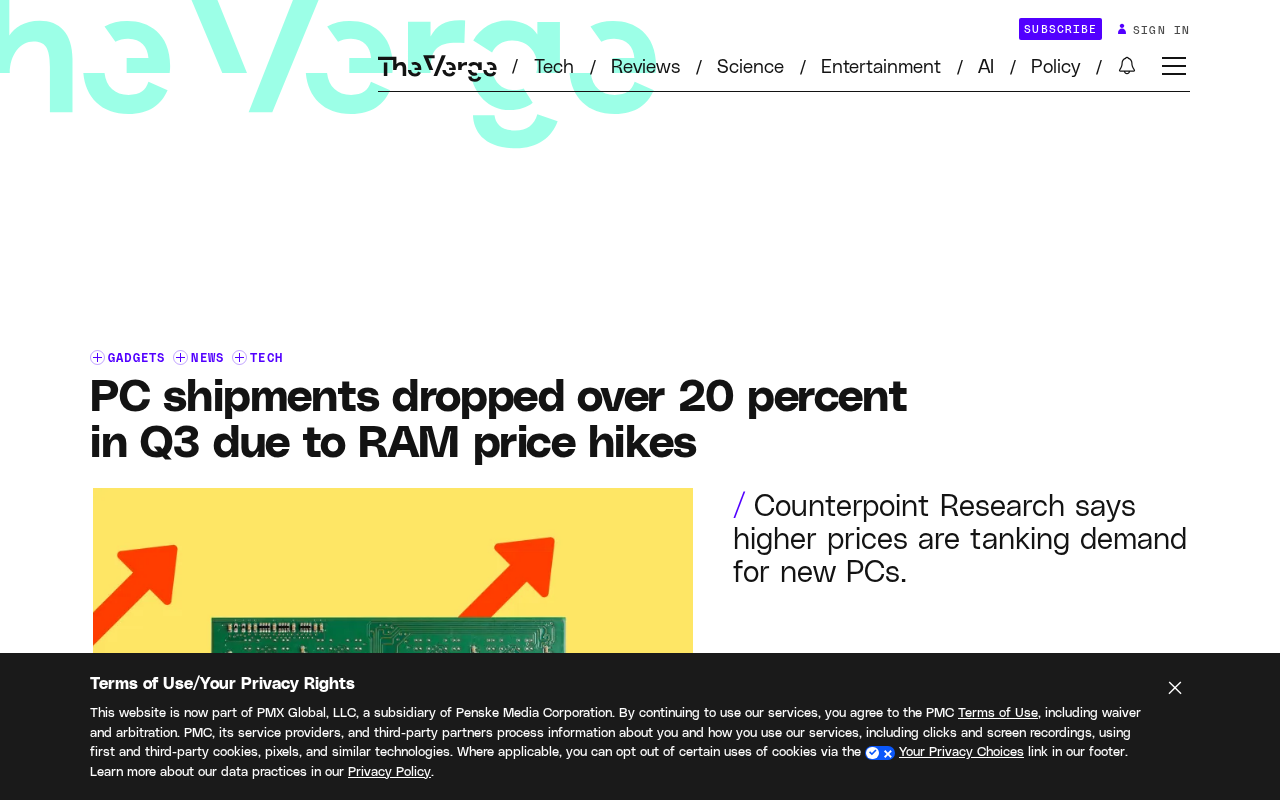
The PC market is enduring a harsh winter driven by rising upstream component prices. According to the latest report from Counterpoint Research, global PC shipments in Q3 2026 fell 21% year-over-year, marking the largest decline in recent years. This figure aligns broadly with earlier reports from IDC and Omdia, indicating that the downward pressure on the PC industry is not a statistical anomaly from a single firm but a shared predicament across the entire sector.
Behind the Shipment Collapse: RAM Price Hikes as the Direct Driver
Counterpoint attributes the shipment decline directly to months of sustained price increases, with the surge in RAM (memory) prices as the core factor. Over the past several quarters, memory contract prices have climbed steadily, forcing PC manufacturers to pass costs on to consumers and driving up whole-device prices. For the price-sensitive consumer market, this has directly suppressed upgrade demand.
More noteworthy is that this round of price increases is not a short-term fluctuation. Signals from the supply chain show that memory manufacturers are shifting capacity toward higher-margin server and HBM products, continuously tightening consumer-grade DRAM supply. This means PC makers will struggle to absorb cost pressure through supply chain adjustments in the short term, and price pass-through will continue.
The difference between memory contract prices and spot prices: The "memory contract prices" mentioned in this article are the primary pricing mechanism in the DRAM market. PC manufacturers typically sign supply contracts with major manufacturers such as Samsung, SK Hynix, and Micron on a quarterly or monthly basis. Once contract prices are locked in, the BOM cost of whole devices becomes relatively fixed in the short term. By contrast, spot prices fluctuate in real time with supply and demand, with greater volatility, and are often seen as a leading indicator of contract price trends. When spot prices remain consistently above contract prices, it often signals that the next round of contract negotiations will bring price increases. Therefore, observing the quarter-over-quarter change in contract prices is more useful for judging the sustainability of PC manufacturers' cost pressure than watching single-day spot quotes.
Why HBM is crowding out consumer-grade DRAM capacity: HBM (High Bandwidth Memory) is a high-value-added product that stacks multiple DRAM chips using TSV (Through-Silicon Via) packaging, primarily used in AI accelerator cards and high-end servers. It consumes far more wafer capacity per unit than ordinary DDR dies and commands significantly higher gross margins. Amid the AI computing demand explosion, manufacturers are prioritizing limited wafer capacity for HBM and server DDR5, causing a passive contraction in DDR4/DDR5 supply for consumer PCs. This structural crowding-out cannot be resolved through short-term production scheduling adjustments—building new wafer fabs typically takes 2-3 years—so the tightness in consumer-grade DRAM has a strong rigidity.
Beyond PCs: Smartphone Market Cools in Tandem
According to the Counterpoint report, global smartphone shipments in the same quarter also fell to their lowest level in 14 years. The simultaneous contraction of two major consumer electronics categories shows that the problem is not limited to a cyclical adjustment in the PC industry but reflects broader weakness in consumer electronics demand.
Both markets share similar logic: rising upstream memory chip prices push up device costs, compounded by declining consumer willingness to spend on non-essential electronics, ultimately forming a negative loop of "price increases—demand contraction—shipment decline." For smartphones, a category with shorter replacement cycles, the 14-year low is even more alarming—when even phones won't sell, the PC recovery clearly cannot rely on a short-term demand rebound.
Corroborated by IDC and Omdia Data
Counterpoint's 21% decline is not an isolated data point. Earlier reports from IDC and Omdia both point to the same trend, and the three firms' directional consensus strengthens the credibility of this judgment. Although the statistical scopes of different firms vary, all confirm a significant decline in Q3 2026 PC shipments.
The significance of this multi-source cross-validation lies in ruling out methodological bias from any single data source, demonstrating that the market contraction is real and widespread. For industry observers and channel partners, this consensus is more valuable for reference than any single figure.
Differences in statistical scope among the three firms: Although Counterpoint, IDC, and Omdia all track PC shipments, their methodologies are not entirely consistent. IDC's PC statistics typically include desktops, notebooks, and workstations, with some scopes excluding tablets; Omdia's coverage sometimes lists Chromebooks separately; Counterpoint places more emphasis on brand vendors' sell-in data. Additionally, "shipments" refer to vendor shipments to channels, which have a time lag relative to "activations" and "sell-through"—when channel inventories are high, shipment declines may exceed actual end-demand declines. Therefore, while the three firms' directional consensus confirms the trend is real, specific percentages should not be directly compared across firms; readers should focus on the shared conclusion of "significant decline."
Industry Impact and Outlook
The shipment collapse will cascade down the supply chain. Channel partners face inventory impairment pressure, while PC brand manufacturers must choose between protecting market share and protecting margins. Some vendors may choose to cut low-end product lines and focus on the high-end market to maintain profitability, but this will further raise the entry barrier for consumers.
From a longer perspective, this downturn driven by component prices exposes the PC industry's fragile dependence on upstream memory chip pricing. When memory prices become the key variable determining whole-device sales, vendors' room for differentiation is significantly compressed. The subsequent trajectory will depend on when memory prices stabilize and whether vendors can offset cost pressure through product mix adjustments. At least for now, the market has yet to see a clear inflection signal.
One-line Summary
Counterpoint report shows global PC shipments plunged 21% YoY in Q3 2026, with RAM price hikes as the core driver.
Paragraph Summary
A Counterpoint Research report shows global PC shipments fell 21% year-over-year in Q3 2026, the largest decline in recent years, consistent in direction with IDC and Omdia data. The direct cause is the sustained surge in RAM prices: memory manufacturers are shifting capacity toward servers and HBM, tightening consumer-grade DRAM supply, forcing vendors to raise prices and suppressing upgrade demand. Global smartphone shipments simultaneously fell to a 14-year low, indicating overall weakness in consumer electronics demand and forming a negative loop of "price increases—demand contraction—shipment decline." The shipment decline will translate into channel inventory impairment and vendor margin pressure; some vendors may cut low-end product lines and focus on high-end, but this will raise the entry barrier. The industry's fragile dependence on upstream memory pricing is fully exposed, and no inflection point has yet emerged.
Related articles

Meta vs. Publishers: The AI Data Battle Over Terms of Service Changes and the Future of the Internet
Meta changed its business account terms to allow AI training on linked website data, sparking backlash from publishers and creators. Industry groups demanded negotiations, forcing Meta to remove 'training' wording and delay the effective date. The dispute reveals the deeper battle over data authorization and the future of the internet in the AI era.

When Outside Xbox Meets Blood on the Clocktower: A Legion Match in Minecraft
Outside Xbox guests Ellen and Mike play Minecraft Blood on the Clocktower in a Legion game. How can three good players fight an evil majority amid information noise? This article breaks down Legion mechanics, information-role mind games, and the endgame reversal.

Kimi K3.1 Hands-On Test: Open-Source Model Nears Opus, Video Generation Steals the Show
Kimi K3.1 completed motion graphics, 3D rendering, mini-games, and video generation in a live test. Analysis of its 2.8T MoE architecture, gap vs Opus/GPT, and hidden video generation.