Menlo SDK Goes Open Source: Humanoid Robot Asimov 1 Opens Control Interface to Developers
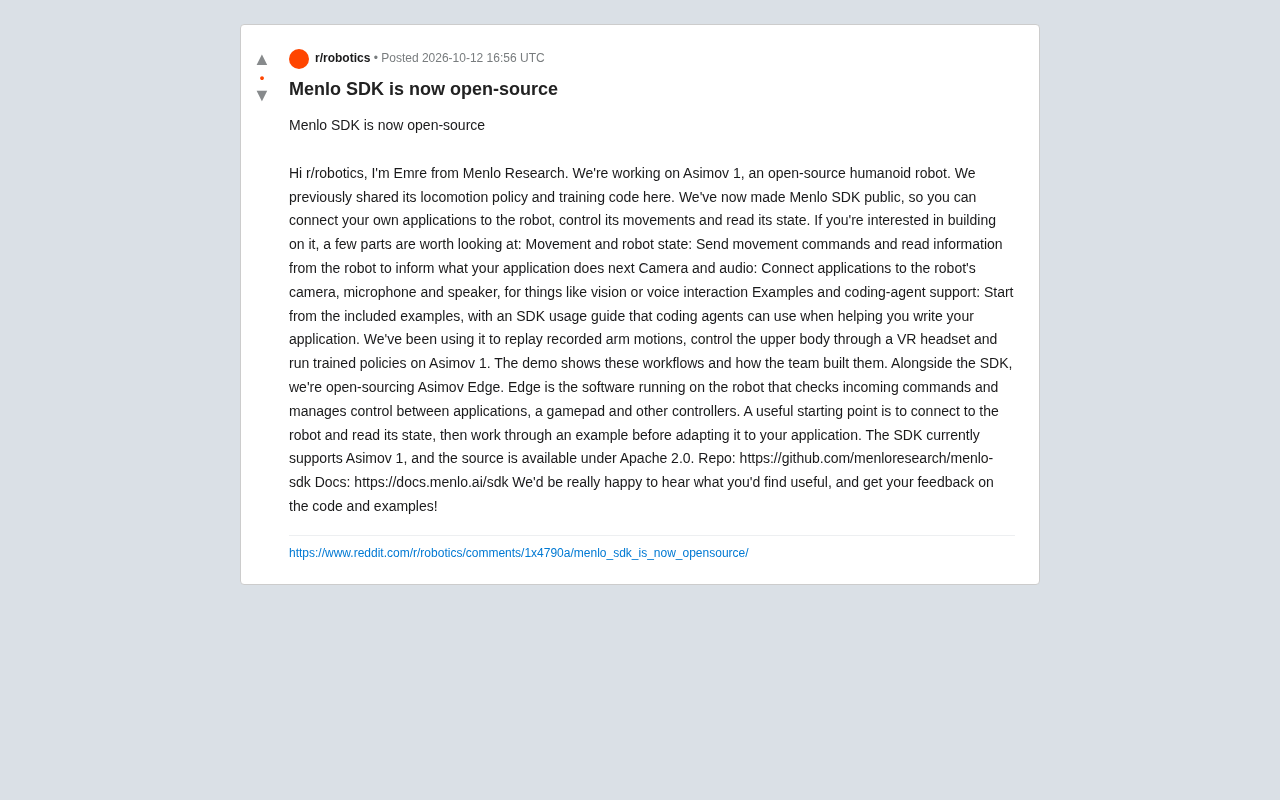
Menlo Research open-sources the SDK and Edge software layers for humanoid robot Asimov 1, completing application development interfaces.
Menlo Research announced on r/robotics the open-sourcing of the Menlo SDK and Asimov Edge for humanoid robot Asimov 1 under Apache 2.0, currently supporting only Asimov 1 hardware. The Menlo SDK handles app-to-robot communication with motion control, state reading, and camera/mic/speaker access for vision and voice applications; Asimov Edge runs on the robot to validate commands and coordinate control among apps, gamepads, and other controllers. The repo includes runnable examples and an AI coding agent-optimized guide. The team has used the SDK for arm motion replay, VR upper-body control, and policy deployment.
For humanoid robots making the leap from lab to real-world application, what's often missing isn't hardware—it's a software interface that lets developers get up and running quickly. Menlo Research's newly open-sourced Menlo SDK and Asimov Edge are filling exactly that gap.
What's Open Source: SDK + Edge, a Two-Pronged Approach
The Menlo Research team announced on the r/robotics community that the Menlo SDK for their open-source humanoid robot Asimov 1 is now publicly available. This isn't their first open-source release—they'd previously shared the locomotion policy and training code, and now they've completed the application-layer interfaces as well.
Specifically, the open-source release includes two core components:
Menlo SDK handles communication between applications and the robot. Through it, developers can send motion commands, read robot state, and connect to cameras and microphones/speakers to build vision or voice interaction applications.
Asimov Edge is the software layer running on the robot itself. Its job is to validate incoming commands and coordinate control authority among applications, gamepads, and other controllers. In other words, Edge is the robot's "gatekeeper," ensuring multiple input sources don't conflict with each other.
The code is open-sourced under the Apache 2.0 license and currently supports only the Asimov 1 hardware.
What is a locomotion policy? In the humanoid robotics field, a locomotion policy typically refers to a neural network model trained via reinforcement learning or imitation learning. It takes sensor inputs such as joint angles, IMU orientation, and foot contact forces, and outputs target positions or torques for each joint—enabling the robot to walk stably, turn, and even climb stairs. Unlike traditional model predictive control (MPC), policy models compress complex balance and gait planning into a network capable of real-time inference, making deployment and iteration easier. Menlo Research's previously open-sourced locomotion policy means developers can directly reuse this walking control rather than building gait algorithms from scratch—which is also the prerequisite for this SDK's ability to decouple the application layer from low-level locomotion.
What Developers Can Do With It
According to the official description, the SDK covers several key capabilities:
Motion control and state reading are the foundation. Developers can send movement commands while reading state information returned by the robot, allowing applications to make decisions based on real-time data. This read-write loop is the prerequisite for building any interactive application.
Camera and audio access opens up the perception layer. The SDK allows applications to connect to the robot's camera, microphone, and speaker, meaning vision recognition, voice dialogue, and similar features can run directly on Asimov 1 without needing to build a separate sensor solution.
Sample code and coding agent support lower the barrier to entry. The repository includes runnable examples along with an SDK usage guide specifically optimized for AI coding agents—when developers ask Claude or Copilot to help write code, these docs provide the necessary context.
What does the Apache 2.0 license mean? Apache 2.0 is one of the most permissive open-source licenses in the industry, allowing users to freely use, modify, and distribute code—even in closed-source commercial products—as long as copyright and license notices are retained. It also includes explicit patent grant provisions that reduce the risk of patent litigation for users. For a robot SDK, this choice is especially important: hardware manufacturers, startups, and research institutions can all confidently integrate Menlo SDK into their products without worrying about being forced to open-source their own code. This also explains why Menlo open-sourced both the SDK and Edge—only when both layers use permissive licenses can they truly attract ecosystem developers to participate.
How the Team Uses It Themselves
Menlo Research's Emre shared several practical internal use cases in the post: replaying recorded arm motions, controlling the upper body via a VR headset, and running trained policy models on Asimov 1. Demo videos showed these workflows and how the team built them.
These use cases send a signal: the SDK's design goal isn't to serve a single scenario, but to let developers flexibly combine different modes like teleoperation, motion replay, and policy deployment.
The relationship between teleoperation, motion replay, and policy deployment. These three concepts are often used interchangeably, but they operate at different levels. Teleoperation is real-time human-in-the-loop robot control, such as mapping an operator's movements through a VR headset or gamepad; motion replay plays back recorded joint trajectories, typically for teaching or data collection; policy deployment runs a trained model on the robot, letting the model make decisions autonomously. The fact that Menlo SDK supports all three means developers can use teleoperation to collect data, replay to verify motion feasibility, and then deploy the trained policy—forming a closed loop from data to deployment. This combinatorial capability is key to building general-purpose humanoid robot applications.
Getting Started Tips and Feedback Channels
For developers wanting to try it out, the official starting point is clear: first connect to the robot and read state, then run through an example, then modify it into your own application. This step-by-step approach avoids getting stuck on complex control logic right from the start.
The repository is at GitHub's menloresearch/menlo-sdk, with documentation at docs.menlo.ai/sdk. The team says they're very eager to hear what features developers find useful, as well as feedback on the code and examples.
The open-source ecosystem for humanoid robots is still in its early days. By releasing both the SDK and Edge together, Menlo has at least made "writing applications on Asimov 1" something with a clear path forward.
One-line Summary
Menlo Research open-sources the SDK and Edge software layers for humanoid robot Asimov 1, completing the application development interface.
Paragraph Summary
Menlo Research announced on the r/robotics community the open-sourcing of the Menlo SDK and Asimov Edge for humanoid robot Asimov 1, under the Apache 2.0 license, currently supporting only Asimov 1 hardware. The Menlo SDK handles communication between applications and the robot, supporting motion control, state reading, and camera and microphone/speaker access, enabling vision recognition and voice dialogue applications; Asimov Edge runs on the robot itself, validating commands and coordinating control authority among applications, gamepads, and other controllers. The repository includes runnable sample code and a usage guide optimized for AI coding agents. The team has already used the SDK for arm motion replay, VR headset upper-body control, and policy model deployment, and officially recommends developers start by connecting to the robot and reading state before progressing step by step.
Related articles

Anthropic IPO Countdown: The Compute Cost Ledger Behind a $2 Trillion Valuation
Anthropic's IPO targets up to $2 trillion — double its Series H valuation. We break down the timeline, compute cost logic, and the key question investor day must answer.

Anthropic IPO Prospectus Revealed: Behind 12x Revenue Growth, the Twin Tests of Compute Costs and Customer Concentration
Anthropic filed its IPO prospectus: 2025 revenue up 12x to $4.6B, net loss $42B including $34B non-cash. Breaking down compute costs, $2T valuation logic, customer concentration risks, and founder control.

Xteink X4 Pro Review: A Mini E-Reader That Fits in Your Pocket, Now More Affordable
Xteink X4 Pro is a 4.26-inch mini e-reader, smaller and thinner than a 6-inch Kindle, magnetically attachable to phones, and cheaper than ever. We analyze its screen, design, use cases, and value.