MeReader: An Offline, Privacy-Preserving AI Reading Assistant with Spoiler Prevention

MeReader uses offline hybrid retrieval and a progress boundary mechanism to deliver a spoiler-free AI reading assistant on consumer hardware.
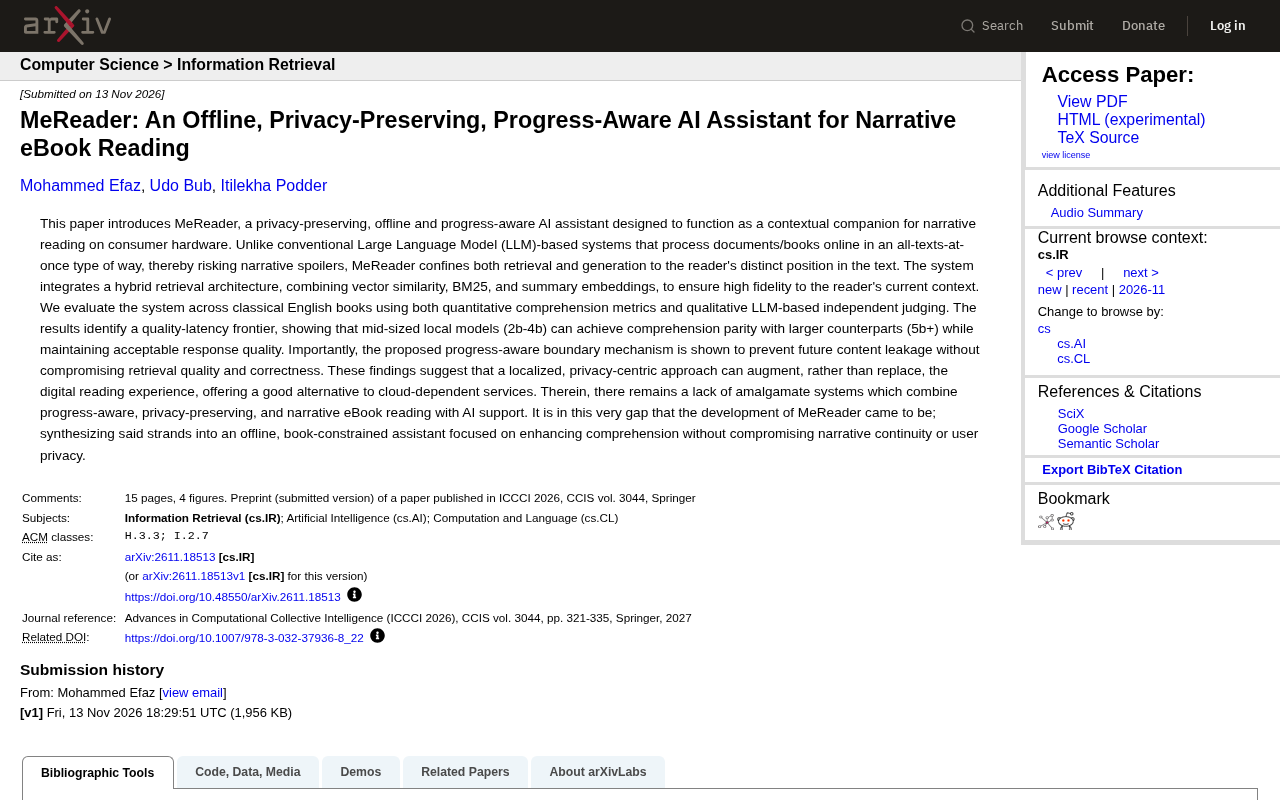
To address privacy leakage and spoiler risks in cloud-based AI reading tools, the paper proposes the fully offline MeReader system. It strictly confines retrieval and generation to the reader's current position using a hybrid retrieval architecture of vector similarity, BM25, and summary embeddings, cutting off future text at the retrieval source. Evaluations show 2B–4B local models match 5B+ models, and the progress-aware boundary does not harm retrieval quality. MeReader is positioned as a privacy-friendly complement to cloud services.
When reading a novel, we often wish we had an assistant who could explain obscure allusions and untangle complex character relationships. But most mainstream AI reading tools rely on the cloud and process the entire book in one go. This creates two problems: privacy risk, and more annoyingly—spoilers. A new paper proposes MeReader, which tries to resolve these tensions in a fully offline way.
The Dilemma of Cloud-Based AI Readers
Current large language model (LLM)-based reading assistance systems typically upload the entire e-book to the cloud and adopt a "full-text, one-shot processing" approach. This means the model may have already "read" chapters the reader hasn't reached yet when generating answers. When a reader asks "why did this person do that," the model can inadvertently reference later plot points and ruin the reading experience.
That said, handing an entire book over to a third-party service is another concern for privacy-conscious readers. The paper points out that existing solutions lack a system that combines "progress awareness," "privacy protection," and "narrative e-book reading." MeReader targets exactly this gap.
Keeping the AI Assistant "Locked" Within the Pages Already Read
MeReader's core design is to strictly confine both retrieval and generation to the reader's current position in the text. The system runs on consumer-grade hardware, fully offline, without relying on any cloud service.
To achieve this, the research team built a hybrid retrieval architecture: vector similarity handles semantic matching, BM25 handles keyword matching, and summary embeddings capture chapter-level context. Together, these three ensure that the AI's answers are highly relevant to what the reader has read so far, rather than any corner of the entire book.
This "progress-aware boundary mechanism" is MeReader's key innovation. It cuts off the inflow of future content at the retrieval source rather than filtering at the generation stage, thereby preventing spoilers without sacrificing retrieval quality.
BM25 is a classic sparse retrieval algorithm belonging to the family of probabilistic retrieval models. It scores document relevance based on term frequency (TF) and inverse document frequency (IDF), and uses a document length normalization parameter to suppress the natural advantage of long documents. Unlike vector retrieval, which excels at capturing semantic similarity, BM25 is extremely sensitive to exact keyword matches—for example, when a reader asks about a specific character name or term, BM25 can reliably recall the original chapter containing that word, whereas semantic vectors may drift due to generalization. MeReader runs the two in parallel, essentially letting "semantic recall" and "literal recall" complement each other and reducing the risk of missed retrieval by a single paradigm on narrative text.
Summary embeddings refer to having the model first generate a condensed summary for each chapter, then vectorizing the summaries and building an index. During retrieval, the query is first matched against chapter-level summary vectors to locate relevant chapters before entering fine-grained retrieval. This two-stage structure is equivalent to building a "chapter-level semantic map" for long texts, enabling the system to still lock onto the correct chapter range when a reader's question involves cross-paragraph plot points, rather than blindly searching the entire book's vector store—balancing retrieval efficiency and chapter-level contextual awareness.
Mid-Sized Local Models Are Already Sufficient
The paper evaluated using classic English books, combining quantitative comprehension metrics with independent LLM-based qualitative judgments. The results reveal a clear quality-latency frontier curve.
As a detail, mid-sized local models with 2B to 4B parameters already match the comprehension performance of larger models with 5B+ parameters while maintaining acceptable response quality. For consumer-grade hardware, this means running an AI reading assistant locally is already feasible in terms of experience, without having to sacrifice response speed in pursuit of larger models.
Another key conclusion is that the progress-aware boundary mechanism was proven not to harm retrieval correctness or quality. In other words, spoiler prevention does not come at the cost of practicality.
The quality-latency frontier curve is a core analytical framework for evaluating local deployment options: the horizontal axis is end-to-end response latency, and the vertical axis is answer quality (such as comprehension accuracy or human ratings). Models with different parameter counts, quantization precisions, and hardware configurations form a series of scatter points on the chart, connected into a trade-off boundary. Points on the curve represent the optimal quality achievable under a given latency budget, and an inward shift of the curve means the system design (such as retrieval augmentation or prompt optimization) has brought a Pareto improvement. MeReader's evaluation uses this framework to show that 2B–4B models already lie in an acceptable frontier range on consumer-grade hardware; further increasing model size yields diminishing quality gains while latency costs rise significantly.
Localized Solutions Complement Rather Than Replace
The paper's authors position MeReader quite modestly: a localized, privacy-centric approach that can enhance rather than replace the digital reading experience, offering a good alternative to cloud-dependent services.
This positioning is realistic. Cloud-based large models still have advantages in knowledge breadth and reasoning capability, but reading assistance scenarios have very specific requirements regarding context boundaries and privacy. Constraining the AI "within" the current reading progress may actually reduce hallucination-style over-association and keep answers more focused on what the reader truly needs to understand.
MeReader demonstrates a path: rather than pursuing larger models, it achieves more scenario-appropriate reading assistance under limited compute through system design—hybrid retrieval and progress boundaries. For readers who want to preserve the purity of reading while not giving up AI assistance, this may be a starting point worth watching.
One-line Summary
MeReader uses offline hybrid retrieval and a progress boundary mechanism to deliver a spoiler-free AI reading assistant on consumer-grade hardware.
Paragraph Summary
Addressing the privacy leakage and spoiler risks of cloud-based AI reading tools, the paper proposes the fully offline MeReader system. Its core is to strictly confine retrieval and generation to the reader's current reading position, using a hybrid retrieval architecture composed of vector similarity, BM25, and summary embeddings to ensure answers align with read content, while cutting off future text at the retrieval source. Evaluations show that local mid-sized models with 2B–4B parameters match the comprehension performance of 5B+ models, and the progress-aware boundary mechanism does not harm retrieval quality. The authors position MeReader as a privacy-friendly complement to cloud services, demonstrating a localized reading assistance path that wins through system design rather than model scale.
Related articles

Comparing Three Channels for Subscribing to GPT Plus in China: Is Website Top-Up the Easiest?
How to subscribe to GPT Plus in China? This article compares website top-up, credit card, and mobile top-up channels—process, cost, and risk—with steps and tips to help you choose wisely.
GPT-6.2 Dual-Model Hands-On Test: Astra Burns $419, Sol Just $5
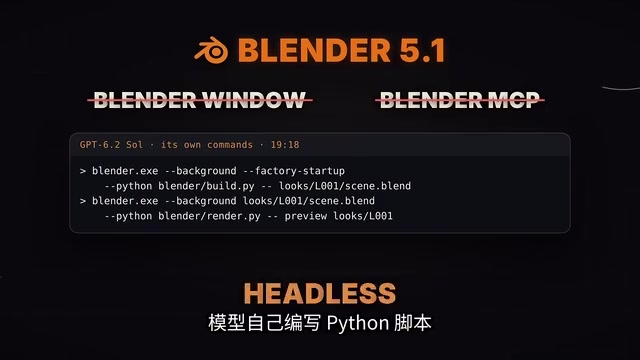
OpenAI GPT-6.2 Astra vs Sol tested on Blender clock, neon shooter, and Formula racing. Astra costs $419, Sol $197, cheapest clock under $5. Cost comparison and selection advice.

After GPT-6 Ultra's Launch: A Complete Guide to Plus/Pro Subscriptions
How to subscribe to GPT membership after GPT-6 Ultra's launch? This article covers the complete Bilibili tutorial: registering a Google account from scratch, Alipay top-up walkthrough, and a comparison of Go, Plus, and Pro plans.