Meta Abruptly Pulls AI Image Feature: The Industry Warning Behind a Privacy Controversy

Meta pulls its new AI image feature amid privacy backlash, revealing key industry warnings.
After strong user backlash, Meta withdrew a newly launched AI image feature within days. This article examines the privacy authorization controversy, the dilemma of deploying generative AI, tightening regulation like the EU AI Act, and why Privacy by Design must be core to AI products.
Overview
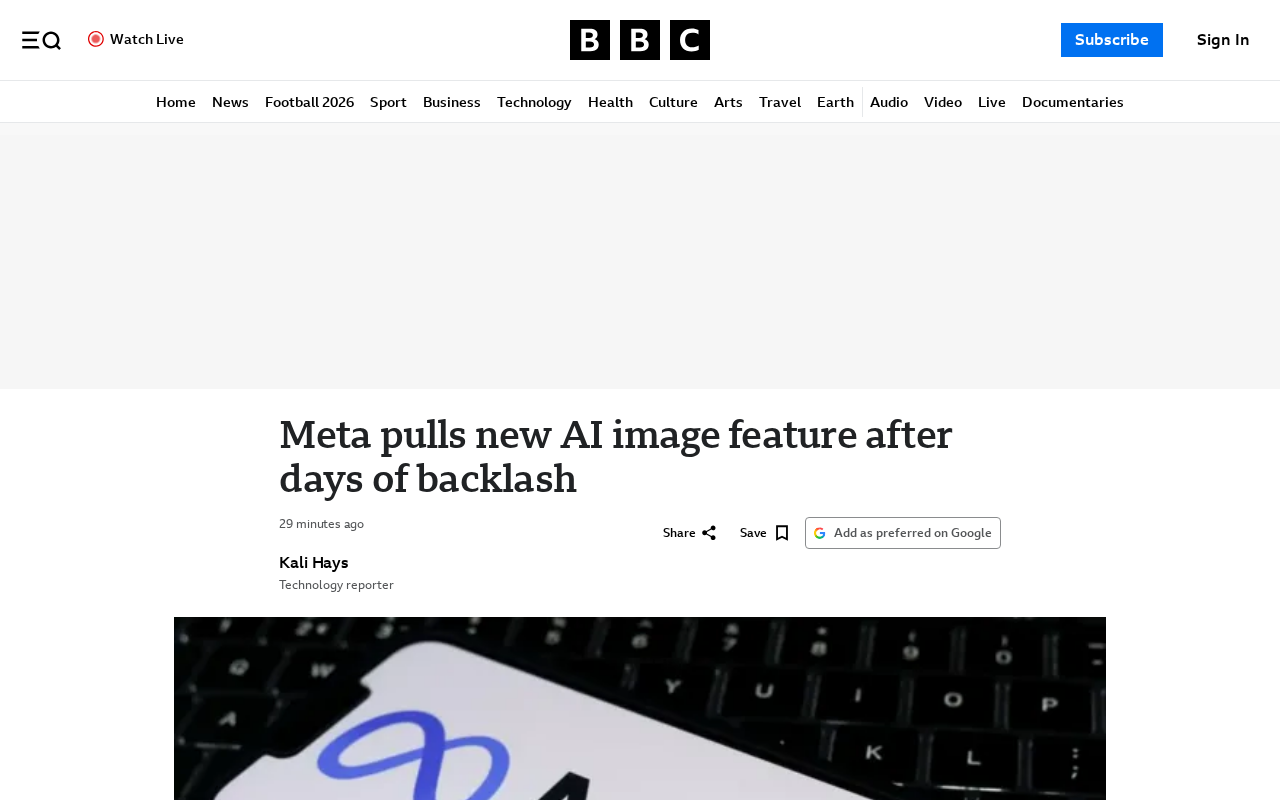
Meta recently pulled a newly launched AI image feature after several days of strong user backlash. This rapid reversal reflects the increasingly severe challenges tech giants face around user trust and privacy compliance as they push to deploy generative AI.
According to discussions in the HackerNews community, the feature sparked widespread controversy as soon as it went live. Meta has consistently treated AI as a core strategic direction, investing heavily in generative models and image processing—its research lab has developed industry-leading models such as SAM (Segment Anything Model) and ImageBind. However, image processing technologies based on diffusion models and generative adversarial networks (GANs) typically require massive amounts of real user images as training data. This is precisely where platform companies hold a natural advantage—but it is also the root of privacy controversies. Meta's product decision this time clearly underestimated how sensitive users are about the boundaries of their privacy.
The Core of the Controversy: Data Authorization and Content Control
The controversy over this AI image feature centered on two key dimensions.
Data authorization was the primary focus of public concern—are the photos that users upload or store on the platform being used to train models or generate new content? And was explicit user consent obtained for this process?
The controllability of content generation was equally worrying. When AI can automatically process, modify, or even regenerate a user's personal images, the user's control over that content becomes blurred. People fear that their facial features and identity information may be processed by algorithms without adequate notice.
For social platforms, images and photos are among the most private types of user data. Any feature involving automated AI processing touches users' privacy bottom line. The strong backlash Meta encountered here is precisely a concentrated eruption of this deep-seated anxiety.
Why Meta Chose a Quick Withdrawal
From a corporate decision-making perspective, Meta's withdrawal of the feature within a matter of days reveals several signals.
On one hand, in the age of social media, public opinion spreads extremely quickly, and negative feedback can achieve scale in a short time, causing substantial damage to a brand. On the other hand, Meta has already paid a heavy price for data privacy issues in the past, and remains highly vigilant about such risks.
It's worth revisiting an important piece of historical context here: the Cambridge Analytica scandal exposed in 2018 was one of the most serious data misuse scandals in the history of social media. Through a third-party app, the company obtained data on roughly 87 million Facebook users without their knowledge and used it for targeted political advertising, allegedly influencing the 2016 U.S. presidential election. The incident led Meta (then called Facebook) CEO Zuckerberg to testify before Congress, and the company was fined a record $5 billion by the U.S. Federal Trade Commission (FTC). This history keeps Meta's reputation on data privacy under strict public scrutiny, and any similar feature controversy tends to be amplified in interpretation.
While the quick withdrawal was a wise move to cut losses, it also exposed gaps in the pre-launch evaluation process. A well-designed release mechanism should identify privacy risks during internal testing and gradual rollout stages, rather than waiting until full deployment for users to discover the problems.
The Industry Dilemma of Deploying Generative AI
This incident is not an isolated case. From Google and Adobe to various image editing apps, many companies in recent years have encountered similar privacy controversies when launching AI image features—reflecting a shared dilemma across the entire industry.
The Gap Between Technical Capability and User Acceptance
The pace of progress in AI image processing far outstrips ordinary users' psychological adaptation. When technology can "pass off fake as real" or "automatically process personal data," users instinctively become wary and resistant. What is technically "feasible" does not equal what is "appropriate" at the product level.
The Absence of Informed Consent Mechanisms
Many AI features are enabled by default, and users are often folded into data processing workflows without their knowledge. This touches on a long-debated core mechanism in the data privacy field—the battle between "opt-out" (enabled by default) and "opt-in" (disabled by default). Behavioral economics research shows that over 90% of users will not proactively change default settings, so the choice of default state effectively determines how the data of the vast majority of users is processed. The EU's General Data Protection Regulation (GDPR) explicitly requires an opt-in mechanism for processing sensitive data, meaning users must actively grant authorization. In recent years, the mandatory enforcement of Apple's ATT (App Tracking Transparency) framework and numerous regulatory enforcement cases have accelerated the industry's shift toward an explicit authorization model. The "enabled by default, opt-out afterward" model is increasingly difficult to gain acceptance from users and regulators, and the industry is accelerating toward a direction of "explicit authorization, disabled by default."
A Continuously Tightening Regulatory Environment
With the advancement of regulations such as the EU AI Act, along with strengthening data privacy oversight in various countries, the compliance costs for tech companies deploying AI features are rising significantly. The EU AI Act officially took effect in 2024 as the world's first comprehensive AI regulation, adopting a risk-based tiered regulatory framework. AI systems involving biometric identification (such as facial processing) are classified as high-risk and must meet strict requirements for transparency, data governance, and user informed consent; non-compliant companies may face fines of up to 7% of global annual revenue. Notably, European market regulatory standards often propagate to global product strategies through the "Brussels Effect"—that is, companies tend to uniformly apply the strictest compliance standards across all markets to reduce the operational complexity of maintaining multiple compliance systems. Any product that ignores privacy in its design may face dual risks to both its legal standing and reputation.
Lessons for the Industry
Meta's withdrawal offers a reference case worth deep reflection for the entire AI industry.
First, privacy protection should be built into the underlying product architecture, rather than tacked on as a remedial feature after the fact. The concept of "Privacy by Design" was proposed as early as the 1990s by Ann Cavoukian, Canada's Information and Privacy Commissioner, and comprises seven core principles: proactive prevention rather than reactive remediation, privacy as the default setting, privacy embedded into system design, full functionality, end-to-end security, visibility and transparency, and respect for user privacy. This principle has been incorporated into Article 25 of the GDPR, becoming a legally binding compliance requirement. For AI products, this means privacy impact must be systematically considered at the model training, data collection, and feature design stages. The "Privacy by Design" philosophy should become a fundamental principle of all AI product development, not an optional extra.
Second, companies need to find a genuine balance between the speed of innovation and user trust. Rushing to seize market share while ignoring user sentiment may ultimately lead to greater losses. Transparent communication mechanisms, clear authorization processes, and ample user choice options are key to earning long-term trust.
Finally, this incident reminds us once again: the widespread adoption of generative AI is by no means merely a technical issue—it is also a social and ethical proposition. The degree to which users accept AI processing of their personal data will, to a large extent, determine the market fate of these features.
Conclusion
While the full details of Meta's withdrawal of the AI image feature have not been made public, the incident has clearly revealed a core contradiction in the current process of productizing AI—the deep tension between the rapid expansion of technical capabilities and user expectations of privacy. For all companies hoping to position themselves in the generative AI space, this is a warning delivered at a relatively controllable cost. The AI products that can truly establish a lasting foothold will inevitably be those that place user trust and privacy protection at their core.
Related articles

Automate Job Search with AI Agents and Residential Proxies for Precise Matching
Build an AI Agent with MCP and residential proxies to bypass recruitment site anti-scraping and geo-restrictions, scrape thousands of DevOps jobs, then have Claude score and rank each against your resume. Includes proxy comparison experiments, project structure, and cost analysis—filtering only, no auto-submission.

The AI Task Assistant That Knows When to Back Off: A Cure for Activation Struggles
One Small Step is an AI assistant for task initiation struggles, using agentic decisions for guilt-free reminders, timely retreat, and cross-platform task management. The developer shares real test results on 13 tasks and architectural trade-offs.

FastAPI: A High-Performance Python Framework and a Production-Ready API Development Powerhouse
FastAPI is a high-performance web framework based on Python type hints, supporting async and automatic OpenAPI docs. With over 100k GitHub stars, this article analyzes its core strengths, production readiness, and selection advice.