Meta AI Agent Muse Gets a Major Upgrade: Smart Glasses Become the New Battleground

Meta bets big on AI agent Muse at Connect, expanding it to smart glasses to compete for hardware AI entry points.
At its annual Connect conference, Meta CEO Zuckerberg announced a full commitment to AI agent Muse, extending it from mobile apps to wearables like AI smart glasses. Positioned as the intelligent hub across Meta's ecosystem, Muse leverages billions of users on Facebook, Instagram, and WhatsApp for rapid distribution. Smart glasses' screenless, voice-first format is a natural fit for AI agents, differentiating Meta from pure-software AI rivals. Meta aims to build a unified "one agent, multiple entry points" experience layer to compete with OpenAI and Google — though battery life, compute, and privacy challenges remain key hurdles for real-world deployment.
At its annual Connect conference held in Menlo Park, Meta CEO Mark Zuckerberg sent a clear signal in his keynote: Meta is going all-in on its AI agent Muse, pushing it across multiple platforms — including AI-powered smart glasses.
Meta's New AI Strategy Focus
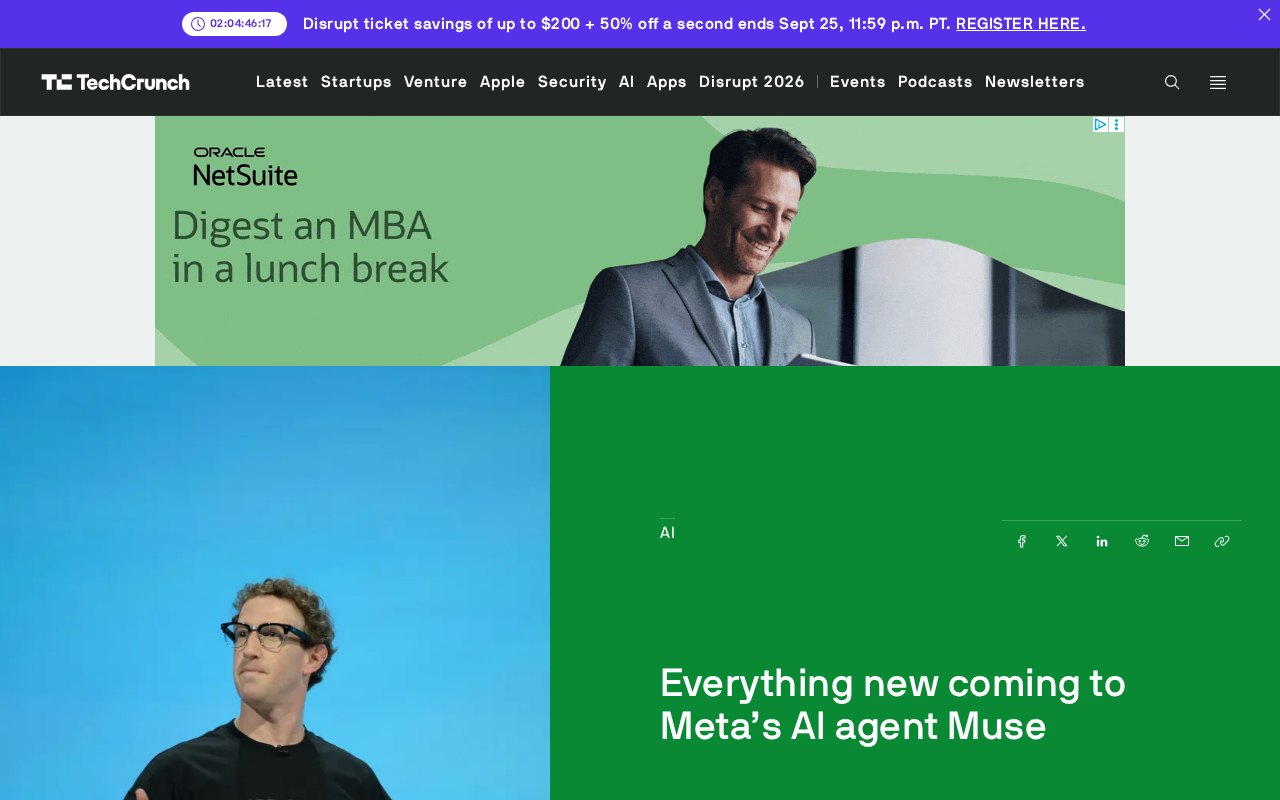
Zuckerberg opened his remarks by emphasizing Muse's central role in Meta's overall product ecosystem. As an AI agent, Muse is no longer limited to a single use case — it's positioned as an intelligent hub running throughout the Meta ecosystem. This "all-in" stance reflects Meta's ambition to capture users' everyday interaction entry points amid the generative AI wave.
Strategically, Meta's approach is consistent with its social platform distribution strengths. With the massive user bases of Facebook, Instagram, and WhatsApp, any AI feature embedded within these platforms can rapidly reach billions of users. Muse is the latest vehicle for that distribution advantage.
Muse Comes to AI Smart Glasses
The most notable development at this year's conference is Muse's integration into Meta's AI smart glasses — a move that continues Meta's long-term investment in wearable devices. Smart glasses, as a "screenless" or "light-screen" interaction format, are a natural fit for voice-driven AI assistants: users can query information, generate content, or recognize scenes without ever taking out their phone.
Bringing an AI agent down to the glasses level signals that Meta wants to liberate AI from the phone screen and weave it into users' actual field of vision and daily actions. This aligns closely with the industry's broadly bullish outlook on "AI-native hardware" and represents Meta's differentiation path from purely software-based AI vendors.
Meta's smart glasses product line is currently represented by the Ray-Ban Meta series, developed in collaboration with Ray-Ban. These glasses feature a camera, microphone, and speakers, supporting photo capture, video recording, and voice interaction — but without AR pass-through display, making them a lightweight, "audio-first" wearable. Meta had previously integrated a basic version of the Meta AI assistant into these glasses, allowing users to ask questions and request translations via voice. Muse's integration means the glasses' AI capabilities will evolve from simple Q&A into a more proactive, task-executing agent — shifting from "answering questions" to "getting things done for you." This hardware platform reportedly surpassed one million units sold in 2024, giving Meta a sizeable deployment surface for its AI capabilities.
Intent to Expand Across All Platforms
Muse's multi-device strategy — spanning from apps to smart glasses — suggests Meta wants to build a unified AI experience layer. Regardless of which Meta product a user is in, they can invoke the same agent, creating consistent usage habits and cumulative data collection. This "one agent, multiple entry points" model could help Meta build a moat against competitors like OpenAI and Google.
However, based on information disclosed so far, specific details about Muse's features, capability boundaries, and launch timeline remain to be revealed. The conference conveyed more of a strategic direction than a complete product roadmap.
The core distinction between an "AI Agent" and a conventional AI assistant lies in autonomy and the ability to execute multi-step task chains. Traditional AI assistants (like early Siri or Alexa) focused on single-turn Q&A, while AI agents can break a complex goal into multiple sub-steps, invoke external tools (such as search, calendar, or camera recognition), and continue progressing through multi-turn interactions until a task is complete. By positioning Muse as an agent rather than an assistant, Meta's design intent includes cross-app orchestration, contextual memory, and proactive triggering. In a multi-device context, this agent architecture becomes even more critical — the same "Muse" needs to behave consistently across phones, glasses, earphones, and other hardware, placing high demands on the underlying model's generalization capabilities and cloud sync architecture.
Observations and Takeaways
Meta's push to bring an AI agent to smart glasses is a deep attempt to bind software capabilities with hardware form factors. If executed well, Muse on glasses could deliver a distinctive experience that sets it apart from phone-based AI assistants. But the challenges are equally apparent: battery life, on-device compute, and privacy concerns around smart glasses could all impact how effectively AI features land in practice.
For those following AI's development, Meta's latest move once again confirms a key trend — major players are racing to embed AI capabilities into hardware that's closer to users' daily lives, not just phone apps. The competition over "AI entry points" is expanding beyond screens and into our field of view.
Related articles

WorkBuddy Full Tutorial: Build an AI Office Automation Agent from Scratch
A complete WorkBuddy tutorial: installation, three working modes, multimodal picture book video practice, expert team agent building, and workflow configuration for low-cost AI office automation.

WorkBuddy Agent Complete Guide: From Beginner to Automation in 7 Days
Based on Bilibili's 256-episode WorkBuddy masterclass, this systematically breaks down Tencent's AI office workbench core capabilities: Agent principles, Skill encapsulation, cross-platform connectors, scheduled automation, knowledge bases, and zero-code development, with learning path recommendations.

8 AI Accounts, 7 Failed: An Honest Review of Using AI to Get Work Done
Only 1 of 8 AI-run Bilibili accounts succeeded. We break down the real difference between "performing AI" and "using AI to get work done."