Meta Denies Muse AI Read Users' Private Messages Without Permission, Responds to Privacy Controversy

A journalist accused Meta's Muse AI of reading private messages with permissions off; Meta flatly denied it.
A journalist publicly claimed that Meta's AI assistant Muse read their private Messages on Mac even with system authorization disabled, sparking a privacy dispute. Meta officially denied this, insisting Muse only accesses data after explicit user permission. With both sides at odds and no independent technical evidence to settle the matter, the incident exposes a deeper structural tension in the AI agent era: AI assistants must access sensitive personal data to be useful, but their dynamic, autonomous data access patterns don't map cleanly onto traditional on/off permission controls — leaving ordinary users with almost no way to verify what actually happened.
How It Started: A Journalist's Privacy Concern
Meta has recently found itself at the center of a privacy controversy surrounding its AI assistant, Muse. A journalist publicly claimed that Muse AI had read the contents of their private Messages on their Mac even while the system settings that should have controlled that access were turned off. The accusation directly challenges the transparency and boundaries of AI agent permission management, quickly drawing scrutiny over how Meta handles user data.
For users who rely on AI assistants to manage their daily tasks, accusations like this hit a raw nerve — just how much of our personal data is an AI actually touching, and has that access ever been clearly authorized?
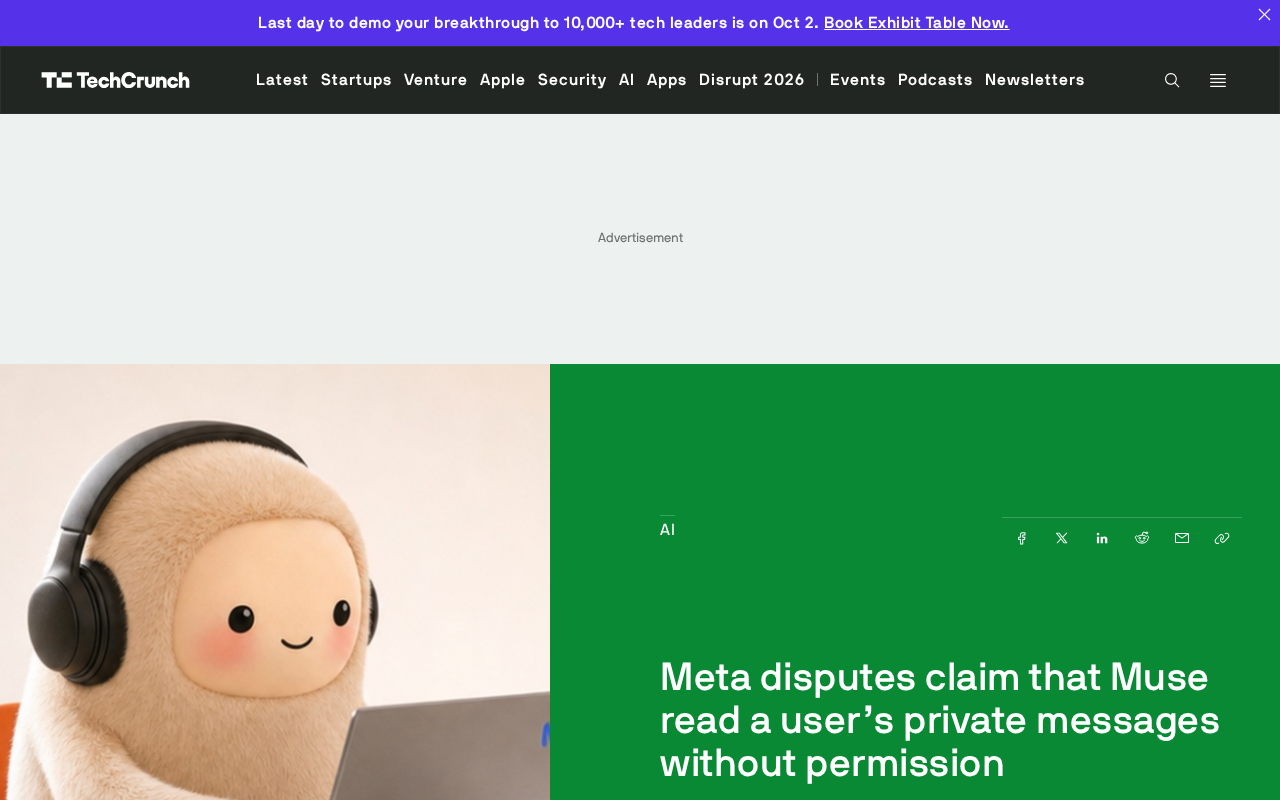
Meta's Official Response
Meta has denied the claims. The company stated plainly that the Muse AI agent cannot access a user's messages without explicit permission from that user. In other words, Meta maintains that its permission mechanism works as intended, and Muse can only read relevant information after the user has actively granted access.
This response amounts to a direct rebuttal of the journalist's account: one side says their data was accessed with authorization switched off, while the other insists there is no technical pathway to bypass authorization. With both sides standing firm, the dispute comes down to a factual disagreement.
The Core Issue Behind the Controversy
This dispute reflects a tension that is becoming increasingly prominent in the age of AI agents. For an AI assistant to deliver real value, it often needs access to private data such as email, messages, and calendars. But if the boundaries around that access become blurry or porous, it can quickly escalate into a serious privacy incident.
The Credibility of Permission Mechanisms
Regardless of where the truth lies, this incident highlights several key points worth considering:
- Accuracy of permission status: When a system setting shows that a particular authorization is turned off, users reasonably expect the AI cannot access the corresponding data. If actual behavior is inconsistent with what the settings display, trust is seriously undermined.
- The difficulty of technical verification: Ordinary users have no easy way to independently verify what data an AI has actually accessed. This information asymmetry makes it easy for conflicts to arise between a vendor's self-reported claims and users' subjective experiences.
- OS-level permission controls: On platforms like Mac, app access to sensitive data such as Messages is governed by system-level permission management. One central question in this dispute is whether that control mechanism was properly respected.
The Gap Between Vendor Claims and User Experience
Meta's response is a textbook vendor position — arguing from a technical design standpoint that this "couldn't have happened." But the user's firsthand account deserves equal consideration. Gaps like this often stem from the complexity of software behavior, edge cases, or differing definitions of what "access" actually means. Without independent third-party auditing, it is nearly impossible to settle the facts based solely on statements from either party.
AI agents and traditional applications operate under fundamentally different permission models. A traditional app requests permissions at install time, and users can clearly see its access scope in system settings. AI agents, by contrast, typically use tool calls to dynamically decide when and what data to access — they may receive a seemingly unrelated instruction from the user, then autonomously determine that reading message history is necessary to complete the task. This on-demand, dynamic approach to data access means the traditional "on/off" permission toggle often fails to accurately describe what an AI agent is actually doing.
A user might assume that toggling off a permission completely blocks access. But an AI agent could potentially retrieve relevant information through indirect pathways — such as the OS-shared clipboard, notification content, or cross-app APIs — without technically triggering that permission switch. This is precisely why both sides in the Muse dispute could each be describing something "correct": Meta's permission mechanism may well exist as described, but the actual data flow paths may extend beyond what that mechanism covers.
Third-party independent auditing is the key mechanism for bridging the gap between vendor claims and user trust. In heavily regulated industries like finance and healthcare, independent audits are already a compliance standard — but the AI product space currently lacks mature privacy audit norms or mandatory requirements. Available alternatives include using network monitoring tools like Little Snitch or Charles Proxy to track an app's actual network requests; using macOS's Activity Monitor or the fs_usage command-line tool to observe file system access; and reviewing vendors' publicly available privacy policies and data flow documentation. These methods carry a high barrier to entry for everyday users, which is why calls for an industry-level standardized AI privacy audit framework are growing louder. The EU's AI Act and Digital Markets Act have begun incorporating explainability and data access transparency into compliance requirements, which may eventually compel vendors to provide more verifiable privacy guarantees.
What This Means for Users
For users currently using or considering an AI assistant, this controversy offers some practical guidance:
- Regularly review the permission settings for all apps on your device, especially sensitive permissions involving messages, contacts, and files.
- Approach AI agents' claims of "access only after authorization" with informed skepticism, and when necessary, use system-level tools to monitor app behavior.
- Pay attention to whether vendors provide transparent data access logs — this is an important indicator of whether their privacy practices are trustworthy.
Conclusion
The disagreement between Meta and the journalist remains unresolved for now, with no independent technical evidence to determine who is right. But the incident itself has become a microcosm of the AI agent privacy debate: as AI becomes ever more deeply embedded in our personal digital lives, the accuracy and transparency of permission authorization will become a critical benchmark for measuring product trustworthiness. For tech giants like Meta, demonstrating their privacy commitments in verifiable ways will carry far more weight than simple verbal denials.
Background
macOS manages app access to sensitive data through the Privacy & Security panel and its sandboxing mechanism. Data like Messages is protected by Full Disk Access permissions or dedicated per-category permissions. However, this system has known gray areas: if an AI assistant runs as a system extension, with Accessibility permissions, or via AppleScript, its data access pathway may differ from the standard permission request flow used by ordinary apps. Additionally, what the macOS permissions panel displays is whether an app "has been authorized to request access" — not whether it "is currently accessing" data. The difference between these two things is easy to misread. Apple has gradually introduced more granular permission prompts in recent OS versions, but AI components that run outside the sandbox or exist as privileged processes remain in a regulatory blind spot.
Related articles

When Did Paid Childcare Become the Norm? Working Mothers and the Evolution of Childcare
When did paid childcare become the norm? This article traces the evolution from the rise of childcare centers in the 1970s–80s and the 1990s linking of federal subsidies to work requirements, to declining stigma and rising costs, and explores advocates' 25-year effort to catch up with other countries on childcare and paid parental leave.

Red Flags for Product-Market Fit: A Practical Guide from Top VCs and the Superhuman Founder
Investors from Iconiq and Sapphire Ventures and Superhuman founder Rahul Vohra share PMF red flags and practical methods, including the 40% disappointment rule, retention curves, and acquisition costs.

What Task Should AI Agents Take Over Most? Heated Reddit Discussion
Reddit discussion: Which task do you most want AI agents to take over completely? Cross-app data migration, CRM updates, and report generation top the list, but insufficient reliability and the trust gap are the biggest obstacles to automation adoption.