Meta FAIR Releases e-means: FAISS 1.16.0 Gets a New Clustering Option
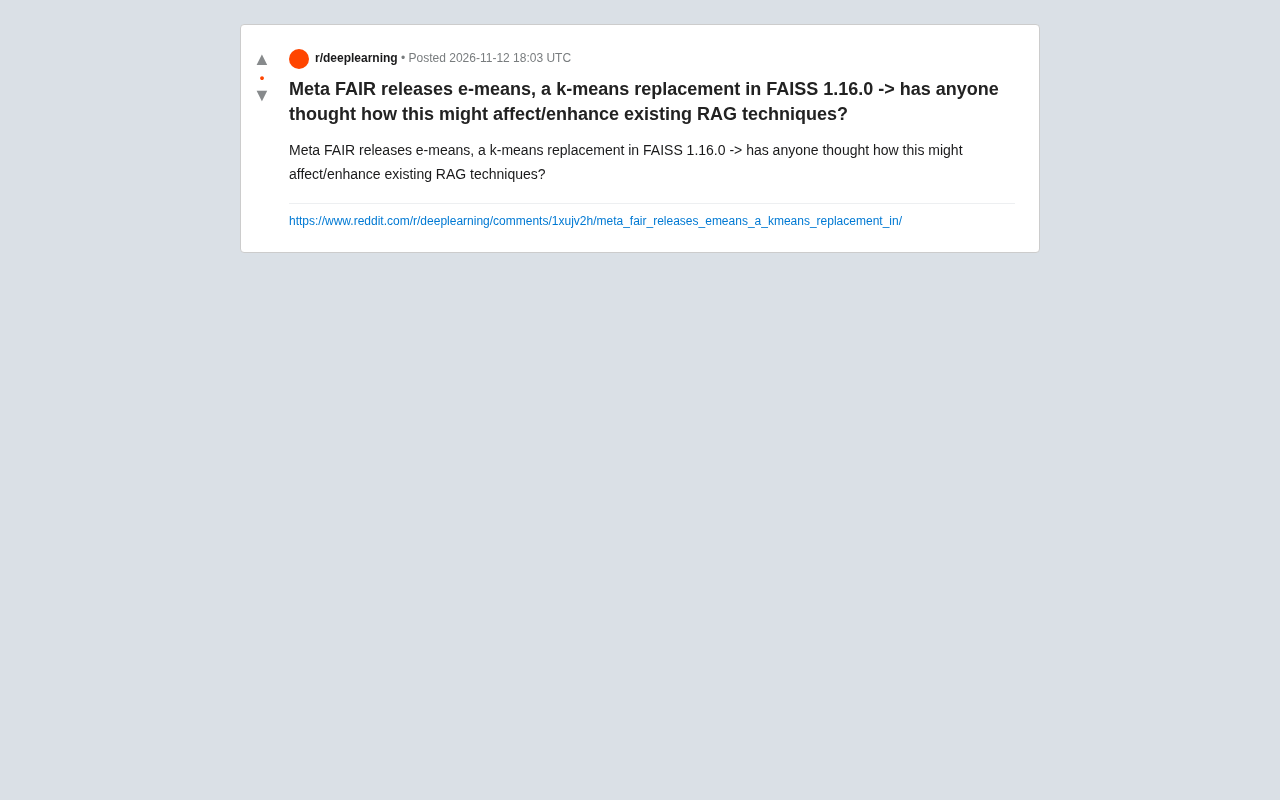
Meta FAIR introduces e-means as a k-means alternative in FAISS 1.16.0, but its real impact on RAG remains to be verified.
Meta FAIR introduces a new clustering algorithm called e-means in FAISS 1.16.0, positioned as a potential alternative to k-means, sparking Reddit discussion about its impact on RAG technology. The article notes that FAISS index construction and vector quantization rely heavily on k-means, and clustering quality affects RAG recall through inverted indexes, quantization codebooks, and related stages, making this update worth the attention of RAG developers. However, the original discussion thread is limited in information and is merely an open-ended question, lacking benchmark comparisons with k-means, descriptions of applicable scenarios, and official interpretation; specific benefits can currently only be speculated. The author recommends that teams using FAISS stay informed and track release notes and API documentation rather than migrating immediately.
Meta FAIR has introduced a new clustering algorithm called e-means in FAISS 1.16.0, which is being viewed as a potential alternative to k-means. The update has sparked discussion in the Reddit community: what impact will it have on existing RAG (Retrieval-Augmented Generation) technology?
What Is e-means?
According to public information, e-means is a new clustering method contributed by Meta FAIR to the FAISS vector retrieval library. FAISS has long been known for efficient similarity search, and its index construction and quantization processes rely heavily on k-means clustering. The arrival of e-means means developers now have a new clustering tool to choose from within a mature vector retrieval infrastructure.
The original discussion thread does not elaborate on the specific mathematical principles or performance data of e-means, but the phrase "k-means replacement" in the title already makes its positioning clear: providing equivalent alternative capability to k-means in FAISS's clustering stage.
The coupling between k-means and FAISS: k-means is an unsupervised clustering algorithm that aims to partition N vectors into K clusters while minimizing the within-cluster squared error; the classic implementation uses Lloyd's iteration (alternating assignment and update steps). Many index types in FAISS depend on it: IVF-family indexes use k-means to generate cluster centroids as the "buckets" of inverted lists, PQ (Product Quantization) uses k-means to learn codebooks for each subspace, and quantization methods such as SQ also often rely on clustering for initialization. Therefore, the computational complexity of the clustering algorithm, its sensitivity to initialization, and its convergence quality directly carry over to index recall and build time. Understanding this coupling is essential to judging why an alternative algorithm like e-means is seen as a change that could affect the entire retrieval pipeline.
Why Should RAG Developers Pay Attention?
The core pipeline of a RAG system includes document chunking, vectorization, index construction, and retrieval. Clustering plays an implicit but critical role throughout: whether building inverted indexes, performing vector quantization, or reranking and deduplicating candidate results, clustering quality affects final recall performance.
If e-means can change computational characteristics while maintaining or improving clustering quality, then RAG pipelines that rely on FAISS for index construction may gain room for adjustment. The question raised on Reddit hits exactly this point—what people care about is "whether existing RAG technology will be enhanced as a result."
The role of vector quantization and inverted indexes in RAG: The retrieval stage of RAG typically deals with millions of vectors or more, and exact brute-force search is too costly, so approximate nearest neighbor (ANN) approaches are widely adopted. Inverted indexes (IVF) first perform coarse clustering to assign vectors to several clusters, and at query time scan only a few candidate clusters, thereby narrowing the search scope from the full set to a local region; vector quantization (such as PQ) compresses high-dimensional floating-point vectors into short codes and quickly estimates distances via table lookup, significantly reducing memory usage. Both paths share a common prerequisite: high-quality cluster partitioning—unreasonable cluster boundaries can cause missed recall in the candidate set, and poor codebook quality introduces quantization error. This is exactly the mechanism by which updates to clustering algorithms may affect end-to-end RAG performance.
The Limits of the Community Discussion
To be clear, the information in this Reddit post is quite limited. It is more of an open-ended question than an in-depth technical analysis. The original content provides no benchmark comparison between e-means and k-means, no description of applicable scenarios, and no official interpretation from Meta FAIR.
Therefore, regarding the specific benefits of e-means for RAG, we can currently only remain at the level of reasonable speculation: it may affect index construction efficiency, clustering stability, or improve retrieval quality under certain data distributions. All of this needs to be verified through subsequent testing and official documentation.
The credibility of Reddit discussions: In technical communities, posts about a new algorithm "replacing a classic method" often lead with the headline while evidence lags behind, making it easy for such claims to be amplified into definitive conclusions as they spread. When evaluating this kind of information, several signals are worth watching: whether benchmark datasets and comparison metrics are included (such as clustering quality, build time, and memory usage), whether reproducible experimental configurations are provided, and whether there is an official release note or paper from the project. In the absence of these elements, the reasonable approach is to treat it as a lead rather than a conclusion, and avoid making architecture-level migration decisions based on it.
Implications for RAG Practitioners
For teams currently using FAISS, the addition of e-means means one more question to ask during technology selection: is there still room for optimization in the current clustering stage? If e-means is confirmed in official documentation to have advantages in certain scenarios, then adjusting the index construction strategy could become a low-cost path to improving RAG performance.
In the absence of empirical data, it is advisable to stay informed rather than migrate immediately. The FAISS 1.16.0 release notes and the e-means API documentation are the next information sources worth tracking.
Related articles

Daybreak Red Deployment Guide: A Reference Architecture for Supervised Security Investigation
A breakdown of the Daybreak Red reference architecture: security control design, deployment configuration process, and runtime monitoring for supervised security investigation.

Gemini 4 Neon Tops the Models Engineering Index
Gemini 4 Neon tops the Models Engineering Index, sparking Hacker News debate over ranking credibility and evaluation methods. Here's what it means for developers.

Apple's Self-Developed AI Agent: An Agent That Can Operate Your Mac Is Coming
Apple is reportedly developing an AI agent that can operate a Mac, targeting Meta Muse, Claude, OpenAI Dots, and others. This article analyzes Apple's system-level advantages, the competitive landscape, and likely rollout paths in the agent race.