Meta Launches AI Game Creation Tools: Build Games on Your Phone with Prompts

Meta launches AI game creation tools Horizon Create and Horizon Studio to power its metaverse content ecosystem via UGC.
Meta has released two AI-powered game development tools for everyday users: Horizon Create for lightweight mobile creation, and Horizon Studio for more advanced browser-based control. Both tools let users generate game content from natural language prompts, compressing the development barrier down to a single sentence. The underlying business rationale is to solve Horizon's content shortage by empowering ordinary creators at minimal cost — mirroring Roblox's UGC-driven moat. Key challenges remain, however: AI content quality ceilings, the platform's cold-start problem, and the risk of homogenized, low-quality content flooding the ecosystem.
Meta Brings Game Development to Your Phone
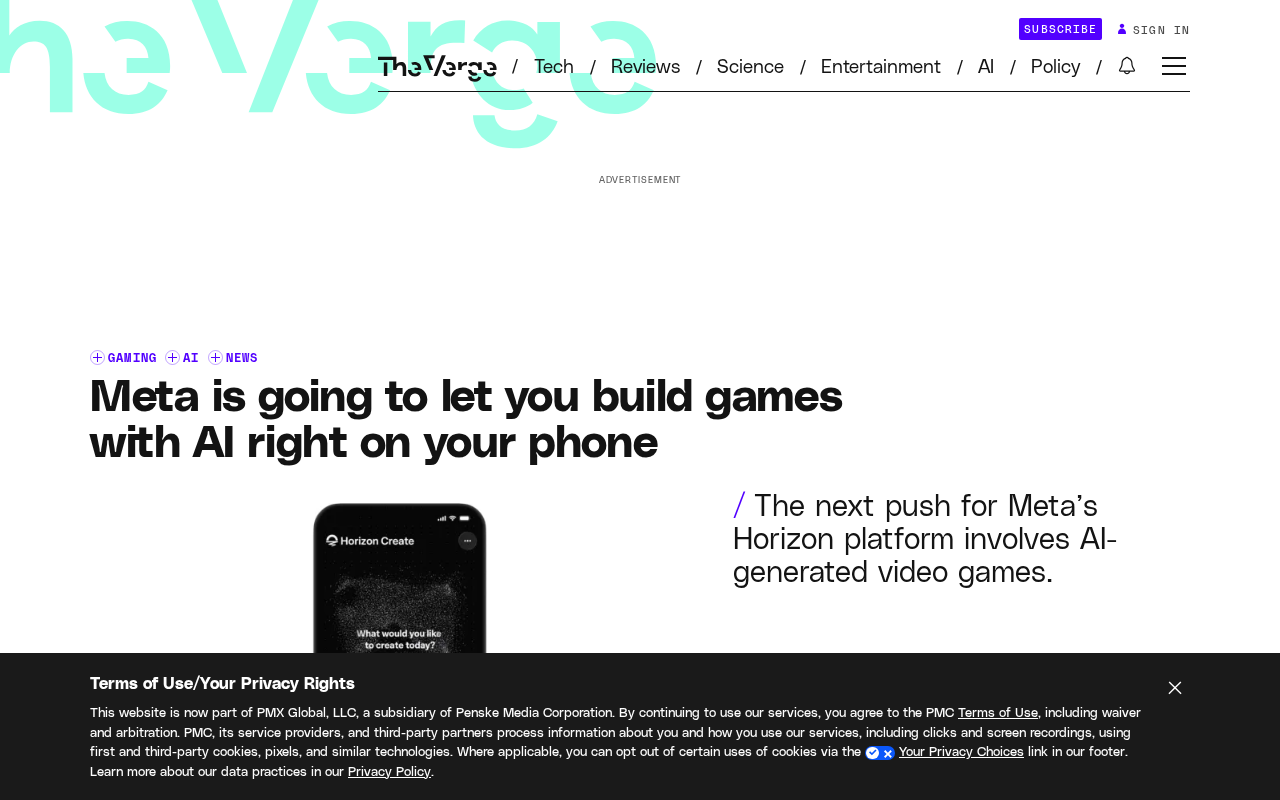
Meta has unveiled a new content ecosystem initiative for its Horizon social platform: AI-powered development tools that let everyday users create their own games. The two tools announced are Horizon Create, a mobile app, and Horizon Studio, a browser-based app — both built around the same core concept: generating game content through natural language AI prompts.
This move continues Meta's dual-track strategy of doubling down on generative AI and the metaverse content ecosystem. The Horizon platform has long struggled with a shortage of quality content, and lowering the barrier to creation while expanding the creator base is the key pain point Meta hopes to address with these AI tools.
Two Tools, Two Distinct Roles
From a product design standpoint, Meta has intentionally positioned the two tools for different use cases and audiences.
Horizon Create: Mobile-First, Lightweight Creation
Horizon Create is a mobile app focused on a lightweight, create-anywhere experience. Users don't need a professional development environment — just type in an AI prompt and quickly generate a game prototype on their phone. This design targets everyday users who have no programming background but want to express creative ideas, making "think it, build it" a reality.
Horizon Studio: Granular Control in the Browser
Horizon Studio, by contrast, runs in the browser and offers more granular control. It's aimed at advanced creators who want to fine-tune game logic, mechanics, and details. The browser-based format also means more workspace and the ability to handle more complex functionality, compensating for the inherent limitations of mobile in terms of precision.
The two tools are complementary: the mobile app sparks inspiration and enables quick starts, while the browser app is for polishing and perfecting.
An Industry Signal for AI-Generated Games
Meta's move isn't an isolated event — it's another textbook example of generative AI penetrating content creation. Traditionally, building a game required a coordinated team of artists, programmers, and designers, making the barrier extremely high. The AI prompt-based generation model theoretically compresses this process down to the scale of a single sentence.
For Meta, there's a clear business logic at play. Horizon, as the core social platform at the heart of its metaverse bet, lives or dies by content supply — it determines platform activity and user retention. Empowering a massive pool of ordinary users with AI tools is essentially a way to rapidly fill the platform's content library at minimal cost. This mirrors the approach Roblox used to build its competitive moat through UGC (user-generated content).
Roblox's UGC model is an important reference point for understanding Meta's strategy here. Roblox allows ordinary users to create games using its proprietary Roblox Studio engine, which are then consumed by players on the platform, with creators earning a share of virtual currency. This flywheel effect has helped Roblox accumulate over 50 million user-made games, with daily active users consistently above 80 million. The key to its success wasn't just lowering the barrier to creation tools — it was building a complete economic incentive system where creators could actually profit, motivating them to keep producing content. If Meta wants to replicate this model, designing a creator revenue-sharing and incentive structure for the Horizon platform will be just as important as making the tools easy to use.
Questions Worth Asking
As appealing as the concept is, there are still plenty of unknowns around whether AI game-generation tools can truly deliver high-quality content at scale.
The quality ceiling: Games generated from AI prompts tend to perform reasonably well at the prototype stage, but reaching a finished product with strong playability and a complete experience still heavily depends on the creator's ability to iterate and refine. This explains why Meta also introduced Horizon Studio with its more granular controls.
The cold-start problem: Ease of use is only the first step. The real test for Horizon is whether it can attract enough creators to produce content consistently — and whether players will actually want to consume it.
The homogenization risk: When the barrier to creation is dramatically lowered, the platform may be flooded with a large volume of similar, low-quality content. How Meta curates and surfaces content from an ocean of UGC will be a significant operational challenge it must solve.
On the technical side, AI-generated game content currently relies primarily on large language models (LLMs) combined with game engine scripting capabilities, alongside image and 3D asset generation models working in tandem. Natural language prompts entered by users are parsed into structured parameters — game logic rules, scene layouts, interaction behaviors — which the underlying engine then renders. The core limitation of these systems is "intent alignment": the gap between what the AI interprets from a prompt and what the user actually intended is often significant, and the unpredictability of generated output remains high. The more complex the game mechanics, the greater the demands on prompt engineering — which shifts the technical barrier from "programming ability" to "precise description ability," rather than eliminating the barrier entirely.
Closing Thoughts
Meta's Horizon Create and Horizon Studio represent yet another real-world implementation of the "AI + game creation" trend on a mainstream platform. They take game development out from behind the walls of professional studios and place it in the hands of ordinary users, on their phones and in their browsers. It's an exciting vision — but the road from tool launch to a thriving content ecosystem is still a long one for Meta. The ultimate value of these tools will be determined by how many genuinely fun experiences they actually help bring to life.
Related articles

Claude Pro Doesn't Include API Access? Max and Team Plans Now Add API Credits Explained
Claude Pro has no API access; API is billed separately. But Max and Team plans now include monthly API credits: Max 5x $100, Max 20x $200, Team up to $500 per seat. This article details each tier's credits, how to claim them, and the impact on developers.

Testing the 350K-Star REA in an Isolated Environment: 4-Second Install, but Watch Out for Two Pitfalls
Isolated lab test of the 350K-star open-source reverse-engineering tool REA: 4-second install, 15 seconds to list a screenshot tool's outbound addresses, 565 communication channels mapped, while exposing two pitfalls—user-level settings writes and 31 high-risk tool permissions—plus three safety rules.
Reverse Engineering + AI Agents: The T…
Reverse Engineering + AI Agents: The Technical Truth Behind Cloning Adobe Apps in Weeks
A developer used AI Coding Agents for reverse engineering to build 7 open-source Adobe alternatives in weeks. We explore how it works, the MCP Server that hit 100K stars in 6 days, and the real technical and legal limits.