Meta Launches Camera-Free AI Glasses: Lighter Design with Up to 12-Hour Battery Life

Meta launches lightweight, camera-free AI glasses with 12-hour battery life and voice AI features.
Meta has released a camera-free AI smart glasses model offering up to 12 hours of battery life and a weight closer to ordinary eyewear. Dropping the camera reduces power consumption and weight while sidestepping the persistent privacy concerns that have dogged smart glasses — issues that previously triggered public backlash and regulatory scrutiny. The glasses retain AI capabilities through voice interaction, audio playback, and smartphone connectivity, representing a voice-first alternative to camera-dependent designs. The move expands Meta's lineup into two parallel tracks, giving privacy-conscious and comfort-focused users a more accessible entry point into AI wearables.
Meta's New Direction for AI Glasses
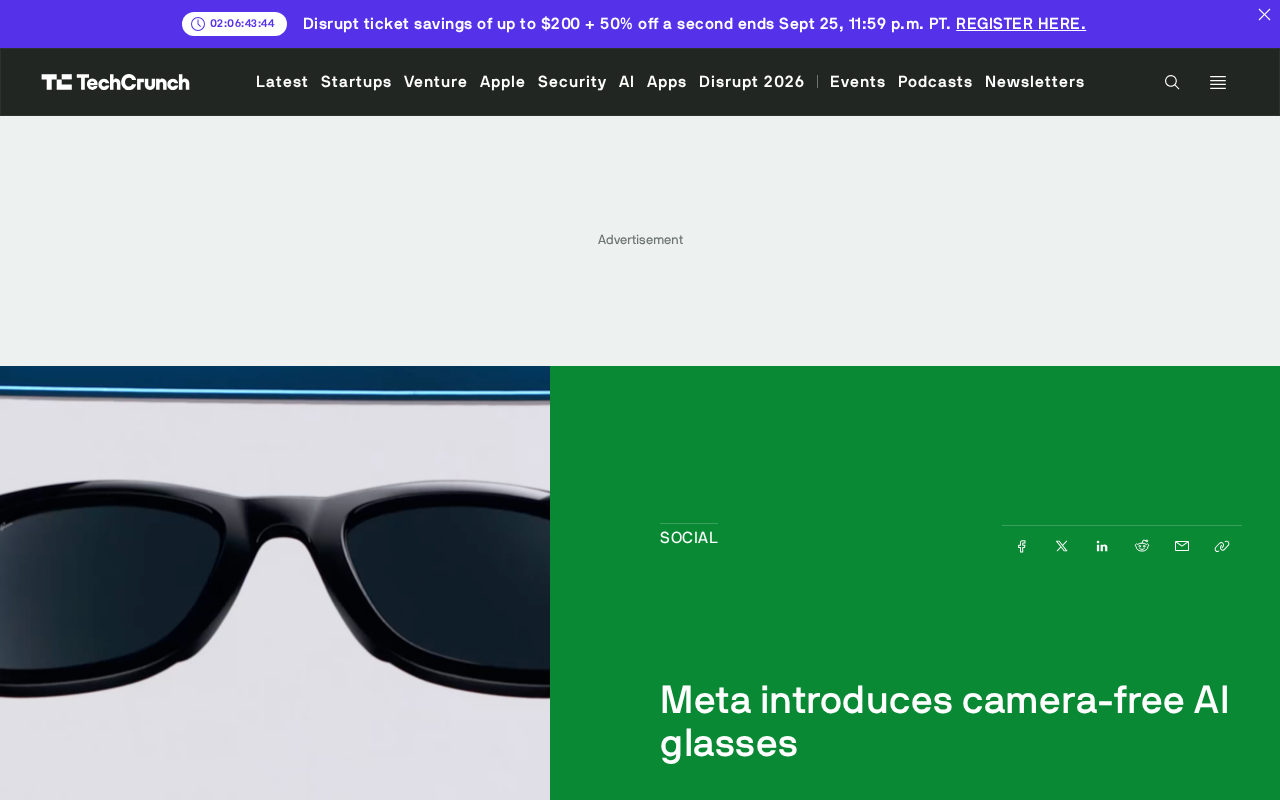
Meta has unveiled a new AI-powered smart glasses model that ditches the camera, prioritizing a lighter form factor and extended battery life. According to Meta, the glasses are noticeably lighter than their camera-equipped predecessors and can last up to 12 hours on a single charge.
This product positioning reflects a strategic shift in Meta's approach to the smart glasses market. Its previous Ray-Ban collaborations all featured built-in cameras capable of taking photos, recording video, and performing real-time AI recognition. This new camera-free variant is clearly aimed at users who are more privacy-conscious or who simply prioritize all-day wearing comfort.
What Removing the Camera Actually Means
Lighter Weight, Longer Battery Life
The camera module is typically one of the more power-hungry, bulky, and heavy components in any smart glasses design. Removing it brings the overall weight down considerably, making the wearing experience much closer to that of ordinary glasses — a meaningful improvement for anyone who needs to wear them for extended periods.
The reduced power consumption also translates directly into better battery life. Meta's claim of up to 12 hours means these glasses can realistically get most users through an entire day without needing a recharge. By contrast, camera-equipped smart glasses tend to drain quickly due to the demands of shooting and video processing.
Sidestepping the Privacy Debate
Camera-equipped smart glasses have long faced privacy concerns — bystanders have no easy way to tell whether the wearer is recording them. Removing the camera is, in many ways, a direct response to those concerns. Without a recording capability, these glasses are far easier for the public to accept and generate far less social friction in everyday settings.
Those privacy concerns are well-founded and have a documented history. When Google Glass launched in 2013, wearers were dubbed "Glassholes" by some members of the public, and multiple restaurants and venues banned the device outright. In 2023, two Harvard students demonstrated how Meta Ray-Ban glasses, combined with facial recognition, could identify a stranger's name and home address in real time from footage captured on the street — a demonstration that sent shockwaves across social media. Regulators in the US, EU, and elsewhere have since launched reviews into data collection practices by such devices. These incidents make clear that the presence of a camera creates ongoing barriers on both legal compliance and public acceptance fronts — not merely technical or product-level challenges.
How AI Features Carry Over
Dropping the camera doesn't mean losing AI capability. Devices like these typically still deliver AI assistant features through voice interaction, audio playback, and a persistent connection to the user's smartphone. Users can ask questions by voice, receive information, control music playback, and more — using the glasses as an always-on, hands-free AI interface.
This represents a distinct technical approach to smart glasses: rather than chasing visual recognition and augmented reality, the focus shifts to a lightweight voice AI assistant paired with a quality audio experience. For the vast majority of everyday scenarios, this feature set is more than sufficient — while avoiding the cost, weight, and privacy baggage that comes with a camera.
Voice- and audio-driven AI assistant functionality is already technically mature. Leading large language models (LLMs) support low-latency voice conversations, and when paired with bone conduction or open-ear speaker technology, glasses can deliver spoken responses without blocking the ear canal — balancing environmental awareness with a degree of privacy. Bluetooth Low Energy (BLE) keeps the glasses connected to a smartphone, enabling smooth operation of features like web queries, message notifications, and navigation prompts. This "voice-first" approach follows in the footsteps of earlier products like Amazon Echo Frames and Bose Frames — but with AI conversational capabilities that have leapt forward dramatically since those devices launched.
Market Significance and What's Next
With this launch, Meta has broadened its smart glasses lineup into two parallel tracks — with and without cameras — to address different user needs. For consumers looking for a lower-barrier entry point into AI glasses, this lighter, longer-lasting option may well be the more approachable choice.
As AI assistant capabilities continue to advance, the vision of smart glasses as a personal AI terminal is becoming increasingly tangible. A camera is not the only interaction modality — voice and audio can support a rich AI experience in their own right. Meta's camera-free glasses represent a pragmatic bet on exactly that direction.
Note: This article is based on limited information from Meta's official announcement. Additional specifications are expected to be disclosed in due course.
Related articles

Perplexity Hybrid Compute Tested: Privacy Data Never Leaves the Mac
Perplexity Hybrid Compute tested: how PrivacyGate intercepts sensitive data, how local and cloud models divide work, model differences on 16GB vs 32GB Macs, and privacy protection in real scenarios like bank statements and medical records.

Big Fat Fish Roasts Mainstream LLMs at Home and Abroad: Doubao Takes the Crown, DeepSeek Tied for First
Bilibili creator Big Fat Fish roasts mainstream LLMs: Doubao tops for emotional value, DeepSeek ties first for open-source value, with ERNIE, Hailuo, Yuanbao, Kimi, Qwen, Kling, Claude, Gemini, and Grok each branded with a distinct persona.

How to Truly Test AI Agents Before Production? A Practical Testing and Monitoring Framework
BotGage founder Pramin Pradeep shares a three-step framework for testing AI Agents before production: Agent registration visibility, red teaming, and production observability — plus a real case cutting QA costs from $180K to $80K and an analysis of IT roles shifting to Agent supervisors.