Meta Launches Muse Image Model: AI Photo Collab Feature Sparks Portrait Rights Debate

Meta launches Muse Image, an AI photo tool that sparks portrait rights and deepfake debates.
Meta has unveiled Muse Image, the first AI image generation model from its Superintelligence Labs, now live across Meta AI, Instagram, and WhatsApp. Its standout feature lets users composite real Instagram users into AI-generated photos, raising serious concerns over portrait rights, privacy, and deepfake misuse — while showcasing Meta's strategy of embedding AI into its 3+ billion-user social ecosystem.
Meta Superintelligence Labs Unveils Its First Image Model
Meta has announced the launch of Muse Image, an AI image generation model and the first of its kind from the company's Superintelligence Labs. According to the official announcement, the model already powers image generation tools across Meta AI, Instagram, and WhatsApp, with Facebook and Messenger integration coming soon.
Background: The Story Behind Meta Superintelligence Labs Meta Superintelligence Labs is a cutting-edge AI research organization Meta assembled in 2025, co-led by former Scale AI CEO Alexandr Wang alongside Meta's internal research teams. Unlike Meta's existing FAIR (Fundamental AI Research) division, this lab is positioned as a more aggressive "moonshot" initiative aimed at breakthrough progress toward artificial general intelligence (AGI). It was established against the backdrop of Zuckerberg publicly declaring 2025 a "decisive year" for AI investment and committing up to $60 billion in AI infrastructure capital expenditure. As the lab's first consumer-facing product, Muse Image represents its first systematic test of real-world execution.
This launch marks another significant move in Meta's generative AI push. Muse Image is not a standalone feature — it embodies Meta's strategy of deeply integrating AI capabilities into its vast social ecosystem. With billions of monthly active users, Meta's platforms offer a distribution channel and use-case breadth that few other AI companies can match.
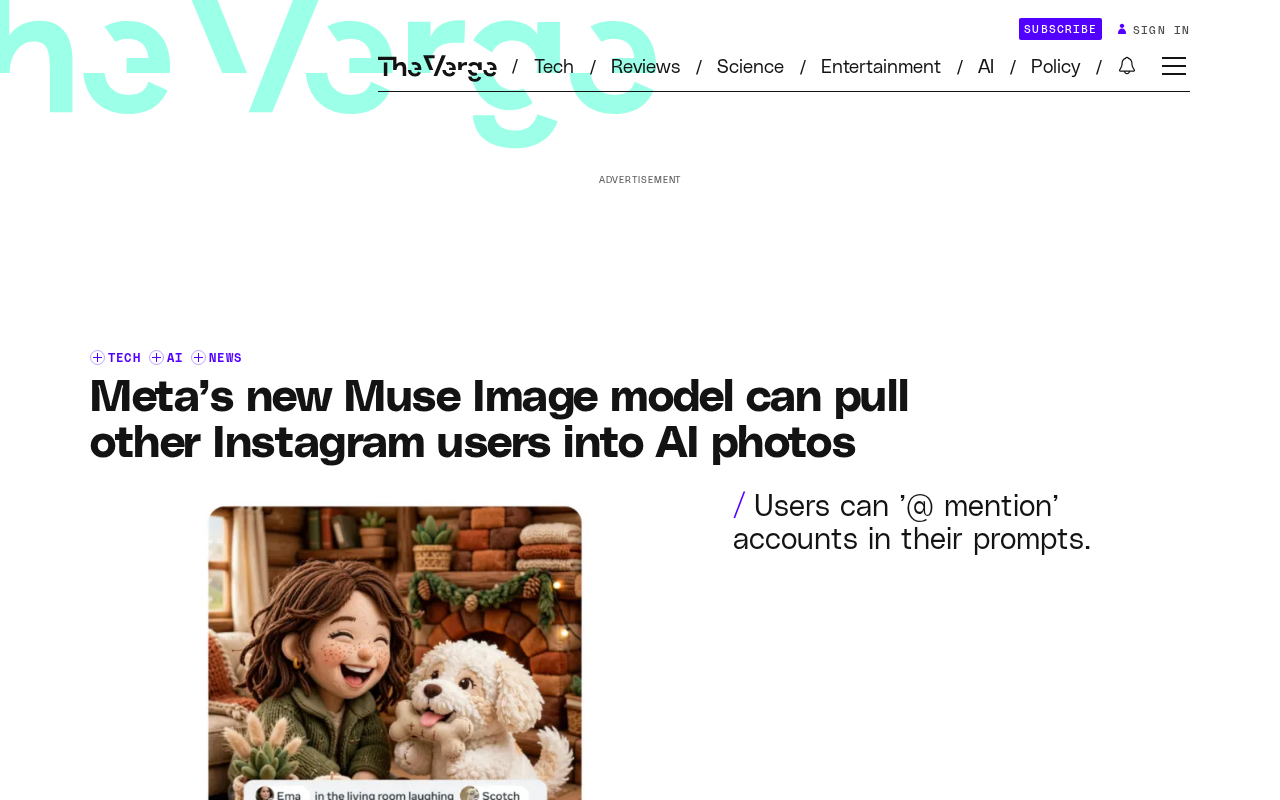
The Most Talked-About Feature: Pulling Real Users Into AI-Generated Photos
Muse Image's most conversation-worthy feature allows users to "pull" other Instagram users into AI-generated photos — incorporating the likenesses of real platform users into synthetic images, producing AI-composited scenes featuring multiple real people.
This capability is enabled by major advances in AI image generation. Current mainstream approaches fall into two broad categories: Diffusion Models (exemplified by Stable Diffusion and DALL-E 3), which generate high-quality images through iterative denoising of a noisy input, excelling at detail fidelity and style control; and autoregressive models, which treat image generation analogously to token prediction in language models.
The core idea behind diffusion models draws from non-equilibrium thermodynamics. During training, the model learns to progressively add Gaussian noise to a real image until it becomes fully randomized; at inference, it starts from pure noise and uses a neural network to iteratively predict and remove that noise, ultimately reconstructing a high-quality image. This symmetric "destroy-and-rebuild" learning framework gives diffusion models exceptional distribution-modeling power. Compared to the previously dominant generative adversarial networks (GANs), diffusion models train more stably and produce greater diversity — though at the cost of slower inference, which remains a core engineering challenge that vendors continue to optimize.
Meta has accumulated substantial research through its CM3leon and Emu multimodal projects, and Muse Image almost certainly builds on this foundation by incorporating Identity Consistency Preservation techniques. This approach injects facial feature vectors from a face encoder into the cross-attention layers of the image generation process, enabling consistent preservation of a person's identity across arbitrary scenes and styles. Industry solutions such as IP-Adapter, InstantID, and PhotoMaker have already validated this technical approach — and it forms the underlying capability that allows Muse Image to naturally composite multiple real Instagram users' likenesses into entirely new scenarios, setting it apart from conventional text-to-image tools.
This feature has natural social virality: appearing together with friends, celebrities, or even strangers in a scene that never actually happened — with minimal effort and immediately visible results. It transforms creative compositing that once required professional editing skills into an everyday operation accessible to any user.
The Flip Side: Portrait Rights, Privacy, and Abuse Risks
However, this feature inevitably raises widespread concerns about portrait rights, privacy protection, and potential misuse. When anyone can place another person's likeness into an AI-generated scene, several urgent questions arise:
- How can unauthorized use of a person's likeness be prevented?
- How can users be protected from being placed in inappropriate or misleading contexts?
- Does the platform offer an effective opt-out mechanism?
The legal landscape around portrait rights varies significantly by region. Laws in various U.S. states — particularly California and New York — strictly prohibit using someone's likeness for commercial purposes without authorization. The EU's General Data Protection Regulation (GDPR) classifies personal likenesses as personal data, requiring a clear legal basis for any processing. When a photo has never actually been taken yet contains a highly realistic rendering of a real person, existing legal frameworks face fundamental challenges.
The NO FAKES Act (Nurture Originals, Foster Art, and Keep Entertainment Safe Act), currently advancing through the U.S. Congress, seeks to establish federal-level authorization requirements for AI-generated likenesses: no one may create, host, or share realistic AI-generated depictions of a person without that person's explicit written consent, and consent cannot be granted by a third party on their behalf. Meanwhile, the EU's AI Act, which took effect in 2024, requires all AI-generated content to carry machine-readable watermarks; China issued its Interim Measures for the Management of Generative AI Services in 2023, mandating prominent labeling of AI-generated content. This multi-region, multi-layered regulatory landscape means Meta's Muse Image will need to build differentiated compliance mechanisms for different markets, rather than adopting a single global product strategy.
If misused, features like this could give rise to new forms of harassment, defamation, and deepfake content. Deepfakes refer to media in which a person's facial features are seamlessly replaced using deep learning techniques — particularly GANs or diffusion models. Since emerging in 2017, their production barrier has dropped dramatically as computing power has become more accessible and open-source tools have proliferated. The UK's Online Safety Act has already criminalized non-consensual intimate deepfakes. Meta has previously faced repeated regulatory pressure over AI face-swap advertisements circulating on its platform, and Muse Image's multi-person compositing feature effectively productizes a subset of deepfake capabilities. Designing effective content moderation and provenance-labeling mechanisms will be its central compliance challenge.
The Muse Product Line and Meta's AI Social Strategy
Muse Image is one component of the broader Muse AI product family Meta is building. Rolling out AI image generation capabilities horizontally across all major applications — from Instagram Reels to everyday WhatsApp conversations — reflects Meta's "AI everywhere" product philosophy.
Unlike OpenAI and Google, which primarily deliver AI capabilities through standalone products or APIs, Meta's core advantage lies in its unmatched user scale and social network effects. Network effects — the economic phenomenon where a product's value increases exponentially as more people use it — are the most fundamental competitive moat of any social platform. The multi-sided network effects within Meta's products are particularly pronounced: users stay because their social graphs are already built there, making the cost of switching extremely high.
Meta's AI distribution moat is striking in numerical terms: Facebook has over 3.1 billion monthly active users, WhatsApp over 2 billion, and Instagram over 2 billion — compared to roughly 400 million for ChatGPT and around 15 million for Midjourney. This scale differential means Muse Image can transform image generation into a native part of everyday social behavior: generating an AI composite in a WhatsApp chat, or embedding an AI-created image into an Instagram Story, with a frequency and emotional stickiness far exceeding what a dedicated standalone AI creative tool could achieve.
Behavioral economics calls this the Default Effect: when an AI generation feature becomes one of the default options in the photo-sharing flow, actual adoption rates far exceed those of apps that require users to deliberately switch to a separate application. This "frictionless integration" approach to AI — embedding image generation directly into apps people use every day to rapidly build scaled user behavior — is Meta's most distinctive competitive differentiator in the generative AI race, and a structural advantage that pure-play AI companies like OpenAI and Midjourney will struggle to replicate in the near term.
The Superintelligence Labs' First Report Card
Muse Image is the first consumer-facing image generation product delivered by Meta's Superintelligence Labs — an organization whose very creation represents Meta's substantial long-term bet on frontier AI capabilities. As its debut, Muse Image's market performance will serve as a meaningful test of Meta's combined strengths in generative AI foundational research and real-world engineering execution.
Looking Ahead: Social Media and AI Enter a New Era of Convergence
The launch of Muse Image is yet another data point in the deepening convergence of social media and generative AI. As AI image generation evolves from a professional tool into a native feature of social platforms, both content creation and social interaction could be profoundly reshaped.
For users, this means richer means of expression. For Meta, it represents a new engine for reinforcing platform stickiness and energizing content production. But the ability to incorporate real users' likenesses into AI-generated composites makes questions of content authenticity, platform accountability, and regulatory compliance more urgent than ever. As the EU AI Act, U.S. state-level AI legislation, and global platform content regulation continue to tighten, Meta will need to build compliance mechanisms into its product design from the start — not bolt them on after the fact. How features like this continue to evolve at the intersection of innovation and governance is well worth watching.
Related articles

Gaussian Process Bandit Optimization: Exploration Strategies and Inference Regret Guarantees
Cumulative regret guarantees in Bayesian optimization fail to reflect final recommendation quality. This article examines a new study that provides inference regret guarantees for Gaussian process bandit optimization through exploration query strategies and fill distance analysis, validated on hyperparameter optimization and control tasks.

The Most Detailed Codex Guide on Bilibili: From Installation to Real-World Practice
The most detailed Codex guide on Bilibili: from app store installation to daily work mode configuration, with a real coffee shop project demonstrating file organization, data extraction, dashboard creation, and other practical tasks. Learn to use Plan Mode and desktop pets to leverage Codex efficiently.

Appearance Compensation in Volume Rendering: Why RGB Accuracy Cannot Guarantee Density Correctness
Volume rendering research reveals that volumetric data perfectly reproducing external RGB views may still contain density errors: appearance compensation can double central density and keep external rays unchanged even when L2 error exceeds 14.52%. Density recovery depends on appearance capacity, spatial resolution, and measurement design.