Meta Launches Spaces: A New Way to Collaborate with the Muse Agent

Meta launches Spaces collaboration feature for Muse agent, but details remain limited
Meta has launched Spaces, a new feature for its Muse agent, positioned as a new way to collaborate with the AI assistant and a continuation of Muse's ongoing feature and integration expansion. The core of Spaces is "collaboration," aiming to provide the agent with a shared context environment that multiple parties can jointly enter and advance tasks within, rather than traditional single-turn Q&A. The article notes this reflects Meta's push to turn Muse into a platform, and aligns with the industry trend of collaborative agents. However, official details are limited — interaction form, participant limits, availability, launch timeline, and integration with other Meta products remain unclear, making it too early to judge the actual experience.
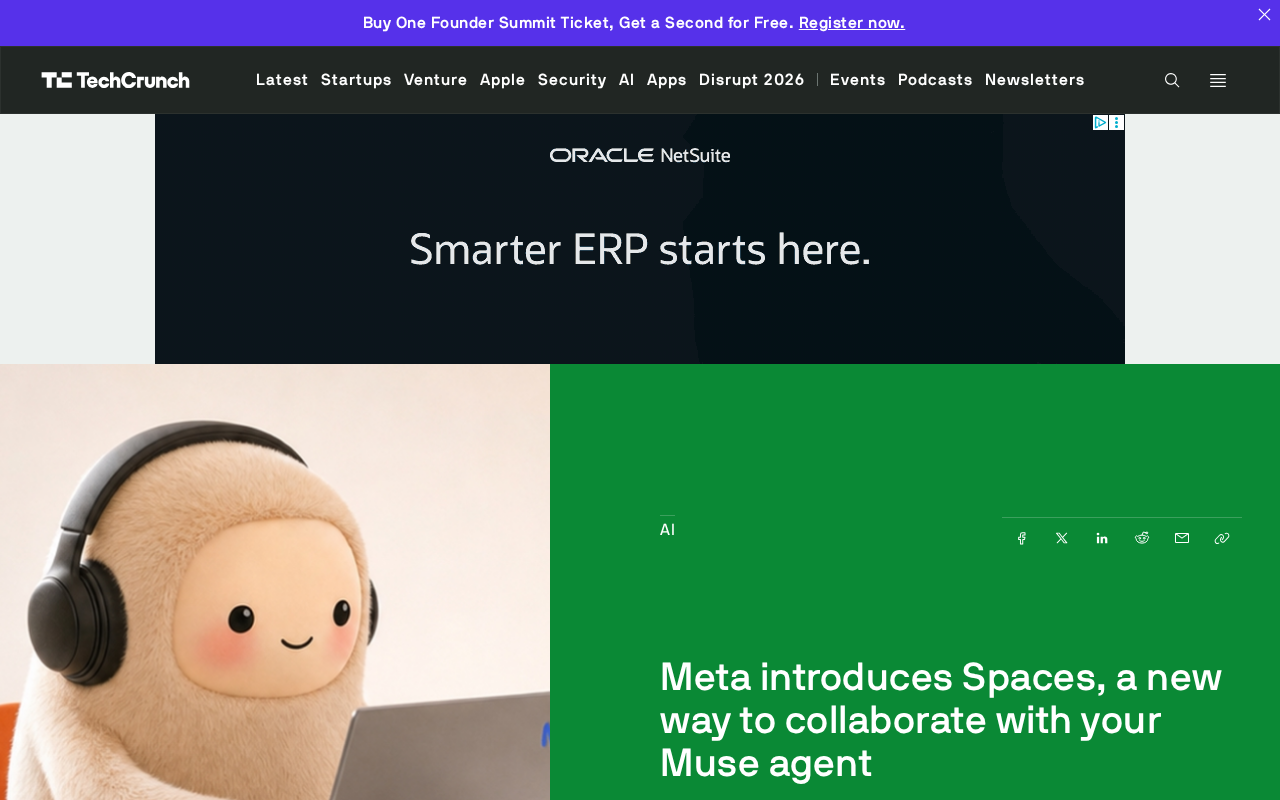
Meta's Muse agent has gained another new feature. The newly launched Spaces is positioned as a new way to interact and collaborate with the AI assistant, continuing the Muse series' pace of steadily expanding capabilities and integrations.
What Spaces Is: A New Collaboration Entry Point for the Muse Agent
According to official information, the core of Spaces lies in "collaboration." Rather than simply asking questions and receiving answers in a dialog box, Spaces provides the Muse agent with a collaborative environment that multiple participants can jointly enter and advance tasks within. Meta describes Muse as an AI helper, and Spaces is the interaction layer built around that helper.
This approach aligns with the current direction of agent products: AI is no longer just passively responding to single instructions, but is being embedded into ongoing workflows and multi-person scenarios. The name Spaces itself hints at the notion of a "shared space" — users and the agent, as well as users with each other, can collaborate within the same context.
However, the details Meta has disclosed so far are quite limited. The company has not specified which specific capabilities Spaces supports, whether there is a cap on participants, or how it connects with existing Muse features. These questions await further information.
Agent is the foundational concept for understanding the relationship between Muse and Spaces. Unlike traditional chatbots, an agent refers to an AI system capable of perceiving its environment, autonomously planning steps, and invoking tools to complete multi-step tasks. Its typical characteristics include goal orientation, tool-use capability, and a degree of autonomous decision-making. Meta calling Muse an AI helper is essentially emphasizing its agent nature — it is not merely an interface for answering questions, but an execution entity that can take on tasks and chain together actions. Spaces, as the interaction layer built around the agent, is essentially providing a context container and collaboration boundary for such autonomous systems, extending the agent's task execution from single-turn dialogue to ongoing workflows. Understanding this is key to grasping why a "collaborative environment" carries significance beyond the interface for agent products.
The Product Logic Behind Continuous Feature Stacking
The Muse agent has recently been gaining new features and integrations at a steady clip, and Spaces is the latest link in this series of iterations. Judging from the product cadence, Meta is expanding Muse from a single-point capability into an assistant system with multiple interaction forms.
This path of "feature stacking + integration expansion" is not unfamiliar. For platform companies, an agent's competitiveness depends not only on the model itself but also on how many scenarios it can be embedded in, how many tools it can connect to, and how many collaborative relationships it can support. The launch of Spaces can be seen as Meta staking a claim in the collaboration scenario — pushing the AI assistant from a personal tool into a team context.
As a side note, there is currently no public information on how deeply Spaces is integrated with Meta's other product lines, nor any clear statement on availability scope or launch timeline. For users interested in this feature, these are more practical questions than the "new feature announcement" itself.
The Industry Direction of Collaborative Agents
Putting AI assistants into multi-person collaborative spaces is a shared trend among recent agent products. While one-on-one conversational interaction is intuitive, in real work, tasks often involve multiple parties, shared context, and continuous back-and-forth revisions. Forms like Spaces attempt to address precisely this gap.
From Meta's wording, Spaces emphasizes "collaborating with your Muse agent," where the subject remains the user and their own assistant, rather than a fully open multi-user plaza. This suggests it is more likely a workspace centered on a personal agent that allows collaborators to step in, rather than a community-style product. Of course, this judgment is based on existing phrasing, and the company has not provided an architectural explanation.
At the industry level, the effectiveness of collaborative agents depends on several key points: whether context can be correctly shared among participants, whether the agent can maintain task consistency across multi-turn collaboration, and how permissions and data boundaries are defined. Meta has not disclosed technical details on these aspects.
Context Sharing is the technical key to whether collaborative agents can work. In large model applications, context refers to all the information visible to the model when generating a response, including conversation history, document content, tool return results, and more. In single-user scenarios, context management is relatively simple; but in multi-person collaborative spaces, the information brought by different participants, their respective permission scopes, and the intermediate states generated during task progression all need to be properly aggregated and isolated. If sharing is insufficient, the agent cannot understand collaborators' intent; if sharing is excessive, it may cause unauthorized information leakage. Therefore, the product design of collaborative agents often must strike a balance between "letting the agent see enough information" and "only letting it see what it should see" — which is precisely why permission and data boundary issues have become especially prominent in the agent era.
What Remains to Be Seen
The release information for Spaces is rather brief, reading more like a feature teaser than a complete product description. The confirmed facts include: the Muse agent has added a Spaces feature, positioned as a new way to collaborate with the AI assistant, as a continuation of Muse's ongoing feature and integration expansion.
The unconfirmed parts are more numerous: the specific interaction form, availability scope, how it works with existing integrations, and whether the rollout strategy targets general users or specific groups. Until Meta provides more detailed product documentation, it is too early to judge the actual experience of Spaces.
What is certain is that Meta is operating the Muse agent as a continuously evolving platform, and Spaces is a new node on this path. Whether it can become an effective entry point in collaboration scenarios depends on subsequent feature details and real-world usage feedback.
One-line Summary
Meta launches Spaces collaboration feature for the Muse agent, but details remain limited
Paragraph Summary
Meta has launched Spaces, a new feature for its Muse agent, positioned as a new way to collaborate with the AI assistant and a continuation of the Muse series' ongoing feature and integration expansion. The core of Spaces is "collaboration," attempting to provide the agent with a shared context environment that multiple parties can jointly enter and advance tasks within, rather than traditional single-turn Q&A interaction. The article notes that this reflects Meta's approach of pushing Muse from a single-point capability toward platform-style operation, and aligns with the judgment that collaborative agents are becoming an industry trend. However, official information is quite limited — the specific interaction form, participant limits, availability scope, launch timeline, and degree of integration with Meta's other product lines all remain unclear, so it is too early to judge the actual experience.
Related articles
 Tech Frontiers
Stylome Bot Slammed as Useless Junk: Why Do AI Detection Tools Keep Failing?
Reddit users test the Stylome AI detection bot: Gemini-rewritten text judged human-written, consistently low confidence. An analysis of AI text detection's technical dilemmas, privacy concerns, and credibility crisis in community governance.
 Tech Frontiers
When AI Becomes a Productivity Divide: Clarity or "AI Psychosis"?
A civil engineer's deep use of agentic AI boosted efficiency but bred contempt for peers who refuse to learn. Is this clarity or AI psychosis? An analysis of the cognitive and psychological challenges behind the AI productivity divide.
 Tech Frontiers
Opus 5.5 Benchmark Scores Climb, Community Says Its "Weights Are Blessed"
Reddit community discusses Opus 5.5's rising scores on the Benchmaxxing Bench, with users describing its performance as "weights are blessed." This article interprets the community reaction and cautions against conflating benchmark scores with real capability.