Meta Model Post-Training in Practice: A Preview of the Fireworks Forge Talk

Meta experts will share post-training practices for business agents and ad creatives at Fireworks Forge.
Junbiao Tang of Meta will speak at the Fireworks Forge Flare stage on how Meta post-trains models for Business Agents and ad creatives, also covering Muse Spark and Muse Glimmer on Fireworks. The article explains that post-training is key to deploying general models in specific businesses: ad creatives need style control and compliance, while business agents need multi-step planning and tool calling. Fireworks, as a high-performance inference and deployment platform, could lower barriers for experimentation and deployment if these variants are integrated, and the article outlines takeaways on data quality, evaluation metrics, and platform selection.
A Preview of a Talk on Model Post-Training
Recently, a message on Twitter drew attention: Junbiao Tang, an AI expert at Meta, will speak on the Flare stage at the Fireworks Forge event, focusing on how Meta does post-training for Business Agents and ad creatives. The talk is also said to cover the application of Muse Spark and Muse Glimmer on the Fireworks platform.
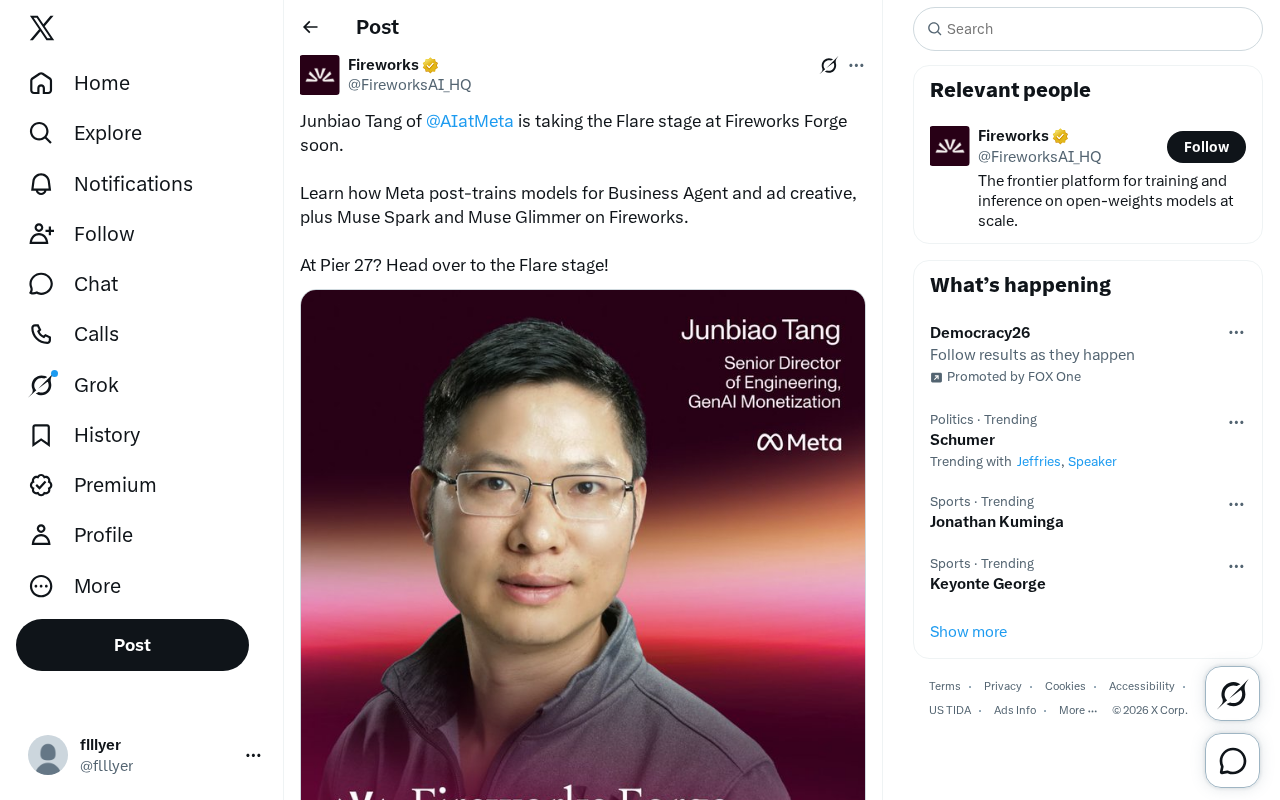
Though brief, this teaser reveals several signals worth exploring: post-training is becoming a key step in bringing large models into real business scenarios, and the Meta–Fireworks collaboration may point to a more efficient path for model deployment.
Post-Training: A Bridge from General Models to Business Specialists
Post-training typically refers to adapting a pretrained foundation model to specific tasks or domains through techniques such as supervised fine-tuning and reinforcement learning. Meta's talk focuses on "Business Agent" and "ad creatives," two scenarios that place high demands on instruction following, style control, and factual accuracy.
In ad creative scenarios, models need to generate copy or visual descriptions that fit the brand tone and attract attention while avoiding non-compliant content; business agents, meanwhile, require models to understand complex instructions, call tools, and complete multi-step tasks. The quality of post-training directly determines the user experience of these applications.
Meta's experience in model post-training is a valuable reference for many enterprises hoping to put large models into production. If the talk discloses specific technical details or workflows, it will help the industry understand how to balance model capabilities with business constraints.
Post-training is not a single technique but a collection of methods, commonly including supervised fine-tuning (SFT), reinforcement learning from human feedback (RLHF), direct preference optimization (DPO), and rejection sampling. SFT uses high-quality labeled data to teach models to follow instruction formats; RLHF/DPO uses preference-ranking data to adjust the model's output tendencies so they better match human expectations. For business agents, post-training also needs to incorporate tool-calling trajectory data and multi-step reasoning samples; for ad creatives, it requires large volumes of brand-style samples and compliance-related negative examples. Post-training is usually far less compute-intensive than pretraining, but it is highly sensitive to data quality and training strategy, and it is the core step that determines whether a model can move from "generally knowledgeable" to "domain-specialized."
Muse Spark and Muse Glimmer: A New Combination on Fireworks?
The teaser mentions two names, "Muse Spark" and "Muse Glimmer," running on the Fireworks platform. Public information is currently limited, but they may be internal Meta model variants or toolchain components used for generation or inference in specific scenarios.
Fireworks is a platform that provides model inference and deployment services, known for high performance and ease of use. If Muse Spark and Muse Glimmer are already integrated into Fireworks, it means developers may be able to call these models directly through the platform, simplifying the deployment process. This is especially important for teams that want to quickly experiment with Meta model capabilities.
However, the specific meaning and functionality of these two names remain unclear and will require disclosure in the talk or subsequent materials.
Fireworks AI offers an integrated model inference and fine-tuning service, with core capabilities including a high-throughput inference engine based on FireAttention, LoRA fine-tuning, and a rapid deployment API. For a model provider like Meta, hosting models on a third-party inference platform can avoid the operational burden of building its own clusters and reach more developers through the platform's pay-as-you-go model. If Muse Spark and Muse Glimmer are integrated into Fireworks as APIs or fine-tuning bases, developers can perform customized post-training without touching the original weights, consistent with the industry trend of "model-as-a-service." Such collaborations are also often used to test model latency and cost performance under real production workloads.
Event Background and How to Participate
Fireworks Forge is an event hosted by Fireworks. From "Pier 27" and "Flare stage" in the tweet, it can be inferred that the event may be held at an offline venue with multiple stages. The exact time of the talk is not stated in the tweet, but participants are encouraged to go to the Flare stage.
For developers unable to attend, they can follow the official channels of Fireworks or Meta AI to obtain the talk content or recordings. Such events are often good opportunities to learn about cutting-edge technology trends and build industry connections.
Takeaways for Developers
Meta's post-training practice shows that for general large models to be deployed in specific businesses, targeted optimization is still required. For teams building business agents or creative generation tools, several points are worth noting:
- The quality and diversity of post-training data are crucial, especially instruction and feedback data in business scenarios.
- The choice of model deployment platform affects iteration efficiency; toolchains provided by platforms such as Fireworks may reduce engineering burden.
- Pay attention to how Meta defines and evaluates success metrics for post-training, which can help build your own evaluation system.
Although information is currently limited, this talk will undoubtedly provide first-hand experience from Meta on model post-training and business applications.
One-line Summary
Meta experts will share post-training practices for business agents and ad creatives at Fireworks Forge.
Paragraph Summary
Junbiao Tang, an AI expert at Meta, will speak on the Flare stage at the Fireworks Forge event about how Meta does post-training for Business Agents and ad creatives, and will also cover the application of Muse Spark and Muse Glimmer on the Fireworks platform. The article notes that post-training is a key step in bringing general large models into specific business scenarios: ad creatives require style control and compliance, while business agents require multi-step task planning and tool calling. Fireworks, as a high-performance inference and deployment platform, would lower the barrier for developers to experiment and deploy if it has integrated these model variants. The article also summarizes takeaways for developers regarding post-training data quality, evaluation metrics, and platform selection.
Related articles
Starlink Mini 2 Launches: Portable Satellite Internet Evolves Again
Starlink Mini 2 sparks heated debate on Hacker News with 285 points and 291 comments. This article reviews the portable satellite terminal's iteration direction, community discussion focus, and real-world use cases.

PewDiePie Googles Himself: Retirement, His Custom AI Model Ajax, and Linux Life
PewDiePie's self-search video addresses retirement rumors, reveals his custom AI model Ajax hits 60 tokens/s and is still in BF16 training, and shares his Arch Linux routine, OpenAI ban experience, and fatigue with the YouTube ecosystem.

PewDiePie Admits Failure: Why Did His Two-Year Crow Friendship Plan Fall Apart?
PewDiePie shares a two-year failure: trying to befriend Japanese crows, from feeding peanuts to rescuing a hanging crow, only to have the glory 'stolen' by a Japanese dad. The video reveals the real challenges of interacting with wildlife and a creator's honest take on failure.