Meta Muse Allegedly Leaking System Data: What We Know

Reddit post claims Meta Muse leaks system prompts, but lacks screenshots or official confirmation.
A Reddit community post recently alleged that Meta's Muse system may be exposing system prompts and internal configuration data during user interactions. System prompts are core hidden instructions in AI products — if leaked, they enable attackers to craft targeted prompt injection attacks and bypass safety guardrails. However, the claim stems from a single community post with no screenshots, reproduction steps, or official response, and cannot yet be classified as a confirmed security incident. Users are advised to approach AI outputs with caution, while developers should prioritize system prompt isolation, output filtering, and prompt injection testing.
Overview
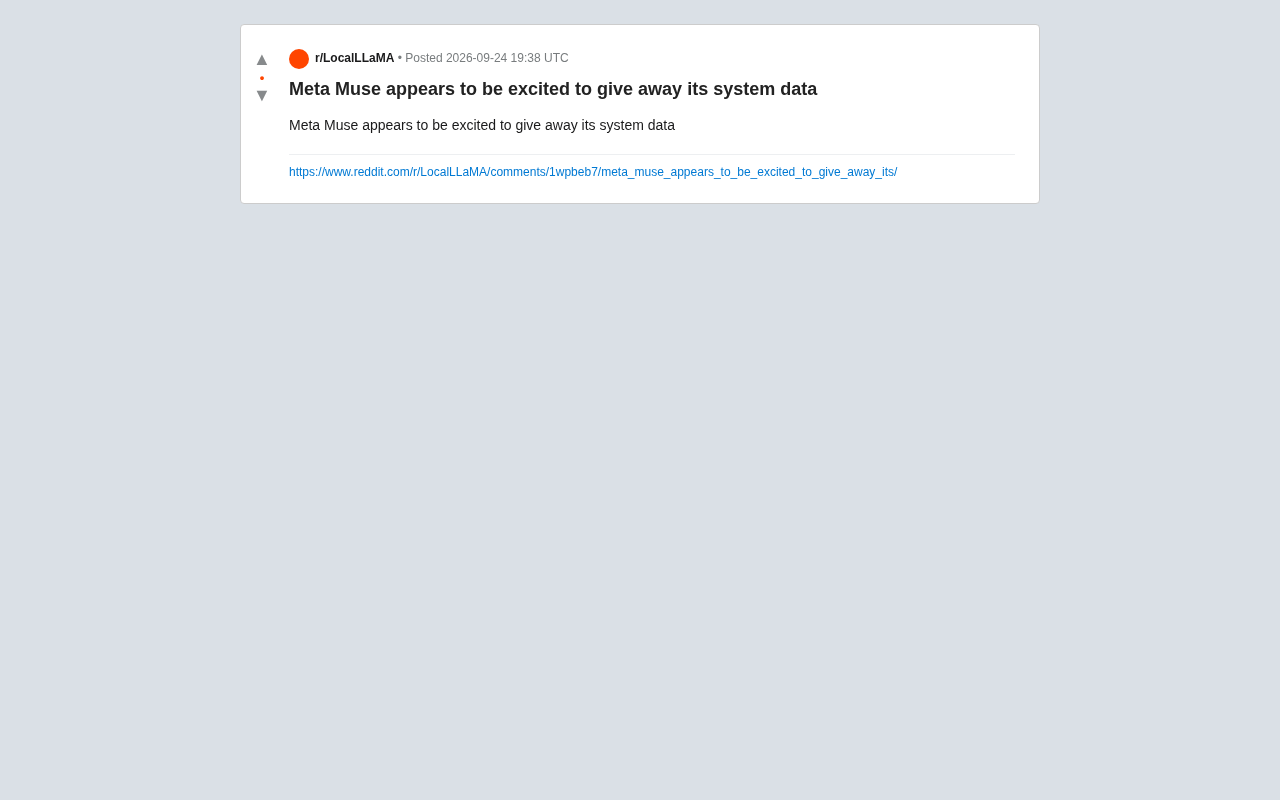
A post circulating in the Reddit community recently claimed that a Meta system associated with "Muse" may be exposing internal system data in certain interactions. The original title — roughly translated as "Meta Muse seems happy to hand over its system data" — suggests the system might be leaking information that was never meant to be visible to end users.
Because the available source material is extremely limited — essentially just a headline-level description — it is not yet possible to confirm what type of data was exposed, the scope of the leak, or the conditions that trigger it. This article provides an objective summary of what is currently known, along with general context on AI system data security, to help readers understand the potential implications.
What Is Meta Muse
Meta has been investing heavily in generative AI, AR/VR, and intelligent assistants in recent years, launching multiple projects and product lines under various codenames. The name "Muse" has been used in the industry to refer to AI-assisted creative and generative projects. It is worth noting that, given the lack of detail in the original source, this article cannot confirm which specific product or research initiative "Muse" refers to here.
For readers concerned about AI product security, the name itself is less important than the core question: can AI systems like this inadvertently output their internal system prompts, configuration parameters, or other sensitive data during user interactions?
In large language model (LLM) product architecture, a System Prompt is a hidden set of instructions that developers insert before a user conversation begins. It defines the model's role, behavioral boundaries, output style, and prohibited actions. For example, an enterprise customer service bot might be instructed via system prompt to "only answer questions related to this product and never discuss competitors." System prompts are typically invisible to end users and serve as a core carrier of product differentiation and security policy. If a model outputs its system prompt verbatim to a user under certain conditions, that constitutes a sensitive information leak — one that can undermine competitive advantage and open the door to security attacks.
Why System Data Leakage Is a Serious Concern
In LLM and AI assistant products, "system data" typically includes system prompts, internal instructions, model configurations, and backend invocation logic. Developers generally treat this information as sensitive assets for three key reasons.
First, leaking system prompts gives attackers insight into a model's behavioral constraints, making it significantly easier to craft prompt injection attacks that bypass safety guardrails.
Second, exposing internal configurations and parameters can reveal technical implementation details, giving competitors or malicious actors potential footholds for exploitation.
Third, if system data can be easily "extracted" from a model, it indicates a flaw in the product's input/output boundary controls — a type of deficiency that often has broader implications for data security.
Prompt Injection is one of the primary attack vectors against large language models. The attacker crafts a specially designed input to trick the model into ignoring its original system instructions and instead executing behavior specified by the attacker. Logically, this is very similar to SQL injection in traditional software — both exploit the failure to effectively separate data from instructions. Once a system prompt is leaked, an attacker can precisely target the specific guardrail rules they want to circumvent, dramatically reducing the cost of trial and error. It is worth noting that there is currently no universally accepted fundamental defense against prompt injection, which is why the AI security research community continues to treat it as a pressing concern.
Limitations of the Current Information
It must be stated plainly: this story currently amounts to a single sentence on Reddit, with no screenshots, reproduction steps, official response, or third-party verification. That means several critical questions remain unanswered:
- What exactly does "system data" refer to here? System prompts, or lower-level configurations?
- Is this behavior universal, or does it only occur under specific conditions?
- Is Meta already aware of the issue, and has it been patched?
Without further evidence, readers should approach this with caution and avoid treating a single community post as a confirmed security incident.
Recommendations for Users and Developers
Even with limited details, discussions like this carry genuine value for AI practitioners.
For everyday users: when interacting with any AI product, keep in mind that a model's output may not always align with the developer's intentions. In sensitive contexts, avoid placing excessive reliance on its reliability.
For developers and product teams: rumors like this serve as a reminder that when deploying AI systems, you should properly isolate system prompts, filter output content, and conduct dedicated testing against common attacks such as prompt injection — to prevent internal information from being inadvertently exposed during conversations.
Summary
The discussion around Meta Muse allegedly leaking system data is, at this stage, an unverified community tip rather than a confirmed security incident. Its value lies in once again highlighting the universal challenges AI systems face around data boundaries and prompt security. If an official response or more substantive technical analysis emerges, this story is worth following closely.
Related articles

AI Reverse-Engineers Monitor Firmware in 15 Minutes — Has the Hacking Barrier Been Flattened?
A security researcher used AI to reverse-engineer Dell monitor firmware in 15 minutes—entropy analysis, key extraction, MD5 verification—revealing encryption design flaws.

Mistral Voxtral 3: Real-Time Voice at 4 Cents per Minute, Challenging OpenAI
Mistral Voxtral 3 cuts real-time voice agent costs to 4 cents per minute, bundling three speech recognition models, a speech generation model, and a real-time voice toolkit, supporting 50+ languages and self-hosting. This article analyzes its pricing structure, sub-second response performance, and its strategic divergence from OpenAI and Gemini on data privacy versus out-of-the-box convenience.

WebMCP: Every Website as Its Own MCP Server, So AI Agents No Longer Rely on Screenshots
WebMCP lets websites expose tools via the document.modelcontext API, becoming directly callable MCP servers. This article explains its architecture, the Claude Code remote-debugging demo, Chrome's current support stage, and its impact on the agent ecosystem.