Meta Muse Charm Priced at $300: A New Bet on AI Hardware
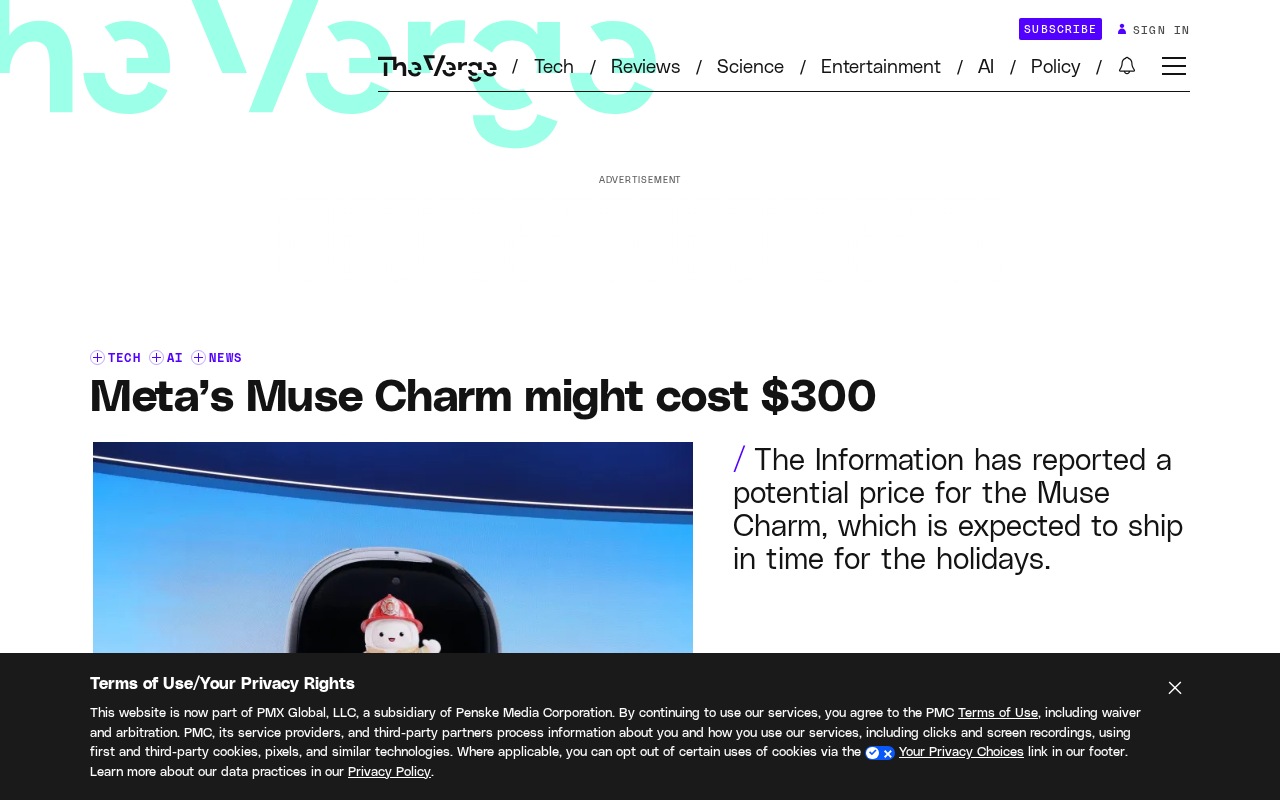
Meta plans to price its AI hardware Muse Charm at $300, betting on the AI agent gateway.
According to The Information, Meta plans to price its screen-equipped Muse Charm device, which lets users converse with the Muse AI agent, at $300. Zuckerberg previously unveiled the product and said it is expected to ship before the December holiday season. The article argues that the $300 price places Muse Charm in the mid-to-high-end consumer electronics segment, with the logic being not hardware profit but locking in high-frequency Muse AI service users through hardware to enable service monetization. However, key details such as functional boundaries, screen size, and independent connectivity remain undisclosed, and users will inevitably compare it to free AI assistants on their phones. The article notes that AI hardware success depends on finding a "must-have" use case, and $300 is more of a hypothesis awaiting validation.
Meta is looking for a concrete price anchor for its AI hardware ambitions. According to The Information, Meta plans to price the Muse Charm—a small device equipped with a screen that lets users converse with the Muse AI agent—at $300. CEO Mark Zuckerberg publicly unveiled the product earlier this year and said the company expects to ship it before the December holiday season.
Product Positioning: More Than Just a "Smart Speaker with a Screen"
Based on the information disclosed so far, the Muse Charm's core interaction is "chatting with the Muse AI agent," and the addition of a screen means it aims to deliver richer information presentation than purely voice-based devices. This creates a subtle differentiation from existing AI hardware form factors: it is neither a pure voice assistant device nor a tablet or phone, but rather a lightweight terminal built around a single AI agent.
The $300 price point places it in the mid-to-high-end consumer electronics segment. This is higher than most smart speakers yet lower than mainstream tablets. Meta clearly hopes to justify the premium with the concept of a "dedicated AI agent gateway" rather than competing purely on hardware specs.
AI Agent refers to an AI system capable of perceiving its environment, autonomously planning, and executing multi-step tasks to achieve goals—distinct from chatbots that merely respond to single-turn commands. It typically possesses memory, tool-calling, and task-decomposition capabilities, and can represent users in completing tasks such as booking tickets, managing schedules, and retrieving information. If Meta's Muse AI agent has such capabilities, the Muse Charm's value extends beyond being a "Q&A terminal" and could become an always-on personal task agent gateway—this is the technical premise behind Meta's attempt to justify the $300 premium with a "dedicated agent gateway."
The Business Logic Behind $300
Zuckerberg previously mentioned the "December holiday season" shipping timeline, indicating that Meta is treating this product as seasonal consumer electronics. The holiday season is a critical window for hardware sales, and $300 falls into the "worth considering but requires deliberation" tier in the gift market.
For Meta, the hardware itself is not necessarily a profit center. A more reasonable interpretation: the Muse Charm is the physical carrier for the Muse AI agent, and selling one device equals locking in a high-frequency user of AI services. This "hardware paves the way, services monetize" approach is nothing new in the tech industry, but betting it on an unproven AI agent form factor carries both risk and upside.
Hardware paves the way, services monetize is a common business model in the consumer electronics industry: selling hardware at or near cost—or even at a loss—to rapidly expand the user base, then generating long-term profits through subscriptions, content, or service commissions. Amazon Echo and Google Nest have both adopted similar approaches. For Meta, the Muse Charm's hardware margins may be limited, but each device is tied to a Muse AI account, creating touchpoints for future subscription or advertising monetization—which aligns closely with Meta's advertising-centric revenue structure.
Unanswered Questions
Public information remains quite limited. The Information's report focuses on pricing, but the product's specific functional boundaries, screen size, battery life, whether it connects to the internet independently, and what capabilities the Muse AI agent possesses all remain unclear. For a $300 device, users will inevitably compare it to free AI assistants on their phones—if the core experience can be replicated on a phone, the hardware's standalone value will need a stronger justification.
Another variable is market acceptance. The AI hardware category has seen many attempts, and success or failure often depends not on AI capabilities themselves but on whether the device has found a "must-have" use case. Whether the Muse Charm can provide that answer will only be verifiable after shipping in December.
The AI hardware category has gone through multiple rounds of experimentation in recent years: products like the Humane AI Pin and Rabbit R1 all positioned themselves as "phone-free AI gateways" but failed to gain traction due to gimmicky features and unstable experiences; Ray-Ban Meta smart glasses, by contrast, achieved relative success through stylish form factor and practical use cases. These cases demonstrate that the key to AI hardware success lies in defining use cases that phones cannot cover, not in AI capabilities themselves. The Muse Charm faces the same category-validation pressure.
Editorial View
$300 is a price point with signal value. It indicates that Meta does not intend to make the Muse Charm a cheap AI novelty toy, but rather to promote it as a serious consumer electronics product. But price is only the starting point. What truly determines this device's fate is whether the Muse AI agent can deliver an interactive experience that phones cannot replace. Until that is proven, $300 is more of a hypothesis awaiting validation than a solid commitment.
Related articles

Anthropic Goes Public: AI Bubble or Buying Opportunity?
Anthropic lists on Nasdaq, opening about a third above its IPO price. We break down the $81.3B raise, $1.5T offering valuation, and $2T market valuation, plus Claude's growth and $567M quarterly operating loss.

Why the FBI's AI Hacker Warning Hinges on a Single Word from Microsoft
FBI says AI tool Artex attacked 2,250+ organizations, but the citation trail leads to Microsoft's wording of "attempted sign-ins." The gap between attempts and breaches reveals the attack's true scale.

Fable 5.2 Powers the Creation of Getsumen Express: A Browser-Based Lunar and Martian Exploration Game
A developer used Fable 5.2 to build Getsumen Express, a browser game where players explore the Moon and Mars, scan real landmarks, shoot aliens, and ride an interstellar train. Built on Three.js and WebGPU for about $730, it showcases AI-assisted development.