Meta Muse Hits 10 Million US Downloads: Joins Top App Club in 40 Days

Meta's AI companion app Muse hit 10 million US downloads in 40 days, with retention leading competitors, but conclusions should still be cautious.
Meta's AI companion app Muse surpassed 10 million US downloads just 40 days after launch, becoming the 12th app in history to reach this milestone, joining Threads in the "10 million downloads in 40 days" club. New data shows its user retention is higher than AI competitors, suggesting Meta has found an effective path in product experience or user habit formation. The article analyzes that Muse's growth benefits from Meta's ecosystem distribution and recommendation algorithms, as well as its grasp of the private, personalized positioning of AI companions; however, the product logic of AI companions differs from social networks, and whether download advantages can translate into long-term activity remains to be verified. The original article does not disclose specific retention figures, competitor comparison methodologies, or paid conversion and other key metrics, so the judgment that "Meta dominates the AI companion space" is premature; a more accurate positioning is a strong start.
Meta Muse Hits 10 Million US Downloads: Joins Top App Club in 40 Days
Meta's AI companion app Muse has set a new record: just 40 days after launch, its US downloads surpassed 10 million. This pace puts it in the exclusive "10 million downloads in 40 days" club alongside a handful of apps like Threads. According to the original report, only 12 apps in history (including Muse) have reached this milestone. More notably, new data shows Muse's user retention rate is higher than its AI competitors, which may indicate that Meta has found a different path in operating consumer AI products.
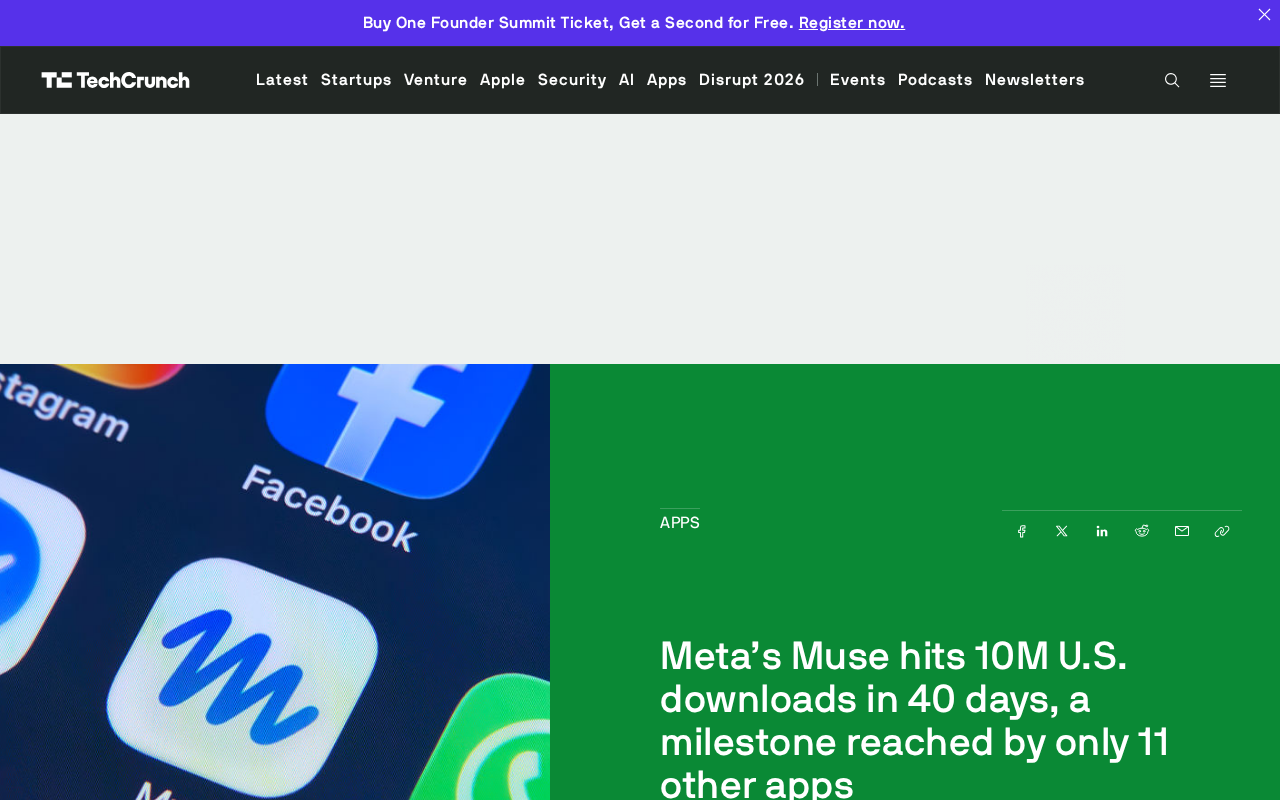
Behind the 10 Million Downloads: Meta's Distribution Advantage and Product Positioning
10 million US downloads in 40 days is top-tier performance in any app category. The original article notes that only 11 other apps have previously reached this level, and Threads is one of them—largely fueled by Instagram's traffic. Muse likely also benefits from Meta's massive social ecosystem, but the product logic of AI companion apps differs from that of social networks: users are motivated by private, personalized interaction rather than migrating social graphs.
Therefore, Muse's download numbers cannot be simply attributed to "Meta's traffic funnel." The product's grasp of the "AI companion" positioning, combined with Meta's accumulated recommendation algorithms, may have jointly driven this result. However, the original article does not disclose specific feature details or user acquisition strategies for Muse, which await further observation.
The reference value of Threads' "10 million downloads in 40 days": Threads is a text-based social app launched by Meta in July 2023, which surpassed 100 million registered users within 5 days, setting a historical record for consumer app growth. Its explosive growth relied mainly on Instagram's account system and one-click social graph migration, allowing users to import their existing social connections at almost zero cost. Unlike Threads, AI companion products lack an existing social graph to leverage; user growth depends more on the product's own appeal and recommendation algorithm reach. Thus, even if Muse benefits from Meta's ecosystem, its growth path is fundamentally different from Threads and should not be directly compared.
Product form of AI Companion: AI companions refer to consumer apps driven by large language models, with emotional companionship and personalized conversation as their core value. Typical products include Character.AI, Replika, Pi, etc. Their product logic emphasizes private one-on-one interaction, character persona settings, and long-term memory capabilities. User stickiness comes from emotional connection rather than social network effects. This is opposite to the "the more users, the better" mechanism of social apps, meaning distribution advantages can only solve the cold start; retention still depends on conversation quality and persona consistency.
Retention Beats Competitors: A More Critical Signal Than Downloads
Downloads only reflect user acquisition capability; retention determines whether a product can survive long-term. The original article explicitly states that Muse's user retention outperforms its AI competitors. In the AI companion space, products like Character.AI and Replika have been established for some time, and user stickiness is their moat. If Muse can surpass them in retention, it suggests Meta has made effective designs in product experience or user habit formation.
A reasonable speculation is that Meta deeply integrated Muse with its own app matrix, lowering the barrier for user return visits. But the original article does not provide specific retention figures or comparison targets, so the strength of the "higher retention" conclusion should be treated with caution.
Common metrics for retention: Consumer apps typically measure user return visits using Day 1 (D1), Day 7 (D7), and Day 30 (D30) retention. Due to high usage frequency and strong emotional investment, AI companion products often have significantly higher D30 retention than utility apps. However, different statistical methodologies (e.g., whether to exclude uninstall-reinstall, whether to count registered users or downloaders) can lead to large discrepancies, and cross-product comparisons require consistent definitions. The original article does not disclose specific retention figures or benchmarks for Muse, so "higher retention" can only serve as a directional signal, not a strict competitive benchmarking conclusion.
Moat of Character.AI and Replika: Character.AI is known for user-created characters and a massive UGC character library, while Replika focuses on long-term companionship relationships and emotional memory. Both have accumulated years of user behavior data and persona tuning experience. Their stickiness barrier lies in the emotions and conversation history users have invested, resulting in high switching costs. If Muse surpasses them in retention, it may mean Meta has found new solutions in recommendation reach, cross-app reminders, or persona consistency, but this judgment still requires more granular data support.
AI Companion Competition Heats Up, Meta's Entry Changes the Landscape
The rapid rise of Muse cannot be ignored in its impact on the AI companion space. As a platform company with billions of users, Meta's entry may squeeze the growth space of small and medium-sized AI companion products. At the same time, Meta's advantages in data, computing power, and distribution may also raise the competitive threshold for the entire sector.
On the other hand, the core barrier of AI companion products lies in user emotional connection and personalized experience, not mere scale effects. Whether Meta can convert download advantages into long-term activity remains to be verified. The original article only provides preliminary data on downloads and retention, without covering deeper metrics such as revenue and paid conversion.
The boundaries of "scale effects" when platform companies enter: Meta's advantages in data, computing power, and distribution can significantly reduce customer acquisition costs and inference costs, but the core value of AI companion products comes from the coherence and emotional resonance of personalized conversations—experiences that are difficult to replicate directly through scale. Platform advantages mainly act on user acquisition and infrastructure layers, while retention and paid conversion still depend on the product team's refinement of companionship scenarios. Historical cases of social giants entering vertical sectors (e.g., Meta's live streaming, short video) show that distribution can bring a strong start, but long-term share still depends on product differentiation and operational refinement.
Editorial View: Milestone Worth Noting, But Conclusions Should Not Be Premature
Muse's 10 million downloads in 40 days is a solid milestone, and the signal of leading retention over competitors is also valuable. However, it should be noted that the original material is limited: it does not disclose specific retention figures, competitor comparison methodologies, user activity, and other key data. Therefore, it is premature to view this as evidence that "Meta has dominated the AI companion space." A more accurate judgment is: Meta has achieved a strong start in consumer AI applications through distribution advantages and product refinement, and whether it can sustain depends on product iteration and commercialization capabilities.
For practitioners following the AI application space, two metrics worth tracking in the Muse case are: whether retention remains stable after 3 months, and whether Meta will integrate Muse's capabilities into a broader AI assistant strategy.
One-line Summary
Meta's AI companion app Muse hit 10 million US downloads in 40 days, with retention leading competitors, but conclusions should still be cautious.
Paragraph Summary
Meta's AI companion app Muse surpassed 10 million US downloads just 40 days after launch, becoming the 12th app in history to reach this milestone, joining Threads in the "10 million downloads in 40 days" club. New data shows its user retention is higher than AI competitors, suggesting Meta has found an effective path in product experience or user habit formation. The article analyzes that Muse's growth benefits from Meta's ecosystem distribution and recommendation algorithms, as well as its grasp of the private, personalized positioning of AI companions; however, the product logic of AI companions differs from social networks, and whether download advantages can translate into long-term activity remains to be verified. The original article does not disclose specific retention figures, competitor comparison methodologies, or paid conversion and other key metrics, so the judgment that "Meta dominates the AI companion space" is premature; a more accurate positioning is a strong start.
Related articles

5 Practical Ways Real Estate Agents Can Use AI to Boost Efficiency (2026 Edition)
How can real estate agents use AI to boost efficiency? Based on a YouTube walkthrough, this breaks down five methods — ChatGPT for listing descriptions, Canva for marketing materials, forms for open house leads, Zapier for automated follow-up, and seller meeting prep — and flags risk boundaries like fair housing laws, photo authenticity, and price verification.

Grok Bot vs ChatGPT Agent: Which AI Agent Is More Powerful?
How does Grok Bot differ from ChatGPT Agent? This comparison examines how they work: Grok Bot has a cloud computer and runs persistently inside tools to execute multi-step tasks automatically; ChatGPT Agent operates web pages in a browser and is more mature at general tasks. Includes selection advice.

Walmart Agent Gateway: AI Shops for You Automatically—Why Is Amazon Going the Opposite Way?
Walmart's Agent Gateway lets ChatGPT, Gemini and other AI assistants access its product catalog to search, compare and add to cart, with spending limits and per-purchase approval. Amazon blocks external AI agents—two retail giants, opposite paths. Currently US-only, India may follow.