Meta Reverses Course: Will Now Run Ads for Musk Documentary

Meta reverses course and will now run ads for Alex Gibney's investigative Musk documentary.
Social media giant Meta has confirmed it will accept advertising for filmmaker Alex Gibney's upcoming documentary about Elon Musk, reversing its previously uncertain stance. The move is sensitive because Musk directly competes with Meta through his X platform (formerly Twitter). Gibney is known for critical, investigative work on powerful figures, and the reversal raises questions about consistency in platform ad policies, commercial motivations, and the public scrutiny facing major platforms when handling content related to their rivals.
Overview
Social media giant Meta appears to have reversed a notable decision: the company now says it will accept advertising for filmmaker Alex Gibney's upcoming documentary about Elon Musk.
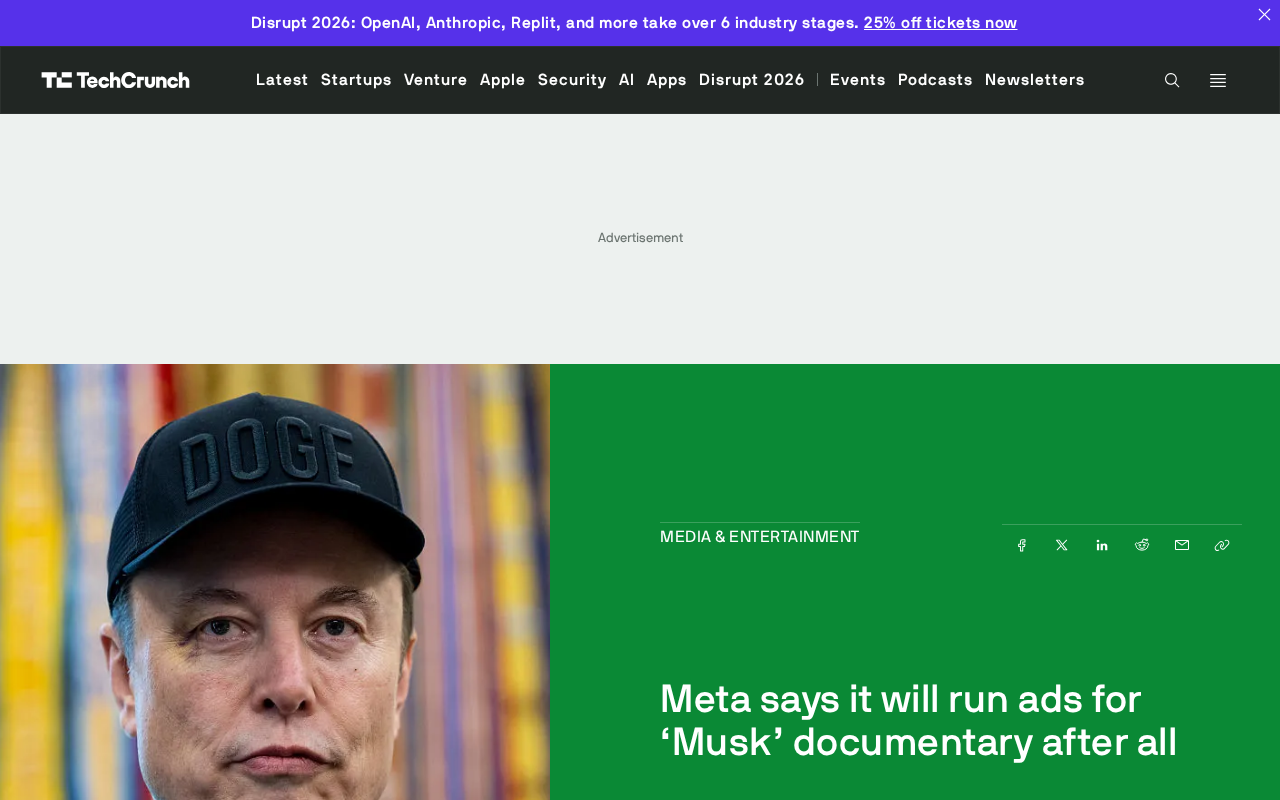
The reversal is significant because it touches on several sensitive issues: content moderation on social platforms, the entanglement of political and commercial interests, and the consistency of platform advertising policies. Previously, there had been uncertainty over whether ads for the documentary would be accepted.
Background: Who Is Alex Gibney?
Alex Gibney is a highly acclaimed documentary filmmaker known for investigative and in-depth analytical work. A documentary about Musk directed by him is inherently newsworthy — Musk is not only the head of Tesla and SpaceX, but also the owner of X (formerly Twitter), making him one of Meta's direct competitors in the social media and advertising markets.
For that reason, whether ads for a critical or investigative documentary about Musk could run smoothly on major social platforms became a delicate question. When platforms encounter content involving their own competitors — especially content that may take a pointed stance — how they formulate and enforce advertising policies inevitably draws scrutiny over their neutrality and commercial motivations.
Gibney's notable works include Enron: The Smartest Guys in the Room (2005), Taxi to the Dark Side (2007, Academy Award winner for Best Documentary Feature), and Steve Jobs: The Man in the Machine (2015). His style is characterized by extensive interviews, reconstruction from internal documents, and critical storytelling. He has a particular talent for focusing on tech and business leaders, revealing the power dynamics and ethical controversies beneath their polished public images. It is this creative track record that made his Musk documentary a subject of intense industry attention from the moment it was announced — most observers expected it to be an investigative work rather than a flattering one.
Meta's Reversal
According to reports, Meta's clear statement that it will run ads for the documentary represents a correction of its previously uncertain stance. As the original reporting put it, "at least one social media company appears to be reversing its position on whether to accept ads for Alex Gibney's upcoming documentary about Musk."
This kind of reversal is not uncommon in platform ad review practice. Ad placements often go through automated systems or initial human review, during which certain content may be temporarily rejected or held due to policy triggers, only to be reassessed following an appeal, re-review, or external attention. Meta's decision can be seen as a response to calls for greater transparency in advertising policy enforcement.
Why This Matters
This event carries significance on several levels:
Consistency in Platform Advertising Policy
How social platforms maintain consistent and predictable policies when dealing with ads involving public figures — especially competitors — has long been a contentious issue. Any seemingly ad hoc rejection or reversal can be interpreted as policy ambiguity or selective enforcement.
The Sensitivity of Commercial Competition
Meta and Musk's X platform are in direct competition for digital advertising revenue and social traffic. Whether an ad for a documentary about Musk gets accepted is easily linked by outside observers to the rivalry between the two platforms, amplifying the story's significance.
The competition between Meta (which owns Facebook, Instagram, and Threads) and X (the platform Musk rebranded after acquiring Twitter) is particularly direct: both compete head-to-head for digital ad revenue, user time, and influence over public discourse. Meta's 2023 launch of Threads was widely seen as a direct challenge to X. Against this backdrop, ads for a Musk-critical documentary appearing on Meta's platforms send a dual commercial and reputational signal. Advertisers and observers alike may read Meta's decision as a willingness to leverage external critical content to gain a rhetorical edge over X — rather than as a purely neutral application of advertising policy.
Public Scrutiny of Content Moderation
This incident is another reminder that mainstream platforms' advertising and content moderation decisions are under increasingly intense public scrutiny. The reversal itself demonstrates that external attention can have a tangible impact on platform decision-making.
Conclusion
Meta's ultimate decision to run ads for the Musk documentary is a seemingly minor detail that nonetheless reflects the complexity of platform governance. It sits at the intersection of ad review standards, commercial competition, and public oversight. Since publicly available information remains limited, the documentary's specific content, release schedule, and the stances of other platforms are still to be revealed. For readers interested in platform governance and the digital advertising ecosystem, this is a story worth following.
Related articles

Gaussian Process Bandit Optimization: Exploration Strategies and Inference Regret Guarantees
Cumulative regret guarantees in Bayesian optimization fail to reflect final recommendation quality. This article examines a new study that provides inference regret guarantees for Gaussian process bandit optimization through exploration query strategies and fill distance analysis, validated on hyperparameter optimization and control tasks.

The Most Detailed Codex Guide on Bilibili: From Installation to Real-World Practice
The most detailed Codex guide on Bilibili: from app store installation to daily work mode configuration, with a real coffee shop project demonstrating file organization, data extraction, dashboard creation, and other practical tasks. Learn to use Plan Mode and desktop pets to leverage Codex efficiently.

Appearance Compensation in Volume Rendering: Why RGB Accuracy Cannot Guarantee Density Correctness
Volume rendering research reveals that volumetric data perfectly reproducing external RGB views may still contain density errors: appearance compensation can double central density and keep external rays unchanged even when L2 error exceeds 14.52%. Density recovery depends on appearance capacity, spatial resolution, and measurement design.