Meta's Open-Weight Model Muse Spark Open Lands on Ollama: 1M Token Context

Meta's open-weight Muse Spark Open launches on Ollama, focused on coding and tool calling with 1M token context.
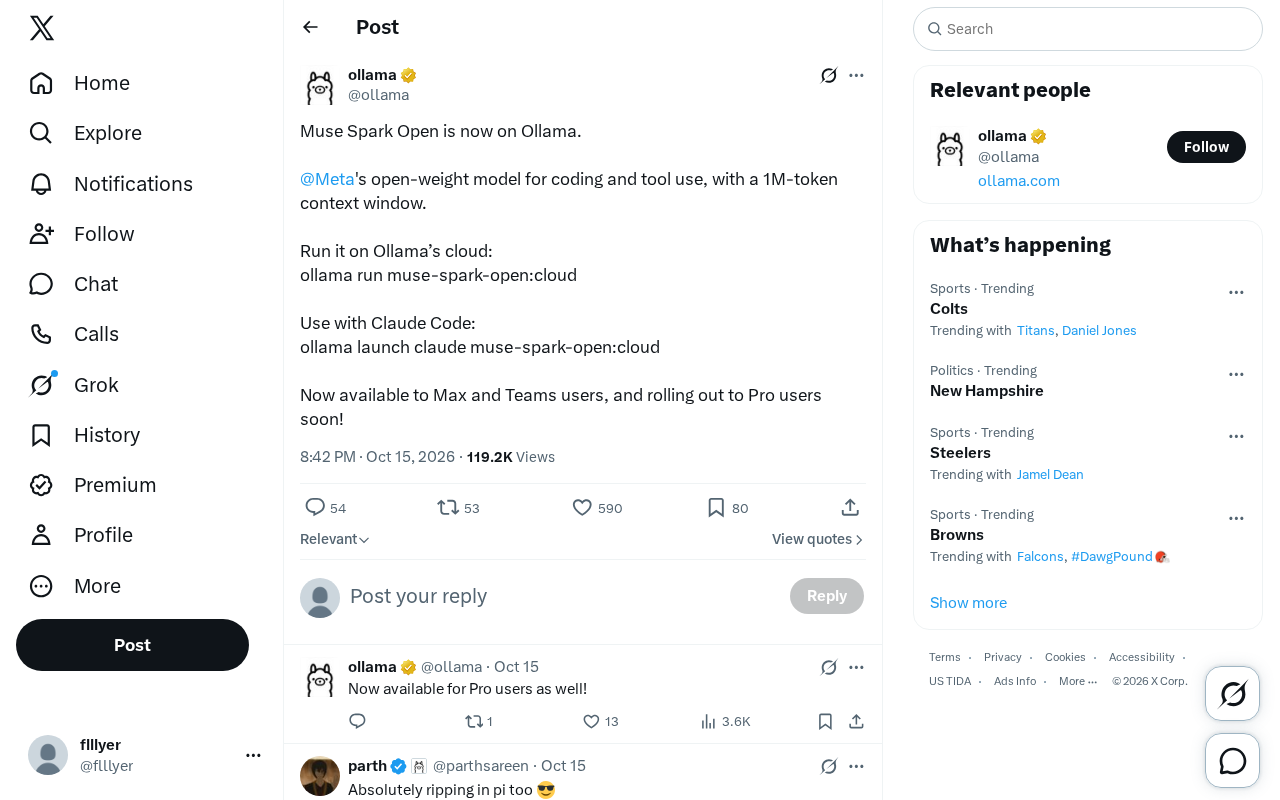
Meta's open-weight model Muse Spark Open has launched on Ollama, targeting coding and tool-calling with a 1M token context window for large codebases and cross-file tasks. It runs via `ollama run muse-spark-open:cloud` or can be hooked into Claude Code. Currently available to Max and Teams users, with Pro rolling out later. Open weights enable self-deployment and fine-tuning for private, compliance-sensitive use, though effective context utilization and tool-calling accuracy still need real-world validation.
Meta's open-weight model Muse Spark Open has officially launched on the Ollama platform. This model, focused on coding and tool-calling scenarios, offers a massive 1 million token context window, giving developers a new option for handling large codebases and complex toolchains.
An Open Model Built for Coding and Tool Calling
Muse Spark Open's positioning is quite clear: it targets coding tasks and tool use. These two areas happen to be where large models are seeing the most active real-world adoption—code generation and completion test a model's understanding of long-range dependencies and structured syntax, while tool calling requires planning ability, the capacity to accurately select and chain external functions.
Meta's decision to release it as open-weight means developers can deploy and fine-tune it themselves rather than relying entirely on API calls. This continues Meta's past strategy with open models and makes Muse Spark Open appealing for private deployments and data-sensitive scenarios.
The difference between open-weight and open-source models: Open-weight means that after training, a model's parameters (weights) are publicly downloadable, allowing others to deploy, run inference, and even fine-tune it themselves. However, it typically does not include public release of training data, training code, or the full training pipeline, so strictly speaking it is not equivalent to "fully open source." The core value of open weights is that users can run the model locally or in a private cloud, avoiding data egress, meeting compliance and privacy requirements, and customizing fine-tuning for specific domains. For developers, this means lower long-term inference costs and greater controllability, but it also means bearing the hardware and operations costs yourself.
What a 1 Million Token Context Means
The 1 million token context window is the model's most eye-catching spec. In practical terms, that's roughly the scale of hundreds of thousands of lines of code, or the core file set of an entire mid-sized project.
For coding scenarios, the value of long context lies in reducing the losses caused by "information trimming." The traditional approach is to concatenate relevant file fragments into the prompt, so the model often only sees a local view and struggles to understand cross-file call relationships. A million-token context gives the model a chance to ingest far more context at once, which is friendlier for tasks like refactoring, cross-module debugging, and code review. Of course, the actual effective utilization of that context still needs empirical verification—a large window doesn't mean the model maintains equal attention at every position.
Context window vs. effective context utilization: The context window refers to the maximum total number of tokens a model can process in a single inference, including input prompts and output generation. A 1 million token window means the model can receive extremely long text at once, but "fitting it in" is not the same as "understanding it well." The industry commonly uses "effective context length" to describe a model's actual ability to maintain attention and reasoning quality over long texts—as positions move further from the start of the input, the model's recall and use of earlier information tends to decay, the so-called "lost in the middle" phenomenon. Therefore, when evaluating long-context models, beyond window size, pay attention to measured performance on retrieval, cross-file references, and long-range dependency tasks.
How to Run It on Ollama
Ollama offers the most direct way to get started, via cloud execution:
ollama run muse-spark-open:cloud
If you want to plug it into a Claude Code workflow, you can use:
ollama launch claude muse-spark-open:cloud
The intent behind these two commands is clear: one is for general conversation and testing, the other mounts the model directly into a coding agent tool. For developers already using Claude Code, this means they can switch to Muse Spark Open for comparison testing at relatively low cost.
Ollama's cloud vs. local execution modes: Ollama was originally known for running open models locally, where users download model weights and run inference offline on a personal computer or server. As models have grown larger, Ollama has also added a cloud execution option (such as the :cloud tag in the commands), placing the inference workload on Ollama's hosted infrastructure so users can call large models without a local GPU. Each mode has trade-offs: cloud mode has a low barrier to entry and is quick to start, but depends on the network and routes data through a third party; local mode requires hardware investment but keeps data in-house and allows deep customization. Developers can choose flexibly based on compliance requirements and compute conditions.
Availability and Rollout Pace
According to official information, Muse Spark Open is currently available to Max and Teams users, with Pro users gaining access gradually later. This kind of phased rollout is common in the early days of a model launch and helps control cloud load.
It's worth noting that the version running via Ollama's cloud is not entirely identical to the open-weight version in terms of resource scheduling—the cloud version removes the hardware barrier of local deployment, but the real value of open weights is that you can download them and host them yourself. For teams with compliance requirements or a desire for deep customization, the latter is what matters.
A Few Observations
Meta singling out coding and tool calling as the model's selling points reflects how open-model competition is shifting from "general capability contests" to "scenario-focused depth." If the 1 million token context delivers on real coding tasks, it will provide substantive help for code understanding and cross-file reasoning; but if it's just a number in the specs, developers will notice quickly in testing.
Ollama's role as a distribution channel is also worth watching. It is expanding from "a convenient tool for running models locally" to "the default entry point for model launches," which is good for the spread of open models. As for whether Muse Spark Open can hold its ground in the already crowded coding-agent arena, ultimately it will come down to tool-calling accuracy and stability under long contexts.
One-line Summary
Meta's open-weight model Muse Spark Open launches on Ollama, focused on coding and tool calling, with 1M token context support.
Paragraph Summary
Meta's open-weight model Muse Spark Open has officially launched on Ollama, targeting coding and tool-calling scenarios with a 1 million token context window suited to large codebases and cross-file tasks. Developers can run it in the cloud with ollama run muse-spark-open:cloud or hook it into a Claude Code workflow with ollama launch claude. The model is currently available to Max and Teams users, with Pro users gaining access gradually. The open-weight format supports self-deployment and fine-tuning, making it suitable for private and compliance-sensitive scenarios. The article notes that the actual effective utilization of the long context still needs empirical verification, and that tool-calling accuracy and long-context stability will determine its competitiveness.
Related articles

DeepCell: One-Click AI Generation of Documents, Spreadsheets, and Slides
DeepCell tops Product Hunt with one-click generation of documents, spreadsheets, and slides, using the .deepcell format for linked updates, designed for System 2 tasks like modeling and sales reviews.

Doneas: 15-Minute Daily Accountability Calls That Keep Indie Developers From Procrastinating
Doneas is a daily accountability tool for indie developers: plan tasks on Monday, join a 15-minute call with five builders each day, and log deliveries on a public progress page. This article analyzes its core mechanics, effectiveness, and potential issues around retention and matching.

Fastlane 2.0: Fully Automated AI Ad Campaigns, From Creative to Optimization
Fastlane 2.0 is an AI ad automation tool: enter your website and it learns your brand, generates video and image ads, and runs and optimizes them on Meta, TikTok, Instagram, and YouTube.