MetaAct: Advancing Self-Evolving Language Agents with Executable Action Constraints
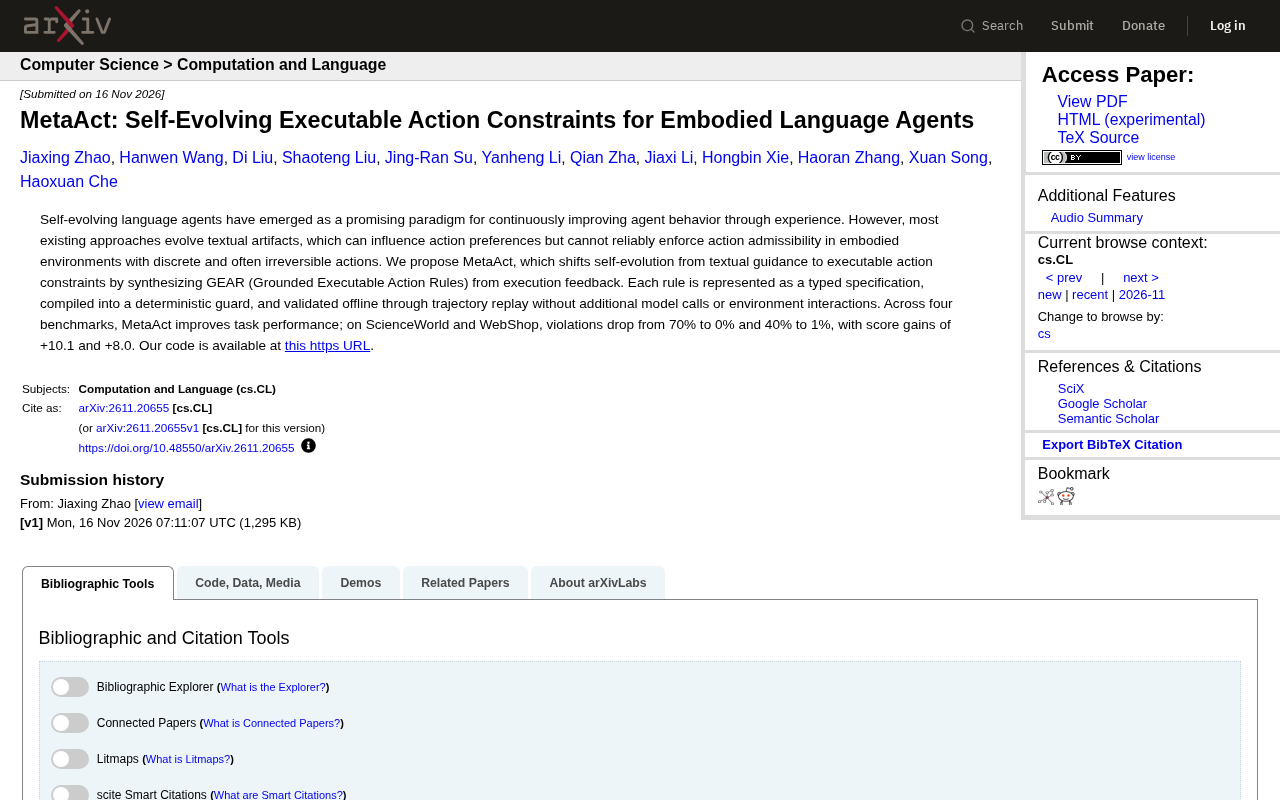
MetaAct turns agent self-evolution from textual guidance into executable action constraints, sharply reducing violation rates.
MetaAct tackles a fundamental limitation of self-evolving language agents: they mostly evolve textual artifacts like prompts, memories, and reflections, which only influence action preferences and cannot enforce action admissibility in discrete, irreversible embodied environments. The method synthesizes GEAR (Grounded Executable Action Rules) from execution feedback—typed specifications compiled into deterministic guards that intercept non-compliant actions at decision time—and validates them offline via trajectory replay without extra model calls or environment interaction. On four benchmarks, performance improves; ScienceWorld and WebShop violation rates drop from 70% to 0% and 40% to 1%, with score gains of +10.1 and +8.0. Code is open-sourced.
From Textual Guidance to Action Constraints: MetaAct's New Approach to Self-Evolution
Self-evolving language agents are seen as an effective path to continuously improving behavioral capabilities, but most existing methods evolve textual artifacts—prompts, memories, or reflections. Such text can influence action preferences but cannot reliably enforce action admissibility in discrete and often irreversible embodied environments. MetaAct proposes shifting self-evolution from textual guidance to executable action constraints: synthesizing GEAR (Grounded Executable Action Rules) from execution feedback, where each rule is represented as a typed specification, compiled into a deterministic guard, and validated offline via trajectory replay—all without additional model calls or environment interactions.
GEAR: Making Action Rules Executable
MetaAct's core innovation lies in distilling experience into executable action constraints. Each GEAR rule is a typed specification defining which actions are permitted or forbidden under which circumstances. These rules are compiled into deterministic guards that directly intercept non-compliant actions during agent decision-making. Unlike textual guidance, this mechanism does not rely on the model's understanding and compliance; instead, it enforces constraints on the action space at the execution level.
Offline validation is another key design of MetaAct. Through trajectory replay, rules can be validated without calling models or interacting with the environment, greatly reducing evolution costs and making rule iteration more efficient.
Deterministic guard refers to an unambiguous, non-random decision procedure that runs when the agent selects an action: given the current state and a candidate action, it judges whether the action is allowed according to pre-compiled rules and directly returns allow or deny. Unlike soft constraints that rely on large models to "read the prompt and voluntarily comply," the guard's decision is entirely determined by its inputs—no sampling, no natural language understanding—so rules cannot be ignored or misinterpreted. In implementation, guards typically appear as Boolean condition checks over state fields and action parameters, with extremely low runtime overhead, and can be executed synchronously at every decision step. This makes action admissibility a structural guarantee rather than a probabilistic expectation.
Trajectory replay is the concrete means of offline rule validation: previously generated execution trajectories in the environment are fed one by one back into the rule checker to verify whether actions intercepted by rules are indeed violations and whether actions allowed through miss any violations. Since replay only reads recorded state and action sequences, it requires neither re-calling models nor interacting with the real environment, making validation cost nearly zero and repeatable. This allows rapid iteration on adding, removing, and modifying rules, and enables low-cost exclusion of overly strict or overly loose rules before deployment.
Experimental Results: Violation Rates Drop Significantly, Scores Improve
MetaAct was evaluated on four benchmarks, with task performance improving on all. On ScienceWorld and WebShop, violation rates dropped from 70% to 0% and from 40% to 1%, respectively, with scores improving by +10.1 and +8.0. These results demonstrate that executable action constraints can effectively curb high-risk violations in embodied environments while maintaining task performance.
The code is open-sourced on GitHub (https://github.com/BaiCubed/MetaAct), providing a reproducible foundation for future research.
ScienceWorld and WebShop are two interactive benchmarks commonly used to evaluate language agents. ScienceWorld simulates elementary school science experiment scenarios, where agents must complete experimental tasks through a series of operations; many actions are physically irreversible (e.g., pouring, mixing reagents), and mistakes can cause task failure. WebShop simulates search, filtering, and ordering processes on e-commerce websites, where incorrect actions may result in invalid purchases. Both share characteristics of discrete action spaces, deterministic state transitions, and high costs of violations, making them suitable for testing whether "action constraints" can truly take effect. In such benchmarks, violation rate measures the proportion of actions the agent executes that the environment judges as illegal or dangerous, while score reflects task completion quality. MetaAct reduces the violation rate on ScienceWorld from 70% to 0%, showing that the guard mechanism almost completely eliminates illegal actions; on WebShop, it drops from 40% to 1% with a small residual, typically arising from boundary cases not yet covered by rules, which also suggests room for further expansion of rule synthesis.
Significance and Outlook
MetaAct advances self-evolution from "telling the agent what to do" to "constraining what the agent cannot do," providing a more reliable evolution paradigm for embodied language agents. In real-world scenarios with irreversible actions, such executable constraints are more robust than textual guidance. In the future, synthesizing more complex rules and transferring to more environments will be worthwhile directions to explore.
One-line Summary
MetaAct shifts agent self-evolution from textual guidance to executable action constraints, significantly reducing violation rates.
Paragraph Summary
MetaAct addresses a fundamental limitation of existing self-evolving language agents: they mostly evolve textual artifacts such as prompts, memories, and reflections, which can only influence action preferences and cannot enforce action admissibility in discrete and irreversible embodied environments. The method instead synthesizes GEAR (Grounded Executable Action Rules) from execution feedback; each rule is represented as a typed specification, compiled into a deterministic guard that directly intercepts non-compliant actions at decision time, and validated offline via trajectory replay without additional model calls or environment interactions. Experiments show improvements on four benchmarks, with violation rates on ScienceWorld and WebShop dropping from 70% to 0% and from 40% to 1%, respectively, and scores improving by +10.1 and +8.0. The code is open-sourced.
Related articles

VP ≠ VNP: A Major Breakthrough in Computational Complexity Theory
A study claiming to prove VP ≠ VNP over every field sparks heated discussion on Hacker News. This article analyzes the algebraic complexity background of VP and VNP, the proof approach, community controversy, and its potential impact on computational complexity theory.

Developer Naming Woes: The Technical Names That Drive Us Crazy
Why is technical naming so maddening? From Nginx and Vite to Qt and Sudo, a YouTube creator rants about the chaos of developer naming and pronunciation, revealing the tug-of-war between creators' intentions and community habits, and the cultural roots behind spelling traps like PyPI and GNOME.

Figma Workplace Scandal: Employee Sues CEO for Forcing Confrontation with Harasser
Figma and its CEO are sued by a current employee alleging sexual harassment and discrimination, and forcing the victim to confront her harasser. This article outlines the background, potential impact, and industry reflection.