Metacognitive Steering: Learning to Control LLM Reasoning from Scientific Judgment

Metacognitive Steering locates a low-dimensional control surface in LLMs to dynamically guide scientific reasoning at inference time.
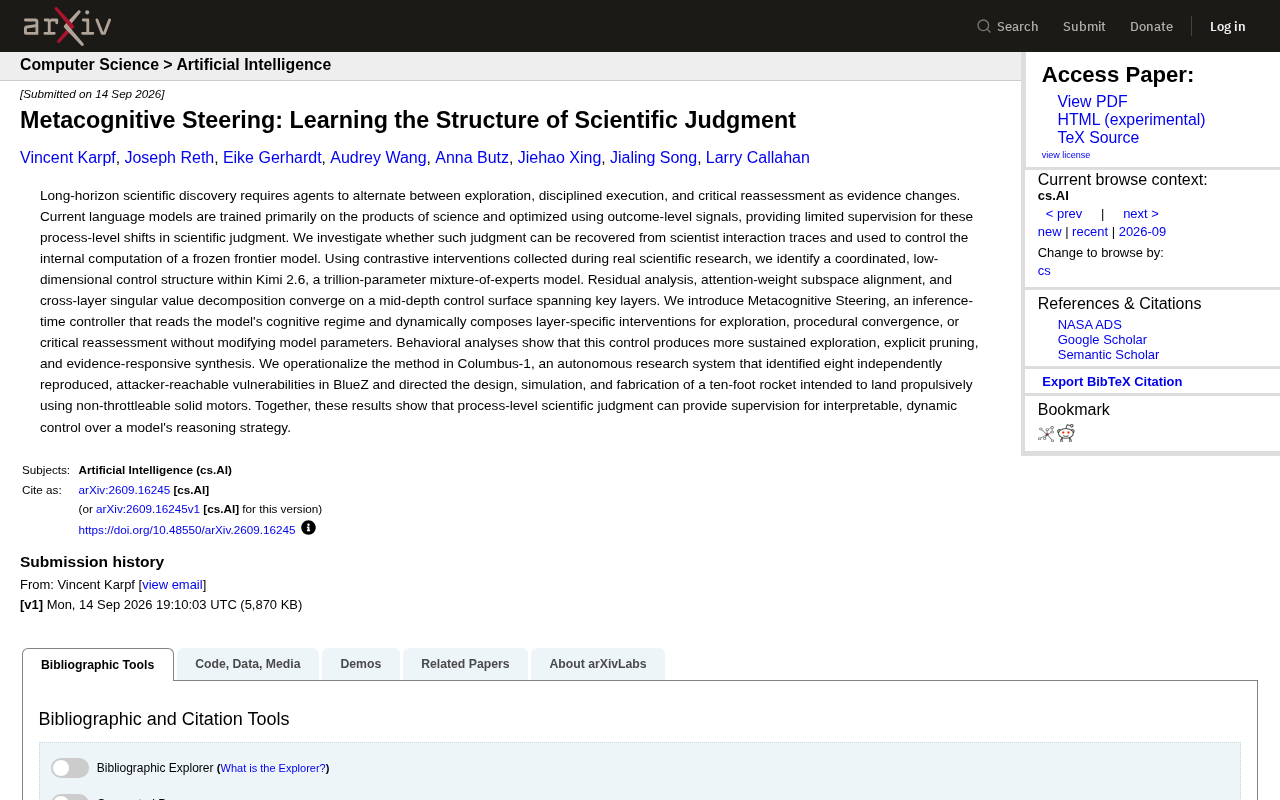
Existing LLMs learn from the products of science — papers, conclusions, and code — but lack supervision over the process-level judgment shifts that real research requires. This arXiv paper proposes Metacognitive Steering, which extracts contrastive intervention signals from scientists' real interaction traces and uses residual analysis, attention subspace alignment, and cross-layer SVD to locate a low-dimensional control surface spanning the middle layers of the trillion-parameter MoE model Kimi 2.6. This surface maps to three human-interpretable cognitive modes — exploration, procedural convergence, and critical re-evaluation — and an inference-time controller dynamically composes layered interventions to steer reasoning without modifying parameters. The Columbus-1 deployment system discovered 8 reproducible vulnerabilities in Linux's BlueZ stack and led the design and simulation of a solid-motor rocket retro-landing, providing cross-domain empirical support for the method's generality.
Long-horizon scientific discovery requires researchers to repeatedly switch between exploration, disciplined execution, and critical re-evaluation. This capacity to adjust judgment as evidence evolves is precisely where current language models fall short — they primarily learn from the products of science and are optimized using outcome-level signals, lacking supervision over these process-level shifts in judgment. A new arXiv paper proposes a method called Metacognitive Steering, which attempts to recover this kind of judgment from scientists' real interaction traces and use it to control the internal computation of a frozen frontier model.
The Problem: Models Learn Scientific Conclusions, Not Scientific Judgment
The core insight of the paper lies in distinguishing between the products and the process of science. Existing large models are trained almost exclusively on completed papers, conclusions, and code, with optimization targets focused on whether the final answer is correct (outcome-level signals). But real scientific work is a dynamic process: knowing when to keep exploring broadly, when to converge toward disciplined execution, and when to overturn a hypothesis and re-evaluate from scratch.
These "process-level" transitions are hard to learn from static scientific outputs. The researchers' approach is to extract this judgment structure from interaction traces left by scientists during real research, and use it to guide the model's reasoning strategy.
Method: Finding a Low-Dimensional "Control Surface" Inside a Trillion-Parameter Model
The research team used Kimi 2.6 — a trillion-parameter Mixture-of-Experts (MoE) model — as their subject. By collecting contrastive interventions from real scientific research processes, they identified a coherent, low-dimensional control structure within the model's internals.
To locate this structure, the paper employed multiple analytical techniques for cross-validation:
- Residual analysis
- Attention-weight subspace alignment
- Cross-layer SVD (Singular Value Decomposition)
All three methods converged on a mid-depth control surface spanning several key layers. In other words, the model's representation of "which cognitive mode it's currently in" is not diffused throughout the entire network, but concentrated in the middle layers — providing an actionable target for intervention.
Mixture-of-Experts (MoE) is an architecture that partitions a large model's parameters into multiple "expert" sub-networks, activating only a small subset during inference, thereby controlling computational cost while keeping total parameter count large. Kimi 2.6's trillion-parameter scale uses this architecture. Locating a control surface in an MoE model is particularly complex, since different inputs route through different expert paths, making the representation distribution more heterogeneous. The fact that the paper identified a cross-layer, low-dimensional structure consistent enough to persist under this dynamic routing suggests that metacognitive state encoding is not bound to specific experts, but is a more globally distributed representational property.
Cross-layer SVD is a key tool for this discovery: by performing singular value decomposition on activation matrices across different layers and comparing the alignment of principal directions, one can test whether a "directional signal" exists stably across layers. When the principal singular vectors across multiple layers are highly aligned, it means the model is propagating consistent hidden-state information between those layers — this is the mathematical basis for the claim of a "low-dimensional control surface."
Core Mechanism: Dynamic Composition of Layered Interventions at Inference Time
Metacognitive Steering is fundamentally an inference-time controller with two key actions:
- Reading the model's current cognitive state — determining whether the model is currently in exploration, procedural convergence, or critical re-evaluation mode;
- Dynamically composing layered interventions — applying interventions corresponding to exploration, convergence, or re-evaluation at different layers to guide reasoning direction.
Critically, the entire process does not modify model parameters. This makes it distinct from fine-tuning — it is an interpretable, controllable, and plug-and-play steering mechanism. Behavioral analysis shows that models steered this way exhibit more sustained exploration, more explicit pruning, and more evidence-responsive synthesis.
Inference-time intervention is an important paradigm in recent controllable generation research, standing alongside fine-tuning and prompt engineering as one of the three main pathways for steering model behavior. The core idea is to directly modify activations at specific layers during the forward pass, shifting them along a pre-computed "target direction" without updating any parameters. This direction is typically extracted via contrastive sample pairs — for example, the activation difference vector between "exploration mode" and "convergence mode" for the same scenario. The innovation of Metacognitive Steering lies in extending this static intervention into a dynamic, multi-directional composite control: the system reads the current activation state in real time, infers the current cognitive mode, and then decides which direction to steer and with what intensity — allowing the model to switch strategies on demand within a single reasoning chain, rather than being locked into a single style.
Empirical Results: Two Achievements from the Columbus-1 Autonomous Research System
The paper doesn't stop at mechanistic explanation — it deploys the method in an autonomous research system called Columbus-1 and presents two compelling demonstrations:
- Security vulnerability discovery: The system identified 8 independently reproducible, attacker-reachable vulnerabilities in the Linux Bluetooth stack BlueZ.
- Engineering design: The system led the design, simulation, and fabrication of a ten-foot-tall rocket aimed at achieving powered retro-propulsion landing using a non-throttleable solid rocket motor — a complex engineering task requiring exceptional judgment and process control.
These two cases span software security and hardware engineering — a wide range of domains — to demonstrate the generality of the control method across real, long-horizon tasks.
BlueZ is the official Bluetooth protocol stack implementation in the Linux kernel, widely present in desktop Linux distributions and embedded devices. Its codebase is large and involves complex protocol parsing logic; historically, several critical vulnerabilities have been disclosed (such as the BleedingTooth series). In security research, automated vulnerability discovery typically relies on coverage-guided fuzzing tools (e.g., syzkaller, AFL++), which offer systematic guarantees on code coverage but are limited in effectiveness against logic vulnerabilities requiring cross-function or cross-protocol-layer reasoning. The paper claims the 8 vulnerabilities found by Columbus-1 are "independently reproducible and attacker-reachable" — if subsequently validated through CVE assignment and community reproduction, this would be one of the few compelling pieces of evidence for autonomous research systems succeeding at real security tasks. However, as a preprint, specific vulnerability types, reproduction details, and comparison baselines against existing tools have yet to be publicly disclosed.
Significance and Reflections
The value of this work lies in offering a path distinct from "pile up data, scale up, and fine-tune." It demonstrates that process-level scientific judgment can itself serve as a supervisory signal for interpretable, dynamic control of a model's reasoning strategy.
From an interpretability standpoint, the ability to locate a low-dimensional control surface inside a trillion-parameter model and map it to human-understandable cognitive modes — exploration, convergence, re-evaluation — is a genuinely interesting finding. It hints that the high-level cognitive behavior of large models may be more structured than we imagined.
Of course, as a newly released preprint, its conclusions still require more replication and scrutiny. While the cases are eye-catching, the actual completion level of tasks like "rocket retro-propulsion landing" and the incremental advantage of the vulnerability discovery over traditional fuzzing tools both deserve more careful evaluation in follow-up work. Overall, this paper provides a novel and actionable framework for thinking about how to supervise a model's scientific judgment capacity.
Related articles

Building an AI-Powered E-Commerce Business from Scratch: A Real-World Account of Multi-Agent Architecture for Print-on-Demand
A blogger builds a print-on-demand e-commerce company from scratch using AI agents — documenting specialized Agent profiles, GPT-5.6 vs Claude Fable multi-model orchestration, and reusable skill accumulation.

AI Agent Earns $10K in One Week: 3 Key Upgrades Explained
A blogger shares how he earned $10K in a week with an AI Agent — not by adding more skills, but through verification, approval gates, and subagents to raise trust and enable true automation.
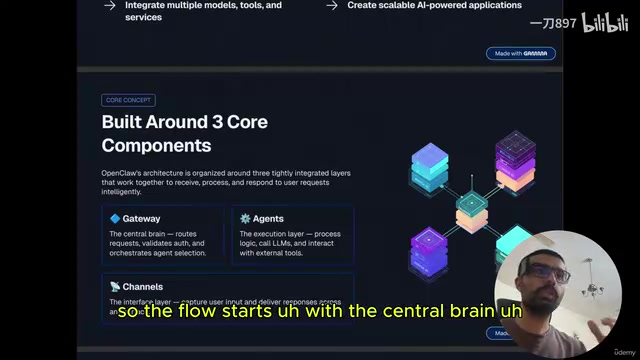
Getting Started with OpenClaw: Multi-Channel AI Agent Gateway and Automated Workflow Guide
OpenClaw is an open-source multi-channel AI agent gateway. This guide covers its three core components — gateway, agents, and channels — plus tool integration and memory mechanisms.