Metal Sandbox: Isolated Execution and Scheduling for GPU Coding Agents on Apple Silicon

Metal Sandbox provides file isolation, command execution, and cross-Mac scheduling for GPU coding agents, significantly boosting GPU utilization.
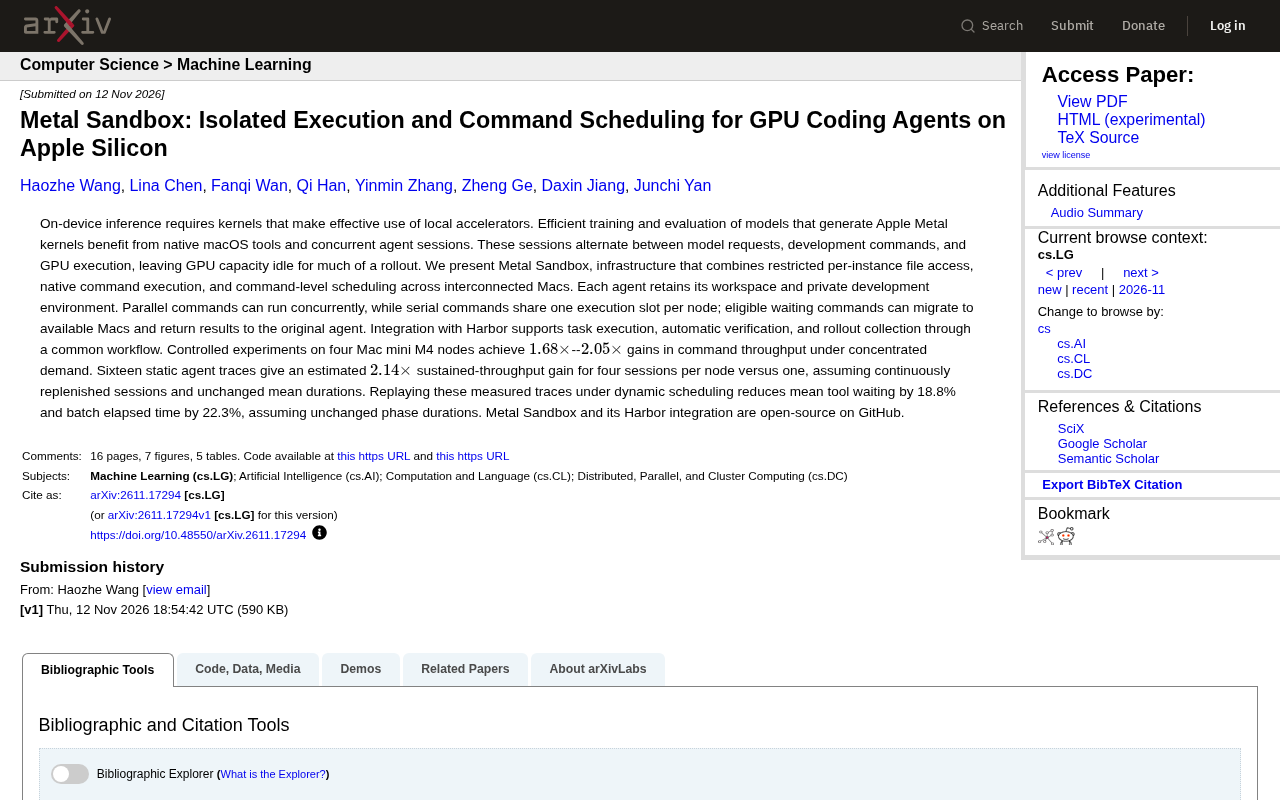
Metal Sandbox is infrastructure for GPU coding agents on Apple Silicon that combines per-instance file isolation, native command execution, and command-level scheduling across interconnected Macs. It separates parallel and serial commands with shared execution slots, allows eligible queued commands to migrate to idle Macs, and integrates with Harbor for unified execution, verification, and rollout collection. Experiments on four Mac mini M4 nodes show 1.68–2.05x higher command throughput, 18.8% lower tool wait, and 22.3% shorter batch duration. The project is open-sourced.
Why GPU Coding Agents Need a Dedicated Sandbox
For on-device inference on Apple Silicon, the key is to let generated Metal kernels fully utilize the local accelerators. When training and evaluating such generative models, native macOS tooling and concurrent agent sessions can deliver clear gains. But in practice, these sessions bounce back and forth between model requests, development commands, and GPU execution, leaving GPU capacity idle for most of the rollout time.
To address this pain point, researchers introduced Metal Sandbox — an infrastructure designed for GPU coding agents. It brings three things together: per-instance file access restriction, native command execution, and command-level scheduling across interconnected Macs. Each agent keeps its own workspace and private development environment without interfering with others.
GPU coding agents refer to a class of AI agents specifically designed to write, optimize, and validate GPU kernels (such as Metal shaders and CUDA kernels). Unlike general coding agents, they need to frequently invoke compilers and GPU runtimes for real execution to evaluate kernel performance, making them heavily dependent on local accelerator resources. Rollout, in the context of reinforcement learning and agent evaluation, refers to the complete execution trajectory of an agent from receiving a task to producing a result, including multiple rounds of model requests, tool calls, and command execution; training or evaluating generative models typically requires massive numbers of rollouts, and within each rollout the GPU is often actually busy for only a small fraction of the time — this is exactly what “GPU capacity idle for most of the rollout time” means in the text.
Isolation and Scheduling: Keeping the GPU Busy
Workspace Isolation and Execution Slots
Metal Sandbox's isolation strategy is built at the filesystem level: each agent instance can only access authorized files, and its development environment is private. This allows multiple agents to work in parallel without state contamination or permission overreach.
For command execution, the system distinguishes two modes. Parallel commands can run simultaneously, fully utilizing the GPU; serial commands share a single execution slot per node, avoiding resource contention. If a command queued on some node meets the migration conditions, it can be scheduled to run on an idle Mac, with the result returned to the original agent. This design lets compute resources flow at the cluster level rather than being pinned to a single node.
Execution slot is a concurrency-control abstraction: each node maintains a fixed number of slots, and a command must acquire a slot to run, thereby limiting the number of simultaneously executing tasks and avoiding GPU and memory contention. Serial commands sharing a single slot means such commands on the same node execute in order; command migration means the scheduler determines that a queued command is not strongly bound to its target node (for example, it does not depend on node-local files or state), forwards it to another idle Mac for execution, and then returns the result to the original agent. This mechanism is essentially load balancing at the cluster level, aggregating scattered idle compute into a schedulable resource pool.
Integration with Harbor
Metal Sandbox integrates with Harbor, supporting task execution, automatic verification, and rollout collection through a unified workflow. This means the entire lifecycle of an agent — from receiving a task and executing commands to result verification — can be completed within a coherent framework, reducing the overhead of manual handoffs.
Harbor here refers to the orchestration and evaluation framework for agent tasks, responsible for dispatching tasks, driving agent execution, automatically verifying outputs, and collecting rollout data. Integrating the sandbox with Harbor means the isolation environment and scheduling capabilities are exposed to the upper-level workflow through a unified interface; agents do not need to be aware of which Mac underlies the system or whether slots are idle, and the process from task dispatch to verification forms a closed loop. This layered design allows the sandbox to be reused by different agents or training pipelines, and makes it easy to compare the effects of different scheduling strategies within the same framework.
Measured Results: Improvements in Throughput and Wait Time
Controlled experiments on four Mac mini M4 nodes showed that command throughput improved by 1.68x to 2.05x under centralized demand. Another set of estimates based on sixteen static agent trajectories indicates that, assuming sessions are continuously replenished and average duration remains unchanged, four sessions per node can achieve roughly 2.14x sustained throughput gain compared with a single session.
Trajectory replay under dynamic scheduling showed that average tool wait time decreased by 18.8% and batch duration decreased by 22.3% (assuming stage durations remain unchanged). These numbers come from controlled experiments and trajectory replay, reflecting the actual effect of the scheduling strategy in reducing idle waiting.
Open Source and Significance
Metal Sandbox and its Harbor integration are open-sourced on GitHub. For teams building GPU coding agents on Apple Silicon, this infrastructure provides a reusable isolation and scheduling solution. What it solves is not a model capability problem but an engineering efficiency problem — making expensive GPU time more fully utilized and resource allocation during multi-agent collaboration more reasonable. As demand for on-device inference continues to grow, the value of such low-level scheduling tools will only become more apparent.
One-line Summary
Metal Sandbox provides file isolation, command execution, and cross-Mac scheduling for GPU coding agents, significantly improving GPU utilization.
Paragraph Summary
Metal Sandbox is an infrastructure designed for GPU coding agents. Targeting the problem of GPUs sitting largely idle during rollouts in on-device inference scenarios on Apple Silicon, it integrates per-instance file access restriction, native command execution, and command-level scheduling across interconnected Macs. The system implements workspace isolation at the filesystem level, with each agent having a private development environment; command execution distinguishes parallel and serial modes, serial commands share node execution slots, and eligible queued commands can be migrated to idle Macs for execution with results returned. Integration with Harbor forms a unified workflow for task execution, automatic verification, and rollout collection. Experiments on four Mac mini M4 nodes show command throughput improved by 1.68x to 2.05x, while trajectory replay shows average tool wait decreased by 18.8% and batch duration reduced by 22.3%. The project is open-sourced.
Related articles

AI Writes Your Code—Do You Still Need to Learn Git? Five Reasons
AI coding agents handle Git operations automatically—is it still necessary to learn Git? Five reasons: team communication, reviewing agent PRs, monitoring code changes, fallback when AI goes down, and the joy of learning—plus how the focus of learning Git is shifting in the agent era.

Anthropic Reportedly Prices IPO at $83 Per Share, Valuing Company at $1.5 Trillion
Anthropic reportedly prices IPO at $83 per share, above the expected range, with a fully diluted valuation of $1.5 trillion. This article analyzes the signal significance of the pricing and its impact on the AI industry's financing environment.

Open-Source Code Hosting Platform Codeberg Suffers Outage, Sparking Debate in Developer Community
Open-source code hosting platform Codeberg.org suffered an outage, sparking Hacker News debate over nonprofit platform stability and open-source infrastructure dependency risks.