MetaRigor: A Decision-Boundary Framework for Verifiable LLM-Based Meta-Analysis

MetaRigor uses task contracts and procedural rules to maintain result identity and enable verifiable end-to-end meta-analysis automation.
This article introduces the MetaRigor framework, which addresses the core problem of result-identity misalignment causing error propagation in automated meta-analysis. It binds each data point as a Study × Target unit and operationalizes scientific decision boundaries through task contracts, procedural rules, and source binding, letting models handle semantic interpretation while programs handle deterministic validation. In five-stage controlled evaluation, it achieves 86.29% F1 on complete result delivery and 80.20% agreement on domain-level certainty of evidence; seven-case end-to-end comprehensive F1 is 77.01%, 9.78 points above the strongest baseline, with a human-evaluated manuscript score of 86.00.
The core challenge of automated meta-analysis goes far beyond accurately extracting numbers from papers. As a study result moves through the pipeline, it must always carry complete identity information—which study it comes from, which comparison it belongs to, which population it targets, which outcome it evaluates, at which timepoint, and under what analytical conditions. Any misalignment or omission at any link can be amplified into erroneous conclusions in subsequent statistics.
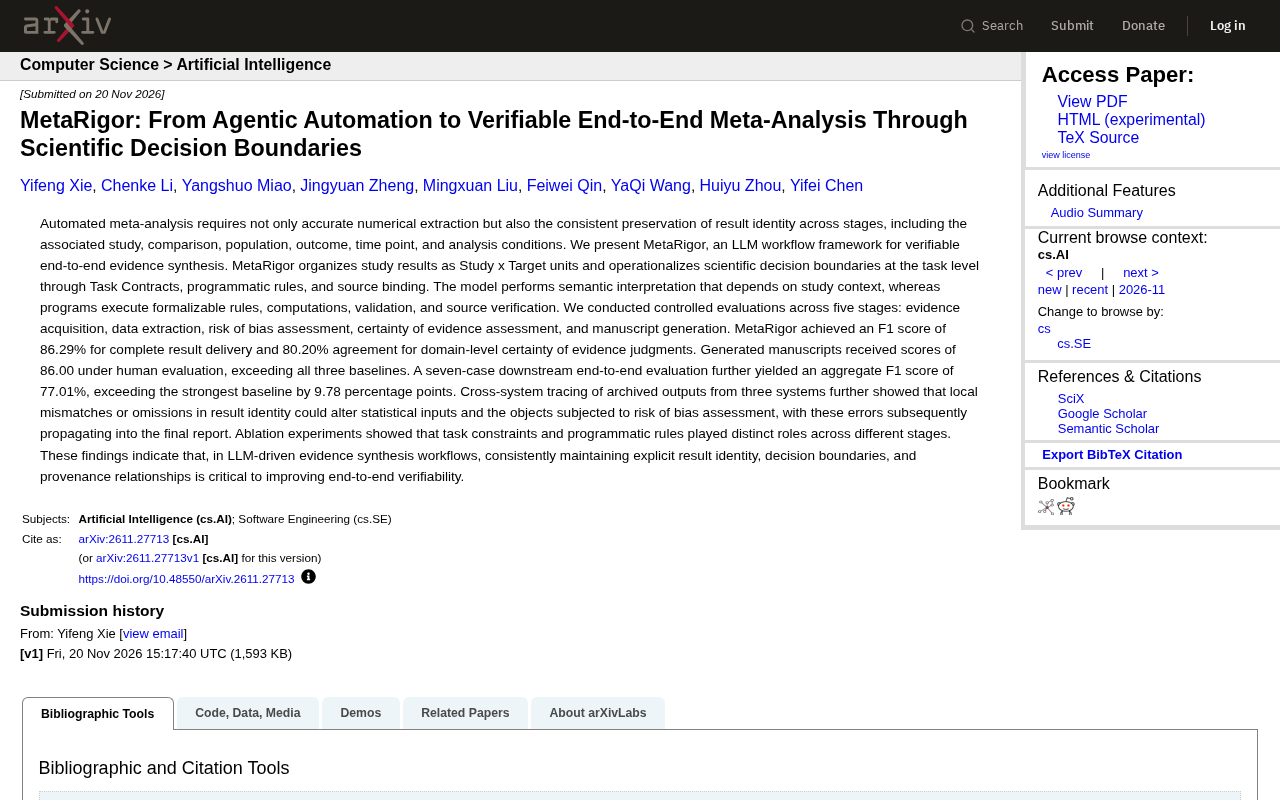
A recent study titled "MetaRigor: From Agentic Automation to Verifiable End-to-End Meta-Analysis Through Scientific Decision Boundaries" proposes an LLM workflow framework centered on exactly this problem. Its goal is not to make the model "write more intelligently," but to make the entire evidence synthesis process traceable and verifiable.
Result Identity: The Overlooked Verification Blind Spot
MetaRigor organizes study results into "Study × Target" units, binding each data point to its study, comparison, population, outcome, and timepoint. This design targets a common but insidious failure mode: the model may correctly extract a numerical value but attach it to the wrong study or comparison.
By tracing three systems' archived outputs across systems, the paper found that local misalignment or omission at the result-identity level directly alters statistical inputs and also changes the objects to which risk-of-bias assessments apply—and these errors then propagate all the way to the final report. In other words, numerical accuracy does not equal result correctness; identity consistency is the prerequisite for end-to-end verifiability.
"Result Identity" in meta-analysis In the methodology of systematic reviews and meta-analyses, each effect size is nested within a multi-layered structure: Study → Comparison (e.g., intervention A vs. control B) → Population → Outcome → Timepoint. Traditional data extraction only requires numerical correctness, but meta-analytic statistical models rely on effect sizes from "the same comparison, the same outcome, the same timepoint" to be pooled. If a data point is mistakenly attached to another comparison or outcome, it can shift the pooled effect size, distort heterogeneity estimates, and even change the direction of conclusions. Result Identity refers to this unique combination of identifiers. In automated pipelines, LLMs often confuse identity labels due to context-window limitations or semantic similarity, and such errors are difficult to detect through numerical validation—hence the need for explicit identity binding and cross-stage tracking mechanisms.
Task Contracts: Writing Scientific Decision Boundaries into the Pipeline
MetaRigor's core mechanism operationalizes "scientific decision boundaries" at the task level through Task Contracts, procedural rules, and source binding. The division of labor is clear: the model handles semantic interpretation that depends on research context, while programs execute formalizable rules, computations, validation, and source verification.
This separation of model and program addresses a fundamental tension in LLM-based evidence synthesis—semantic judgment requires flexibility, while verifiability demands determinism. Mixing the two makes the process both difficult to audit and difficult to reproduce. MetaRigor's approach is to let the model do only what it excels at and delegate the parts requiring strict consistency to deterministic code.
Scientific Decision Boundaries refer to the dividing line in evidence synthesis between which judgments must be made by humans (or equivalent deterministic rules) and which can be delegated to model-based semantic interpretation. For example, judging "whether a study should be included in the pooling of a given outcome" involves clinical heterogeneity and methodological quality—a scientific decision; whereas "whether the direction of an effect size needs to be reversed" can be executed by a program according to preset rules. Operationalizing decision boundaries as Task Contracts means defining input/output specifications, permitted operation ranges, and validation conditions for each subtask, so that LLM outputs must fall within an auditable contractual framework. This concept draws on Design by Contract from software engineering and aims to make implicit methodological decisions explicit, thereby supporting reproducibility and peer review—it is the key bridge connecting automation efficiency and scientific rigor.
Performance in the Five-Stage Controlled Evaluation
The paper conducted controlled evaluations across five stages: evidence acquisition, data extraction, risk-of-bias assessment, certainty-of-evidence assessment, and manuscript generation. MetaRigor achieved an F1 score of 86.29% on complete result delivery and 80.20% agreement on domain-level certainty-of-evidence judgments.
Generated manuscripts received a score of 86.00 under human evaluation, surpassing all three baseline systems. In a seven-case downstream end-to-end evaluation, the framework achieved a comprehensive F1 score of 77.01%, 9.78 percentage points higher than the strongest baseline. These numbers cover the full pipeline from data entry to report output, rather than isolated local metrics.
What F1 scores and agreement metrics mean in meta-analysis evaluation: F1 is the harmonic mean of precision and recall. In result-delivery evaluation, it measures the system's ability to correctly and completely output target units (e.g., the effect size for a given study and outcome); an F1 of 86.29% indicates a good balance between correctness and completeness. Domain-level certainty-of-evidence agreement (80.20%) typically refers to the degree of concordance between system judgments and expert consensus on certainty rating dimensions such as GRADE, reflecting the reliability of semantic judgments. The seven-case end-to-end comprehensive F1 (77.01%) compares the entire pipeline's output against a gold standard unit by unit; being 9.78 percentage points above the strongest baseline shows that the improvement does not come from any single stage but from the cumulative effect of identity maintenance and rule constraints across the full pipeline. The human-evaluated manuscript score (86.00) supplements automated metrics from dimensions such as readability, structural completeness, and methodological accuracy.
Ablation Experiments Reveal Division-of-Labor Differences
Ablation experiments show that task constraints and procedural rules play different roles at different stages. This suggests a practical judgment: verifiability cannot be entrusted to a single mechanism but requires configuring constraint strength according to stage characteristics. Which stages depend on semantic interpretation and which must be locked down by programs is an architectural decision that cannot be avoided when designing LLM-based evidence synthesis workflows.
Implications for LLM Research Workflows
MetaRigor's conclusions point to a more general principle: in LLM-driven evidence synthesis, continuously maintaining explicit result identity, decision boundaries, and source relationships is key to improving end-to-end verifiability. This judgment has direct reference value for scenarios with high traceability requirements, such as systematic reviews and clinical guideline development.
The framework is currently a workflow-level solution, and its evaluation covers five stages and seven end-to-end cases; its performance at scale remains to be further observed. But the question it raises—how model automation and scientific rigor can coexist—deserves serious attention from anyone building AI tools for research.
Related articles

ChatGPT Plus Subscription Pitfall Guide: Go/Plus/Pro Tier Comparison and Quick Activation
A complete ChatGPT Plus subscription guide based on a Bilibili tutorial: from registering an account, comparing Go/Plus/Pro tiers, to the practical steps for quickly completing your subscription.

GPT-6.2 Sol/Astra Released! A Step-by-Step ChatGPT Plus Subscription Guide and Tier Comparison
GPT-6.2 Sol/Astra is out—here's a ChatGPT Plus subscription guide: register an account, compare Go/Plus/Pro tiers, and subscribe in a minute.

Comparing Three Channels for Subscribing to GPT Plus in China: Is Website Top-Up the Easiest?
How to subscribe to GPT Plus in China? This article compares website top-up, credit card, and mobile top-up channels—process, cost, and risk—with steps and tips to help you choose wisely.