Metrics-in-the-Loop: How Real-Time Complexity Feedback Reshapes Coding Agents

Metrics-in-the-Loop injects complexity and coverage feedback into coding agent trajectories to curb structural code degradation.
Coding agents often rely solely on passing tests, which fail to reveal accumulating complexity and coverage blind spots that worsen during long-horizon tasks. Metrics-in-the-Loop is an inference-time intervention that, after each code change, computes cyclomatic complexity and test coverage, injecting short messages about threshold-exceeding complexity and uncovered changed lines into the agent's context so it can refactor or add tests before continuing—what the authors call "re-railing." Experiments on three long-horizon benchmarks show complexity feedback significantly reduces code complexity concentration (erosion) without affecting held-out correctness. The work highlights process quality in agent evaluation and offers a low-cost, toolable inference-time alignment approach for long-term maintainability of large codebases.
Title
Metrics-in-the-Loop: How Real-Time Complexity Feedback Reshapes Coding Agents
Meta Description
A study proposes Metrics-in-the-Loop, injecting complexity and coverage feedback during a coding agent's reasoning to significantly reduce code complexity concentration without affecting correctness, providing maintainability guarantees for long-horizon autonomous coding.
Article Content
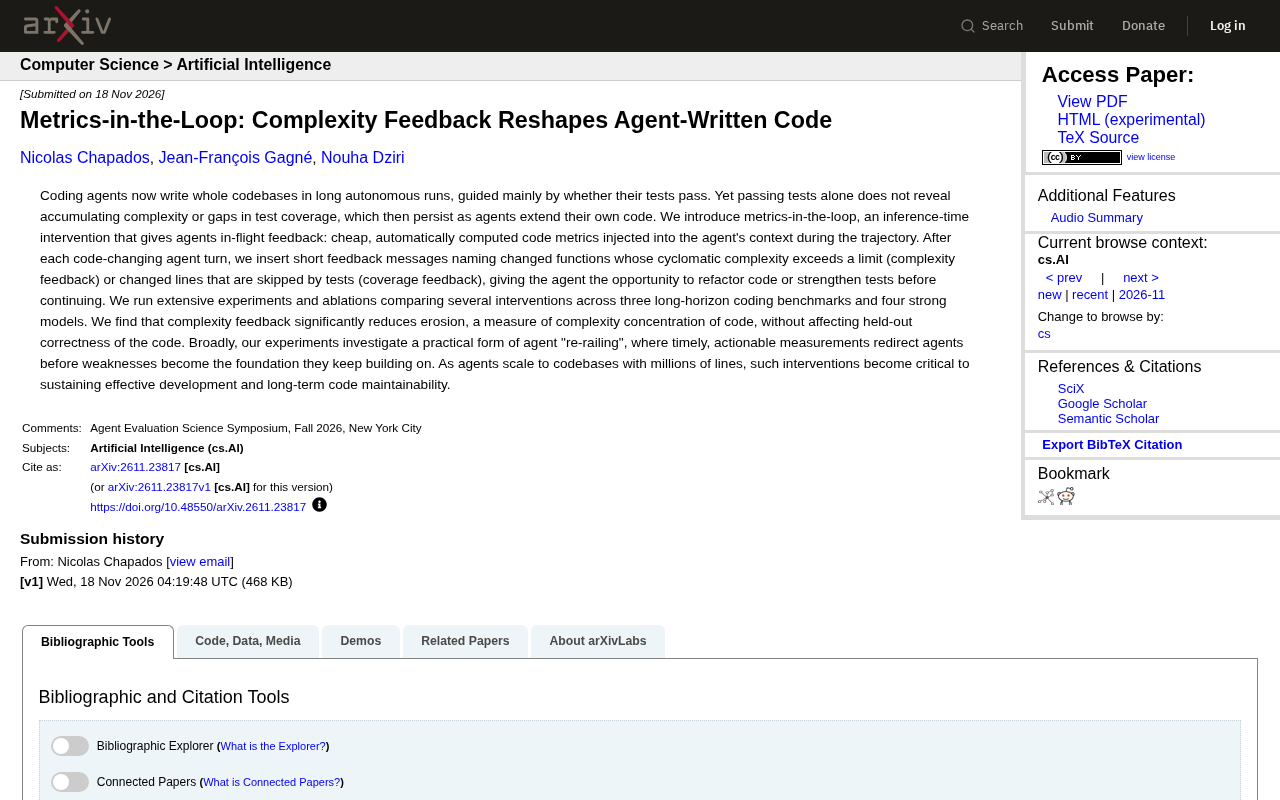
Coding agents can already write complete codebases during long autonomous runs, with their behavior guided primarily by whether tests pass. However, passing tests are insufficient to reveal the complexity accumulating in code and the blind spots in test coverage—problems that persist and worsen as agents extend their own code. A study called "Metrics-in-the-Loop" proposes an inference-time intervention: injecting cheap, automatically computed code metrics into the agent's context to give it in-flight feedback along its trajectory.
Passing Tests Does Not Equal Healthy Code
The current mainstream paradigm for coding agents is "test-driven": as long as tests pass, the agent considers the task complete. But tests only cover explicitly checked behavior. For structural degradation of code—such as surging cyclomatic complexity, bloated functions, or critical logic skipped by tests—the test signal is nearly silent.
As agents continuously self-extend during long-horizon tasks, these structural problems compound like interest. A once-clear function may become complex and hard to understand due to subsequent patches; newly added logic may become a breeding ground for future bugs because tests don't cover it. More critically, in later iterations the agent treats this flawed code as a "foundation" to keep building on, causing maintenance costs to rise exponentially.
The paper's authors call this degradation "erosion," i.e., the concentration of complexity in code. It does not directly cause test failures, yet it gradually strips the codebase of maintainability.
Cyclomatic Complexity is a software metric that measures the control-flow complexity of a function or method, proposed by Thomas J. McCabe in 1976. It counts the number of linearly independent paths in a program's control-flow graph, roughly equal to the number of decision points (such as if, while, for, case, logical and/or) plus one. Higher cyclomatic complexity means more possible branch paths in a function, making the code harder to understand, test, and maintain—because the number of test cases needed to cover all paths grows exponentially with complexity. A common rule of thumb is that a single function's cyclomatic complexity should not exceed 10; beyond that is considered a refactoring signal. In the coding-agent setting, cyclomatic complexity is a cheap, automatically computable structural metric that is well suited as a real-time feedback signal injected into the agent's reasoning loop, helping it perceive structural degradation beyond passing tests.
The Intervention Mechanism of Metrics-in-the-Loop
The core idea of Metrics-in-the-Loop is to insert lightweight feedback messages into the agent's reasoning trajectory. Specifically, after each agent turn that changes code, the system automatically computes two types of metrics:
- Complexity feedback: identifies changed functions whose cyclomatic complexity exceeds a threshold and alerts the agent.
- Coverage feedback: finds changed lines of code skipped by tests and informs the agent.
These feedback messages are injected into the context as short messages, giving the agent a chance to refactor code or strengthen tests before continuing. Unlike post-hoc code review, this intervention happens while the agent is still "thinking," so it is more likely to be adopted and corrected immediately.
The authors call this mechanism "re-railing"—using timely, actionable metrics to steer the agent back on track before weaknesses become foundations.
Inference-time Intervention refers to techniques that guide model behavior by modifying the context, injecting additional information, or imposing constraints during generation or at intermediate points in the generation trajectory, without retraining or fine-tuning the model. Unlike training-time alignment (such as RLHF), inference-time intervention is low-cost, immediately deployable, and easy to customize for specific tasks. Common forms include inserting feedback messages into prompts, attaching diagnostic information to tool-call results, or dynamically correcting intermediate outputs. Metrics-in-the-Loop is a typical application of this paradigm: it automatically computes metrics after each code change by the agent and appends them as new messages to the conversation trajectory, so that the model "sees" these signals in subsequent reasoning and adjusts its behavior accordingly. This approach is essentially context engineering, an important direction for improving agent reliability today.
Coverage feedback usually refers to code coverage metrics, which measure which parts of the source code are executed by test cases. The most common are line coverage and branch coverage: the former counts the proportion of code lines executed by at least one test, and the latter counts the proportion of control-flow branches covered. Coverage tools (such as Python's coverage.py, JavaScript's Istanbul/nyc, and Java's JaCoCo) can automatically instrument and generate reports when tests run. In this study, coverage feedback focuses on "changed lines of code skipped by tests"—code newly written or modified by the agent that existing tests do not cover. These blind spots are breeding grounds for future bugs, because the passing-test signal is entirely silent for these lines. Injecting information about uncovered lines into the agent's context can prompt it to proactively add tests or simplify logic (for example, removing dead code or merging redundant branches), thereby immediately shrinking test blind spots along the trajectory.
Experimental Design and Key Findings
The research team conducted extensive experiments and ablations on three long-horizon coding benchmarks, compared multiple intervention approaches, and used four strong models. The experimental results show that complexity feedback significantly reduces the concentration of code complexity (i.e., erosion) without affecting correctness on held-out sets.
This means that after receiving complexity feedback, the agent can proactively refactor code and reduce complexity buildup without sacrificing functional correctness. The effects of coverage feedback are not detailed in the abstract, but as another intervention under the same framework, it likewise aims to fill test blind spots.
One detail: complexity feedback did not make the agent "slower" or "worse"—there was no significant difference in held-out correctness, indicating that the refactoring behavior is safe, or that the agent can improve structure without breaking functionality.
Why This Matters: Long-Term Code Maintainability
As agents are used to write projects with millions of lines of code, this intervention becomes crucial. Without real-time metric feedback, an agent may produce a codebase where all tests pass but the structure is a disaster. With Metrics-in-the-Loop, developers can maintain long-term maintainability without adding extra manual review.
This study also points to a broader direction: agent evaluation should not rely only on final outcomes (passing tests) but should also consider process quality. By embedding lightweight, automated metrics into the reasoning loop, we can guide agents toward better engineering decisions without significantly increasing cost.
For teams using or building coding agents, this means adding a similar real-time metric feedback layer to the agent's toolchain as a complement to existing test signals. This does not require changing the model itself—only working on context engineering—making it a practical means of "inference-time alignment."
One-line Summary
Metrics-in-the-Loop injects complexity and coverage feedback into the coding agent's trajectory to suppress structural code degradation.
Paragraph Summary
Coding agents often treat passing tests as the sole signal of task completion, but tests cannot reveal accumulating code complexity and coverage blind spots; in long-horizon tasks these structural problems worsen like compound interest. Metrics-in-the-Loop proposes an inference-time intervention: after each code change by the agent, it automatically computes cyclomatic complexity and test coverage, and injects into the agent's context short messages about complexity concentrations exceeding thresholds and changed lines not covered by tests, giving it a chance to refactor or strengthen tests before continuing to build—what the authors call "re-railing." Experiments on three long-horizon coding benchmarks show that complexity feedback significantly reduces code complexity concentration (erosion) without affecting held-out correctness, indicating that the agent can proactively improve structure without breaking functionality. This work suggests that agent evaluation should account for process quality and provides a low-cost, toolable inference-time alignment approach for the long-term maintainability of large codebases.
Related articles

ChatGPT Plus Subscription Pitfall Guide: Go/Plus/Pro Tier Comparison and Quick Activation
A complete ChatGPT Plus subscription guide based on a Bilibili tutorial: from registering an account, comparing Go/Plus/Pro tiers, to the practical steps for quickly completing your subscription.

GPT-6.2 Sol/Astra Released! A Step-by-Step ChatGPT Plus Subscription Guide and Tier Comparison
GPT-6.2 Sol/Astra is out—here's a ChatGPT Plus subscription guide: register an account, compare Go/Plus/Pro tiers, and subscribe in a minute.

Comparing Three Channels for Subscribing to GPT Plus in China: Is Website Top-Up the Easiest?
How to subscribe to GPT Plus in China? This article compares website top-up, credit card, and mobile top-up channels—process, cost, and risk—with steps and tips to help you choose wisely.