Mexican Developer Josue's AI Agent Journey in Practice

Traditional ops and web developers are accelerating their shift to AI Agent development, with systems experience becoming a key advantage for deployment.
Using Mexican freelance developer Josue's self-introduction as a starting point, this article analyzes how traditional developers with networking, Linux server, and web systems backgrounds are migrating to AI Agents. Their systems design and operations experience fills engineering gaps, while freelancers with direct client access pioneer Agent practice. New skills in prompt engineering, memory management, and observability are needed, and community learning accelerates knowledge accumulation.
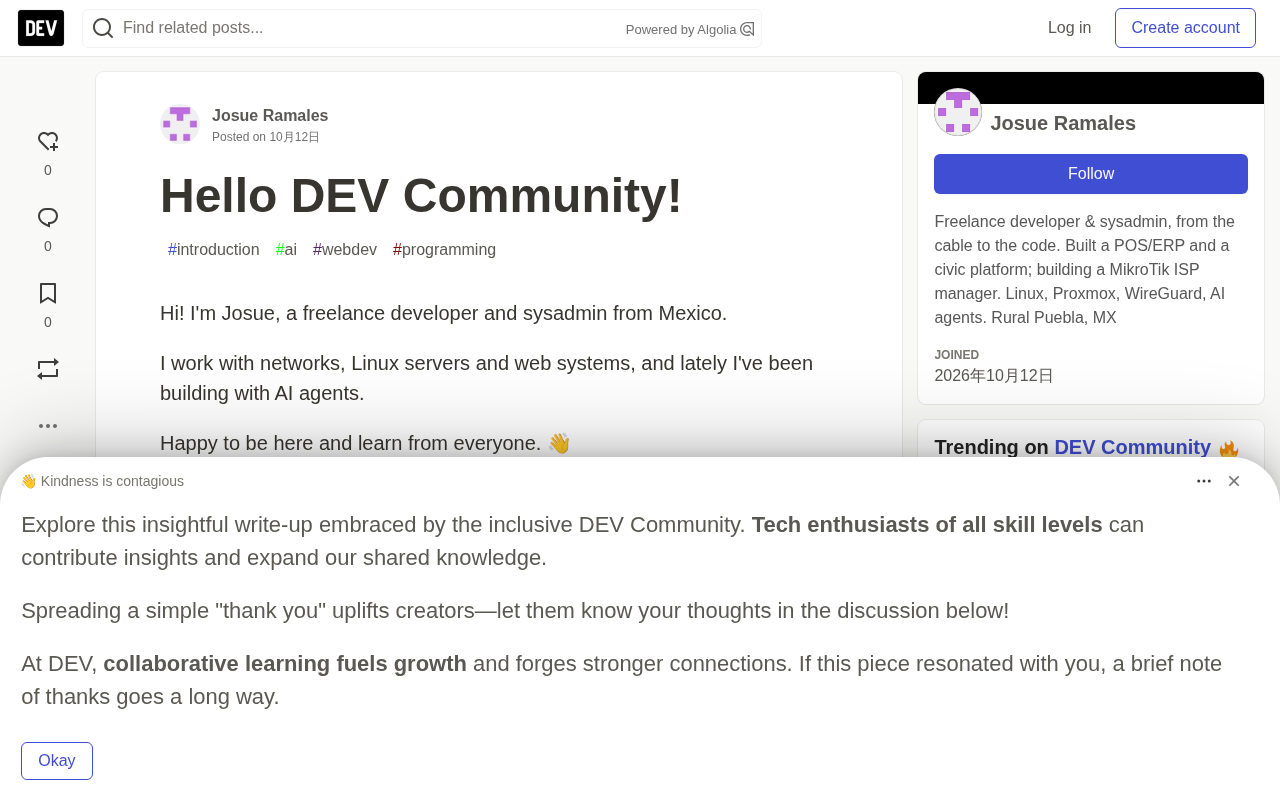
A freelance developer from Mexico named Josue posted a self-introduction on the DEV community. His technical background spans networking, Linux servers, and web systems, but his recent focus has shifted toward AI Agent development. Behind this brief post lies an industry trend worth paying attention to: traditional ops and web developers are accelerating their migration to the AI application layer.
From Network Operations to AI Agents: A Natural Path of Technical Evolution
Josue's self-introduction is brief, but the tech stack information it carries is substantial. The three areas he mentions—networking, Linux servers, and web systems—form the classic triangle of traditional IT infrastructure. Developers with this kind of background typically possess system-level thinking: they understand how services are deployed, how processes are scheduled, and how network requests flow between layers.
This is precisely one of the scarcest capabilities when building AI Agents. AI Agents aren't just about calling APIs for text generation—they involve tool calling, state management, task orchestration, error retries, and concurrency control. These are fundamentally system design problems. A developer familiar with Linux servers and network protocols has a distinct advantage over those with purely algorithmic backgrounds when setting up Agent runtime environments and handling asynchronous tasks.
Josue's decision to move from traditional infrastructure to AI Agents is no coincidence. As Agent frameworks gradually mature, the barriers to deployment and operations have actually become the bottleneck. Who ensures the stability of Agent services? Who handles tool call timeouts? Who designs communication protocols between multiple Agents? These questions happen to fall squarely within the range of developers with operations experience.
AI Agent refers to an intelligent system capable of autonomously perceiving its environment, making decisions, and taking actions to accomplish specific goals, typically using large language models (LLMs) as its reasoning core. Unlike traditional chatbots, AI Agents have tool-calling capabilities, can access external APIs, databases, or file systems, and can dynamically plan their next actions based on task progress. Their typical architecture includes a planning module, a memory module, a toolset, and an execution loop, enabling them to handle complex, multi-step, cross-system tasks. Current mainstream Agent frameworks include LangChain, AutoGPT, CrewAI, and others, which provide infrastructure for task orchestration, state management, and multi-Agent collaboration. The key to understanding Agents is recognizing that they are not merely "smarter chat interfaces" but software systems that require engineered deployment, monitoring, and tuning—which also explains why systems operations experience has irreplaceable value in this field.
Why Freelance Developers Are Becoming the Pioneers of AI Agents
Josue's identity is that of a freelance developer, and this positioning deserves elaboration. Freelance developers have an underappreciated advantage in the AI Agent wave: they directly face clients' real needs.
In the process of taking on projects on the front lines, freelance developers are the first to sense which repetitive tasks can be replaced by Agents. Whether it's automated customer support, data scraping and organization, or cross-platform content publishing, these needs often emerge first in freelance developers' projects before being productized.
Another dimension is flexibility in technology choices. Freelance developers aren't constrained by a large company's tech stack and can choose the most suitable Agent frameworks and toolchains for each project. This flexibility allows them to iterate quickly and accumulate first-hand Agent-building experience.
AI Agent Development Is Reshaping Developers' Skill Maps
In his post, Josue says "lately I've been building with AI agents." This statement represents a typical state for a certain class of developers. For developers with systems operations backgrounds, the skills needed to enter the AI Agent field are mainly concentrated in several areas:
Prompt Engineering and Tool Design—How to define clear tool interfaces for Agents, how to write reliable system prompts—these directly determine the quality of an Agent's behavior.
State and Memory Management—Agents need to maintain context across multiple rounds of interaction. Vector databases, conversation history compression, and long-term memory storage are all components that need to be mastered.
Evaluation and Observability—Traditional service monitoring metrics (latency, error rates) are insufficient in Agent scenarios. You also need to track reasoning chains, tool call success rates, hallucination rates, and more.
These skills complement traditional operations experience rather than replacing it.
Vector databases are a key component in AI Agent memory management, used to store and retrieve vector representations (embeddings) of text. Traditional databases look up data through exact matching or keyword search, while vector databases find semantically relevant content by computing similarity between vectors (such as cosine similarity). In Agent scenarios, vector databases are often used to implement Retrieval-Augmented Generation (RAG), allowing Agents to quickly recall knowledge relevant to the current conversation from large document collections, thereby improving the accuracy and timeliness of responses. Common vector databases include Pinecone, Weaviate, Chroma, and Qdrant. Observability refers to the ability to understand a system's internal state through the three pillars of Logs, Metrics, and Traces. In Agent systems, observability goes beyond traditional latency and error rates—it also requires tracking the inputs and outputs of each reasoning step, the parameters and results of tool calls, and the overall task success rate. This data is crucial for debugging and continuously optimizing Agent behavior.
Community Learning: The Accelerator for Developers in the AI Era
At the end of his post, Josue expresses his desire to "learn from everyone." This open attitude is especially important in the AI field, because practical knowledge about AI Agents is highly fragmented, and best practices are updated daily.
The DEV community, GitHub, and Discord groups form a loose but efficient knowledge network. A freelance developer in Mexico can exchange hard-won lessons with Agent builders around the world—something that was hard to imagine just a few years ago. For developers considering a move into AI Agents, joining such communities may be the highest-value first step.
Josue's post itself contains no technical deep-dives, but it is a signal: the barrier to entry for AI Agents is lowering, and developers from diverse backgrounds are pouring in. The next round of competition isn't about who understands models better—it's about who can actually land Agents in usable systems.
One-line Summary
Traditional ops and web developers are accelerating their shift to AI Agent development, with systems experience becoming a key advantage for real-world deployment.
Paragraph Summary
Using Mexican freelance developer Josue's self-introduction as a starting point, this article analyzes an industry trend: traditional developers with backgrounds in networking, Linux servers, and web systems are migrating to the AI Agent space. It points out that these developers' experience in system design, deployment operations, and asynchronous task handling precisely fills the engineering gaps in AI Agent deployment. Freelance developers, with direct access to client needs and flexible technology choices, are becoming the pioneering group in Agent practice. Transitioning to Agent development requires acquiring new skills in prompt engineering, memory management, and observability, while community exchange becomes an important channel for accumulating fragmented knowledge. The ultimate conclusion: the competitive focus of AI Agents is shifting from model capability to system deployment capability.
Related articles

How Big Can Stars Really Get? The Physical Limits of the Largest Stars
Red supergiants are the largest stars by volume, with radii up to 2,000 times the Sun, engulfing the inner solar system. But there is no precise upper limit on stellar size—models predict up to 15,000 solar radii. The most massive blue stars are far smaller than red supergiants—biggest and heaviest are two different things.

Apple HomeView Smart Display Full Feature Breakdown: Wall-Mount or Desktop, $299
Apple launches HomeView, a $299 smart display with wall-mount and desktop options, 12MP camera for facial recognition, smart home control, music playback, and recipe step-by-step cooking. Full breakdown of watch faces, apps, privacy, and cooking integration.

Where Did the Promised New Studio Go? Craft Computing Answers After Five Years
Craft Computing's host responds to viewer questions: the new studio promised five years ago was shelved as construction costs soared from $30,000 to $75,000, and was replaced by a 168-square-foot garage conversion.