Microduck: A Bipedal Robot Duck Built with Rust, Gaining 421 Stars on GitHub in One Day
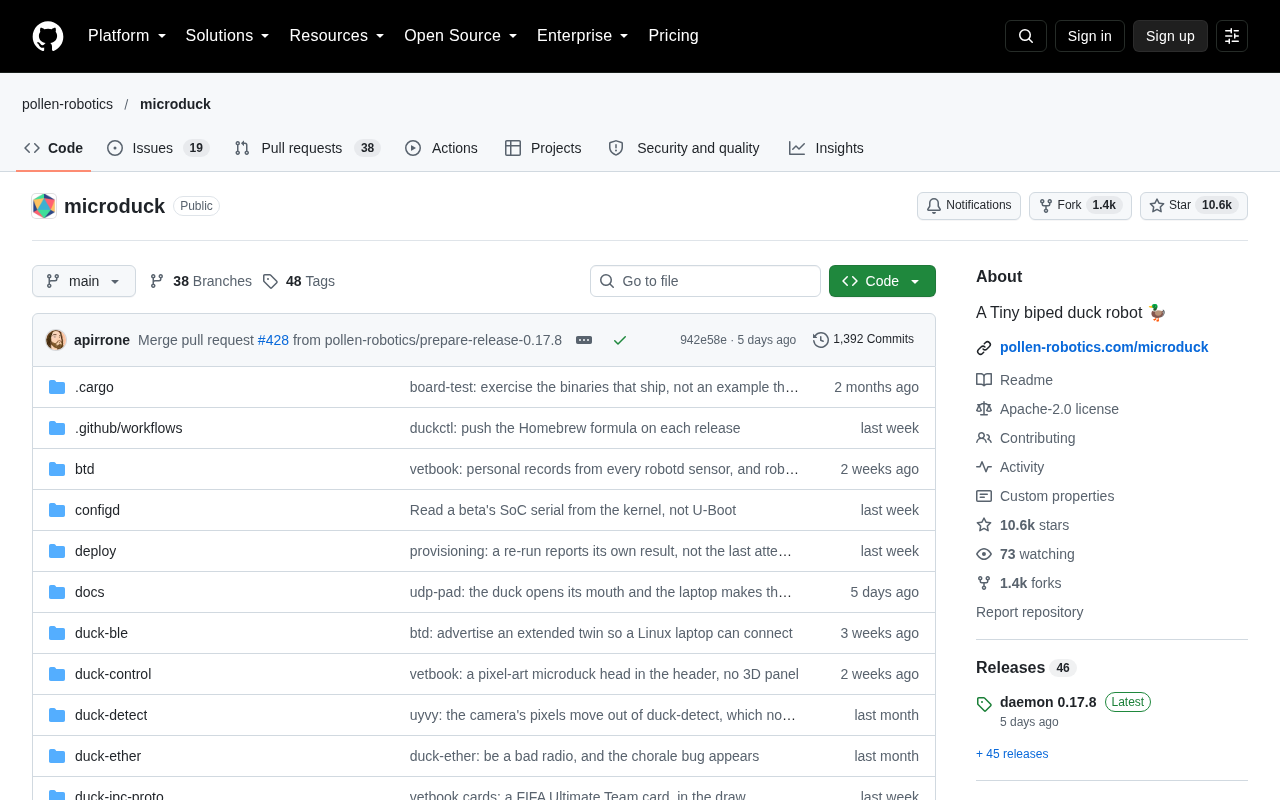
Pollen Robotics' open-source Rust micro bipedal robot duck microduck hits GitHub trending, becoming a low-barrier robotics teaching platform.
Pollen Robotics' open-source micro bipedal robot duck microduck is rapidly trending on GitHub, with total stars reaching 10,620, 421 new stars in a single day, and 1,375 forks. The project uses Rust as its primary development language, leveraging its memory safety, zero-cost abstractions, and modern toolchain to build a complete bipedal robot stack covering kinematic modeling, gait generation, real-time control loops, and mechanical structure. The article analyzes why it went viral: low hardware cost, reproducible teaching positioning, and system-level engineering value that distinguishes it from Arduino/Python projects. It also notes that it suits robotics beginners, Rust developers, and educational scenarios, but the learning curve for bipedal debugging remains steep.
Why Is a Walking Robot Duck Going Viral?
On the GitHub trending list, a project called microduck is rapidly attracting developers' attention—gaining 421 stars in a single day, with total stars exceeding 10,620 and forks reaching 1,375. This small bipedal robot, open-sourced by Pollen Robotics, looks like a duck, and its core development language is Rust.
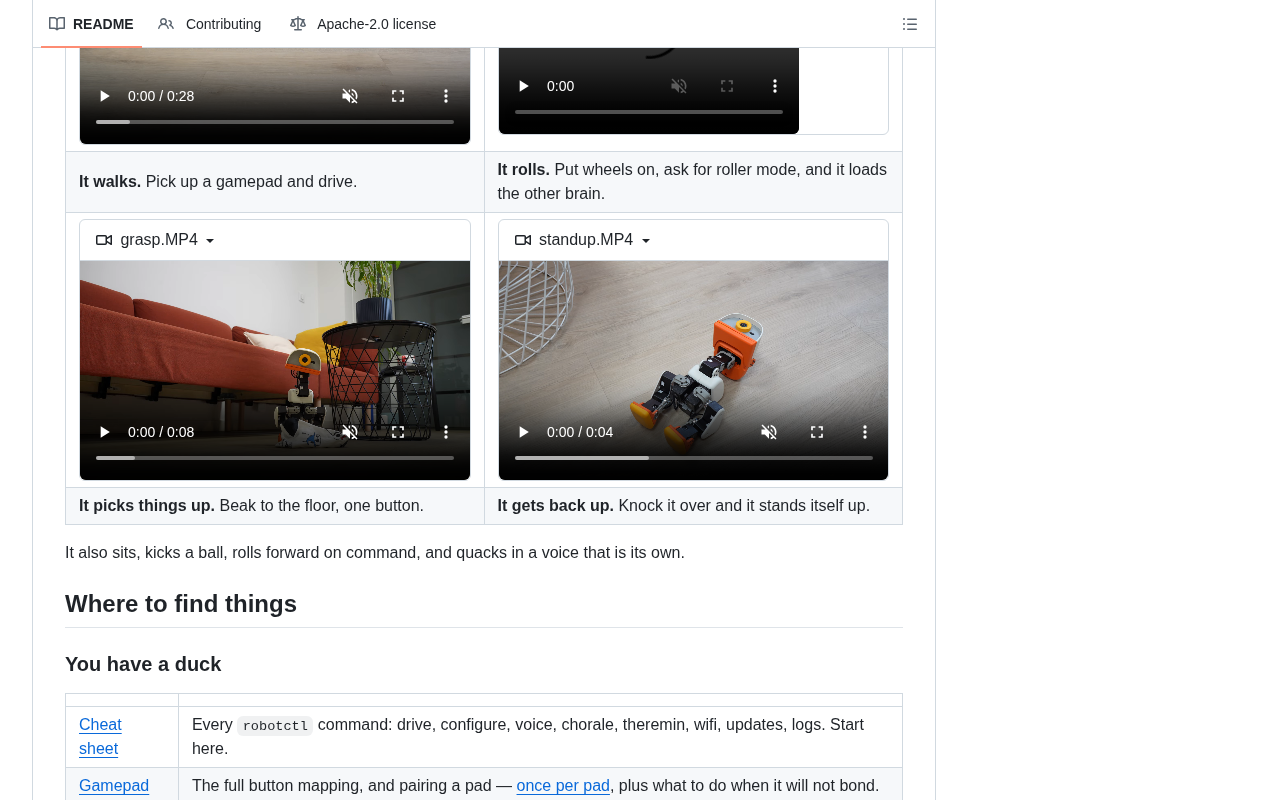
It may seem like just a "toy," but behind it lies a complete learning path covering bipedal locomotion control, embedded real-time systems, and mechanical design. For developers looking to get started in robotics, microduck offers a practical entry point with controllable cost, readable code, and clear structure.
Why Write Robotics in Rust?
Robotics development has long been dominated by C/C++, but the emergence of Rust has gradually been changing this landscape in recent years. microduck's choice of Rust as its primary language sends several clear signals:
- Memory safety and fearless concurrency: Bipedal walking requires high-frequency sensor reading and motor control. Rust's ownership model can eliminate data races at compile time, reducing debugging pain in embedded scenarios.
- Zero-cost abstractions: Rust can handle both low-level register operations and organize high-level control logic, making it suitable for a project like microduck that develops everything from drivers to gait generation in-house.
- Modern toolchain: Cargo package management, built-in testing, and documentation generation lower the barrier for community contributions.
According to the repository information, the project has already built a certain community scale. With 1,375 forks, it means a large number of developers are using it for secondary development or educational experiments.
The ownership model is a set of compile-time rules in Rust for managing memory: each value has exactly one owner, and when the owner goes out of scope, the value is automatically dropped. The borrow checker also restricts that at any given time, there can be only one mutable reference or any number of immutable references. In multi-task concurrent embedded systems like bipedal robots, sensor reading tasks and motor control tasks often need to share state. Data races and dangling pointer issues common in C/C++ are directly rejected by the compiler in Rust. The cost is that you need to reorganize code structure and heavily use Arc, Mutex, or message channels to pass data—this is also the main learning cost for many robotics teams migrating from C++ to Rust.
Where Are the Technical Barriers to Bipedal Walking?
Although microduck is small in size, bipedal balance control does not become simpler just because the size is reduced. On the contrary, small robots have low inertia and are more sensitive to disturbances, requiring higher control cycle frequencies.
Based on public information, the project involves the following technical layers:
- Kinematic modeling: Inverse kinematics solving for both legs, mapping target foot positions to joint angles.
- Gait generation: Periodically planning stance and swing phases to maintain dynamic balance.
- Real-time control loop: Sensor data reading → state estimation → control output, which needs to be completed at millisecond level.
- Mechanical structure: Micro servo selection, leg linkage design, and 3D-printed part assembly.
These modules are encapsulated in a runnable open-source stack in microduck. Learners don't need to build each layer from scratch but can replace and compare experiments layer by layer.
Inverse kinematics (IK) is the process of deriving the angles each joint should rotate given a target position of the foot in space. For a micro-robot like microduck with a limited number of leg linkages, analytical solutions can usually be derived directly through geometric relationships, requiring little computation and suitable for real-time execution on microcontrollers. In contrast, forward kinematics is finding the foot position given known joint angles, commonly used for state estimation and simulation validation. In actual debugging, inverse kinematics solving also needs to handle joint limits, singular configurations (where solutions are not unique or do not exist in certain postures), and other issues—these are engineering details that learners will directly encounter when replacing gait algorithms.
In gait generation, the "stance phase" refers to the stage when a leg is in contact with the ground and bearing weight, while the "swing phase" refers to the stage when the leg is off the ground and swinging forward. Bipedal walking differs from quadrupedal walking in that at least one leg is always in support at any moment, and there are often brief windows of single-leg support where the robot's center of mass must fall within the support polygon formed by the supporting foot to avoid tipping over. Common gait strategies include Zero Moment Point (ZMP)-based planning, Linear Inverted Pendulum Model (LIPM)-based trajectory generation, and in recent years, Central Pattern Generator (CPG)-based periodic oscillation methods that are more practical for small robots. Low-cost platforms like microduck typically use simplified models with parameter tuning, first ensuring standing stability, then gradually introducing dynamic walking.
What Does This Mean for the Developer Community?
10,620 stars and 421 new stars in a single day indicate that microduck has hit a real need: a low-barrier, reproducible bipedal robot teaching platform.
Complete bipedal robot kits on the market are generally expensive, but microduck's "tiny" positioning means hardware costs are compressed to a range affordable for individual developers. The addition of Rust also distinguishes it from the many Arduino- or Python-based educational projects, attracting engineers who have requirements for system performance and safety.
Pollen Robotics has previously accumulated experience in open-source robotics, and microduck can be seen as an extension of its tech stack toward lightweight, educational directions. Behind the 1,375 forks, it's likely that various hardware variants and gait algorithm branches have already emerged.
Who Is It For?
- Robotics beginners: Understand the basic principles of bipedal walking through assembly and debugging.
- Rust developers: Looking for hands-on projects in embedded and real-time control.
- Educational scenarios: As a foundation for course design or graduation projects, replacing gait algorithms for comparative research.
It should be noted that bipedal robot debugging has a long cycle, and going from standing to stable walking often requires repeated parameter tuning. microduck lowers the starting point but does not eliminate the steep part of this learning curve.
Conclusion
The value of microduck is not in the "duck" gimmick, but in open-sourcing a complete bipedal robot system in Rust, allowing more people to take it apart, modify it, and rebuild it. 421 stars in one day is the community voting with their feet—good educational open-source hardware will always have a market.
Related articles

zCAD AI: Generating Editable Parametric 3D Parts with Natural Language
zCAD AI tops Product Hunt with natural-language generation of editable parametric 3D parts and assemblies, browser CAD editing, and STEP export. We break down its boundaries and use cases.

myPip: Building Monetizable Games with AI Vibe Coding
myPip is an AI game creation tool that generates playable games from natural language descriptions, with built-in in-app purchases and ads for monetization. This article covers its features, use cases, and challenges.

AI Code Documentation Isn't Just Boring Text: The Practice of Visual Interactive Docs
AI-generated code is outpacing static docs. Learn how visual, dynamic, interactive documentation—with Linear/Jira integration and interactive PR review—keeps engineers in sync.