Microsoft Azure Leaks Claude's New Flagship: Mythos 5.5 vs. Fable 5.5

Azure leaks unreleased Anthropic models, Qwen runs on a CPU, and DeepSeek's agent efficiency doubles.
This article rounds up a day of AI industry news. Microsoft Azure's configuration page accidentally leaked two unreleased Anthropic models: Fable 5.5 at $10 input/$50 output per million tokens with million-token context, and Mythos 5.5 specializing in cybersecurity and biology. A developer ran Qwen 3.5's full forward pass on a 32-bit RISC CPU, boosting math accuracy from 55% to 97.5%. DeepSeek's V4.1 Pro fine-tuning cut complex task time from over 29 minutes to just over 15.
Microsoft Azure Accidentally Leaks Anthropic's Unreleased Models: Fable 5.5 and Mythos 5.5 Surface
According to the daily AI roundup by Bilibili creator "Will Shu," Microsoft Azure's configuration pages accidentally exposed two unreleased Anthropic models—Fable 5.5 and Mythos 5.5—along with their pricing and parameters. This is seen as a signal that the large-model competition is entering a new phase.
Details of the Azure Configuration Page Leak
According to the screenshots, Fable 5.5's API pricing is $10 per million input tokens and $50 per million output tokens, with support for a million-token context window. Even more closely watched is Mythos 5.5, whose official website source code indicates it specializes in cybersecurity and biology.

The simultaneous leak of pricing and positioning suggests Anthropic is trying to build moats in specialized vertical domains rather than simply competing on general capabilities. The million-token context combined with the high output price also hints that Fable 5.5 may target long-document analysis and complex reasoning scenarios.
Million-token context window refers to a model's total acceptable token count in a single inference reaching the million scale (typically 1 million tokens), equivalent to reading hundreds of pages of documents or hours of meeting transcripts in one pass. The cost is that memory usage and attention computation grow superlinearly with sequence length, so vendors often pair it with techniques such as chunked attention and KV cache compression. For developers, ultra-long context means "retrieve the whole repository + reason over the full text" no longer relies on complex chunking and stitching, but it also significantly raises input-side costs, and pricing strategies often differentiate between long- and short-text scenarios accordingly.
Alibaba Qwen: Squeezing a Large Model onto a CPU
Even more surprising in the same episode is a developer's reverse-engineering feat with Qwen 3.5. Someone implemented the full forward pass on a 32-bit RISC CPU, effectively making the large model run like a small one.
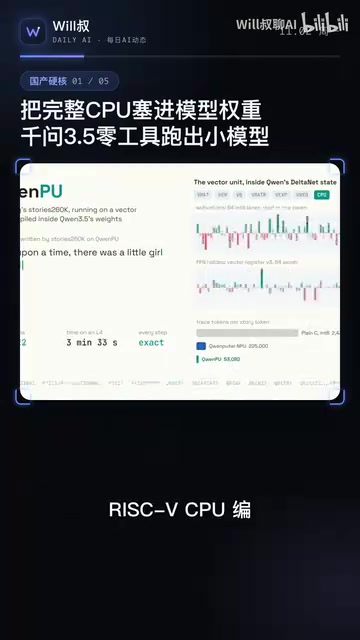
According to the video description, this approach raised mathematical accuracy from 55% to 97.5%, essentially achieving usable inference capability on extremely low-cost hardware. This is significant for edge computing and embedded scenarios, and it also shows that model distillation and quantization still have plenty of untapped potential.
Forward propagation refers to the one-way computation of a neural network from input to output, without involving backpropagation or gradient updates—it is the entirety of the computation in the inference phase. The difficulty of running a forward pass on a CPU lies in the limited register width and memory addressing capability of the 32-bit RISC architecture, as well as its weaker floating-point units; weights must be quantized to low bit widths (such as int8/int4) and the matrix multiplication kernels rewritten to avoid overflow and accuracy collapse. The mathematical accuracy improving from 55% to 97.5% in the article is essentially about optimizing quantization schemes and operator implementations to bring numerical error back into a usable range.
Model distillation and quantization are two complementary compression routes. Distillation lets a small "student model" imitate the output distribution of a large "teacher model," transferring capability to fewer parameters; quantization reduces weights and activations from FP16/FP32 to int8, int4, or even lower, directly shrinking memory usage and compute requirements. The two are often combined: first distill to obtain a structurally smaller model, then quantize to fit low-power hardware. The fact that Qwen 3.5 can run on a RISC CPU is precisely the engineering realization of these two types of techniques at the operator level, rather than mere model size reduction.
DeepSeek Fine-Tunes V4.1 Pro: Efficiency Doubles
On the domestic open-source side, DeepSeekAd has been reported to be stepping up fine-tuning of V4.1 Pro, with the latest evaluation scripts already circulating. Internal tests show that its super-agent architecture cuts the time for complex tasks from over 29 minutes to just over 15 minutes—a substantial efficiency gain.
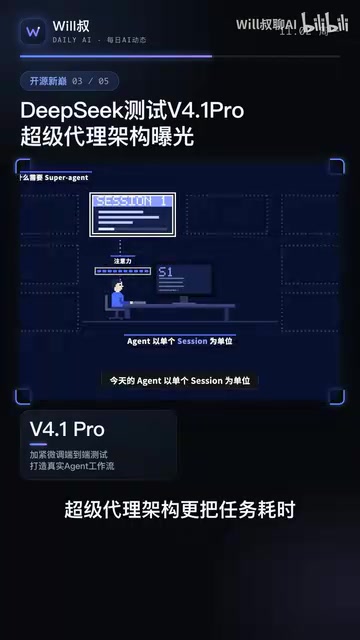
This improvement points to task orchestration optimization in agent scenarios rather than a pure gain in model capability. For complex tasks requiring multi-step execution, halving the time amounts to a qualitative change in usability.
Super-agent architecture (Agent architecture) refers to a multi-step task execution framework composed of modules such as planning, tool invocation, memory, and reflection. The model is no longer a single-turn Q&A but breaks complex goals into subtasks and executes them in a loop. Its time bottleneck is usually not single inference but serial waiting between steps and repeated context passing. V4.1 Pro's reduction of complex task time from 29 minutes to 15 minutes implies optimizations in task orchestration, parallel subtask scheduling, or context reuse—improvements of this kind often have a more direct impact on the usability of multi-step workflows than simply raising benchmark scores.
Other AI News
AI luminary Karpathy shared an experience of being "broken by the algorithm": annoyed by video recommendations on Friday, he directed Claude on Saturday and built Hackertube—a collection of over 6,400 curated videos—in just two hours. His reflection: writing code now relies entirely on AI, and humans just buy the domain.
Maye Musk, Elon Musk's mother, was also reported to use Grok more than a dozen times a day and to have set up a media filter: before an interview, she first uses Grok to assess the positive-review rate and only accepts if it exceeds 95%.

Together, these snippets sketch a trend: AI is moving from a tool to a participant in everyday decisions, and the barrier to use is dropping rapidly—from developers to ordinary users.
One-line Summary
Azure leaks unreleased Anthropic models, Qwen runs on a CPU, and DeepSeek's agent efficiency doubles.
Paragraph Summary
This article rounds up one episode of AI industry news. The most notable item is Microsoft Azure's configuration page accidentally leaking two unreleased Anthropic models: Fable 5.5 is priced at $10 input and $50 output per million tokens with million-token context support, while Mythos 5.5 specializes in cybersecurity and biology, indicating Anthropic is shifting toward vertical-domain moats. On the developer side, someone ran the full forward pass of Qwen 3.5 on a 32-bit RISC CPU, raising mathematical accuracy from 55% to 97.5% and offering new ideas for edge computing. DeepSeek was reported to be fine-tuning V4.1 Pro, whose super-agent architecture cuts complex task time from over 29 minutes to just over 15 minutes, pointing to task orchestration optimization in agent scenarios. In addition, Karpathy built Hackertube with Claude in two hours, and Musk's mother uses Grok to screen interviews—together reflecting the rapidly lowering barrier to AI use.
Related articles

AI Can Read Neural Network Weights Directly: Do Models Already Exceed Expectations?
A Reddit developer experiment shows language models can directly read neural network weights and infer their function. Astra, Opus 5.5, and Muse Spark 1.3 all passed the test, sparking discussion on model generalization and training sources.

India's Microdrama Market Explodes: EloElo Secures $80M Investment from NBCUniversal
EloElo secures $80M from NBCUniversal to boost StoryTV, its microdrama platform with over 33M monthly active users, as India's microdrama market draws global capital.

Acoustic Detection of Multi-Rotor UAVs: Fusing Handcrafted Features with Pre-Trained Embeddings
Study reveals data leakage from random splits in UAV acoustic detection, proposes source-disjoint protocol with stacked ensemble of handcrafted features and YAMNet embeddings, achieving 95.29% accuracy for low-cost drone detection.