Microsoft Evaluation Document Leak Reveals GPT-6.1 Terra, AI Race Heats Up

GPT-6.1 Terra identifier appears in Microsoft evaluation update, possibly signaling OpenAI's new model has entered internal testing.
A Reddit post claims the model identifier "GPT-6.1 Terra" appeared in a Microsoft evaluation update, sparking speculation about OpenAI's next-gen model. The article analyzes that Microsoft's deep partnership with OpenAI means new models undergo Azure-side compatibility, performance, and security evaluations before release. Appearing in evaluation materials typically indicates a testable form, though some test codenames never became products. The "Terra" suffix may represent an independent capability branch, but without official confirmation, interpretations are speculative. The article stresses single-source reliability limits and recommends developers decouple business logic from model versions with a replaceable integration layer.
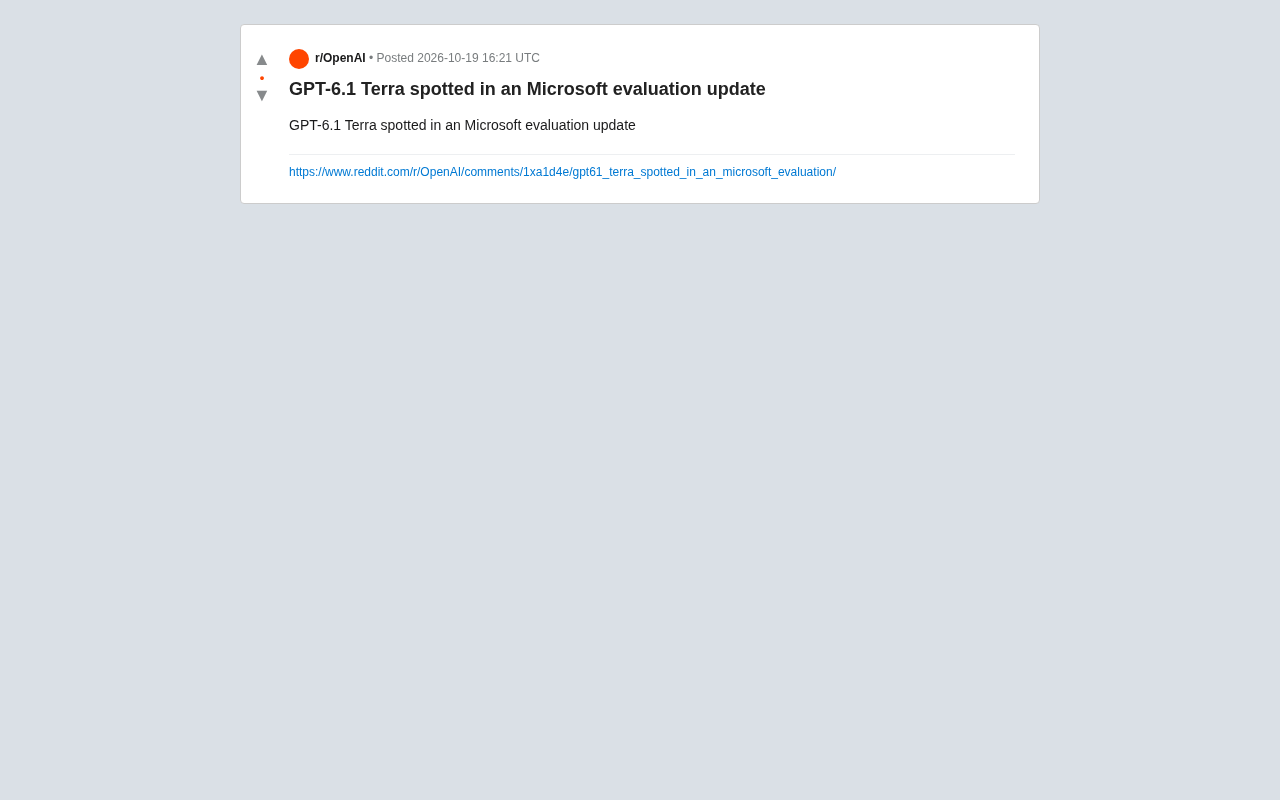
A recent post on Reddit has been circulating: a model identifier named "GPT-6.1 Terra" appeared in a Microsoft evaluation update. Though the clue is brief, it has quickly sparked discussion in the AI community — it may indicate that OpenAI's next-generation model has entered Microsoft's internal testing process.
The Signal Behind a Single Evaluation Record
According to the Reddit post, a user discovered the text "GPT-6.1 Terra" in Microsoft evaluation-related documents or updates. There is currently no official confirmation and no technical details have emerged, but the context of an "evaluation update" itself is worth noting.
Microsoft's deep partnership with OpenAI means that new models often need to undergo Azure-side compatibility testing, performance evaluation, and security review before public release. Appearing in evaluation materials typically indicates that a model has reached a testable form, rather than remaining at the planning stage.
It is important to emphasize that screenshot information from a single source is not sufficient to confirm the model's existence or specifications, and readers should remain cautious.
Microsoft's internal "evaluation update" typically refers to the systematic benchmarking process for candidate models, covering dimensions such as inference latency, throughput, multilingual performance, safety alignment, and Azure infrastructure compatibility. Such evaluations often begin before a model's version is frozen, with the goal of informing capacity planning, pricing strategy, and compliance review. Therefore, when a codename appears in evaluation materials, it indicates that the model has at least a callable API endpoint or internal inference instance, but there remain multiple hurdles before GA (General Availability), including safety red-team testing, SLA commitments, and regional deployment. Historically, multiple model codenames that ultimately went unreleased have appeared in Microsoft evaluation documents, further demonstrating that "appearing in evaluation" is a necessary but not sufficient condition.
What the "Terra" Naming Reveals
The "Terra" suffix is the most informative part of this clue. OpenAI's previous model naming has mostly revolved around version numbers, while additional codenames are often used to distinguish different capability tiers or training routes.
If "Terra" represents an independent branch, it may point to a specific optimization direction — for example, stronger reasoning capabilities, longer context, or a customized version for enterprise scenarios. Combined with the version number "6.1," this appears more like an iterative upgrade than an entirely new architecture, but the specific differences cannot be determined.
In the absence of official explanation, any interpretation of what "Terra" means is merely speculation.
In OpenAI's naming tradition, major version numbers (such as GPT-4, GPT-4o) typically correspond to architecture generations or paradigm shifts in training, while versions after the decimal point (such as 4.1, 4.5) mostly represent capability enhancements or alignment fine-tuning within the same architecture. Additional codenames are more flexible: sometimes they point to specific training routes (such as the o series emphasizing inference-time compute), and sometimes to deployment forms or regional variants. If "Terra" is indeed an independent branch, following industry conventions, it may correspond to long context windows, enterprise-grade private deployment, or some form of modality enhancement. However, codenames may also simply be project codenames with no one-to-one correspondence to actual capabilities. In the absence of official naming rule explanations, interpreting "Terra" as a specific capability tier is reasonable speculation but should not be used as a basis for technical decisions.
What Microsoft and OpenAI's Evaluation Process Means
Microsoft's role in the model release chain is often underestimated. As the primary hosting platform for OpenAI models, Azure needs to complete infrastructure adaptation, inference performance tuning, and compliance evaluation in advance.
Such evaluation updates typically involve internal toolchains and test checklists, and new model codenames appearing is not uncommon — but not every instance corresponds to a public release. Historically, some test codenames ultimately did not translate into products.
From this perspective, "GPT-6.1 Terra" is more likely in an early evaluation stage, with considerable distance remaining before it reaches users.
Microsoft and OpenAI's partnership follows a "preferred cloud provider + joint engineering" model: OpenAI shares early weights with the Azure team during the later stages of model training, enabling Microsoft to complete adaptation and performance tuning of the inference stack (such as ONNX Runtime and Azure AI Inference SDK). This process is called "pre-GA evaluation" and covers latency stress testing, quota planning, content filtering policy configuration, and regional compliance validation (such as EU data residency). Evaluation typically proceeds in stages: first internal smoke tests, then small-scale customer private preview, and finally public preview. A codename appearing in an evaluation update means the model has at least passed preliminary functional validation, but each stage may be halted due to security, cost, or competitive strategy. Therefore, evaluation records are a leading indicator for observing release cadence, but not a commitment.
Community Reaction and Information Verification
On Reddit, such "leak" posts often come with two types of reactions: anticipation for model capabilities and skepticism about the information's authenticity. Strings in evaluation documents may come from placeholders, internal test names, or even misreadings.
As of now, no second source has cross-validated this information. In the field of AI model intelligence, the reliability of single-point leaks has historically been inconsistent, and readers should treat this as a clue rather than a conclusion.
Implications for Developers and Enterprises
Regardless of whether "GPT-6.1 Terra" ultimately materializes, this news reminds developers to pay attention to the pace of model iteration. API compatibility, cost structure, and capability boundaries may all change with version updates.
For enterprises, decoupling business logic from specific model versions and building a replaceable model integration layer is a pragmatic strategy for coping with rapid iteration. Leaks during the evaluation stage precisely indicate that model update cycles may be more frequent than public announcements suggest.
A model abstraction layer is an architectural pattern that decouples business logic from specific model APIs, typically encapsulating different vendors' request formats, authentication methods, and error handling through a unified internal interface. Common implementations include lightweight gateways (such as LiteLLM, OpenRouter) or self-built adapters. Its core value lies in: when model versions change, prices adjust, or a vendor experiences service disruptions, applications only need to switch configurations rather than rewrite code. Additionally, the integration layer can uniformly implement retries, fallbacks, usage metering, and prompt version management. Against the backdrop of model iteration cycles potentially being shorter than public announcement intervals, building a replaceable integration layer and maintaining multi-vendor compatibility has become a baseline requirement for enterprise AI engineering practices.
Conclusion
A single string in an evaluation document sketches the tip of the iceberg in the AI race. In the absence of official information, maintaining caution and tracking multi-source verification is more valuable than chasing codenames themselves.
One-line Summary
GPT-6.1 Terra identifier appears in Microsoft evaluation update, possibly signaling OpenAI's new model has entered internal testing.
Paragraph Summary
A Reddit post circulating claims that the model identifier "GPT-6.1 Terra" appeared in a Microsoft evaluation update, sparking speculation in the AI community about OpenAI's next-generation model. The article notes that Microsoft's deep partnership with OpenAI means new models must undergo Azure-side compatibility testing, performance evaluation, and security review before release. Appearing in evaluation materials typically indicates a testable form, though historically some test codenames never became products. The "Terra" suffix may represent an independent capability branch or specific optimization direction, but without official explanation, all interpretations are speculative. The article emphasizes the limited reliability of single-source screenshots and the need for multi-source cross-validation, and recommends that developers decouple business logic from model versions and build a replaceable model integration layer to cope with rapid iteration.
Related articles

5 Practical Ways Real Estate Agents Can Use AI to Boost Efficiency (2026 Edition)
How can real estate agents use AI to boost efficiency? Based on a YouTube walkthrough, this breaks down five methods — ChatGPT for listing descriptions, Canva for marketing materials, forms for open house leads, Zapier for automated follow-up, and seller meeting prep — and flags risk boundaries like fair housing laws, photo authenticity, and price verification.

Grok Bot vs ChatGPT Agent: Which AI Agent Is More Powerful?
How does Grok Bot differ from ChatGPT Agent? This comparison examines how they work: Grok Bot has a cloud computer and runs persistently inside tools to execute multi-step tasks automatically; ChatGPT Agent operates web pages in a browser and is more mature at general tasks. Includes selection advice.

Walmart Agent Gateway: AI Shops for You Automatically—Why Is Amazon Going the Opposite Way?
Walmart's Agent Gateway lets ChatGPT, Gemini and other AI assistants access its product catalog to search, compare and add to cart, with spending limits and per-purchase approval. Amazon blocks external AI agents—two retail giants, opposite paths. Currently US-only, India may follow.