Microsoft MAI-Image-2.5 Tops Image Editing Leaderboard: A Compounding Breakthrough for Its In-House Model
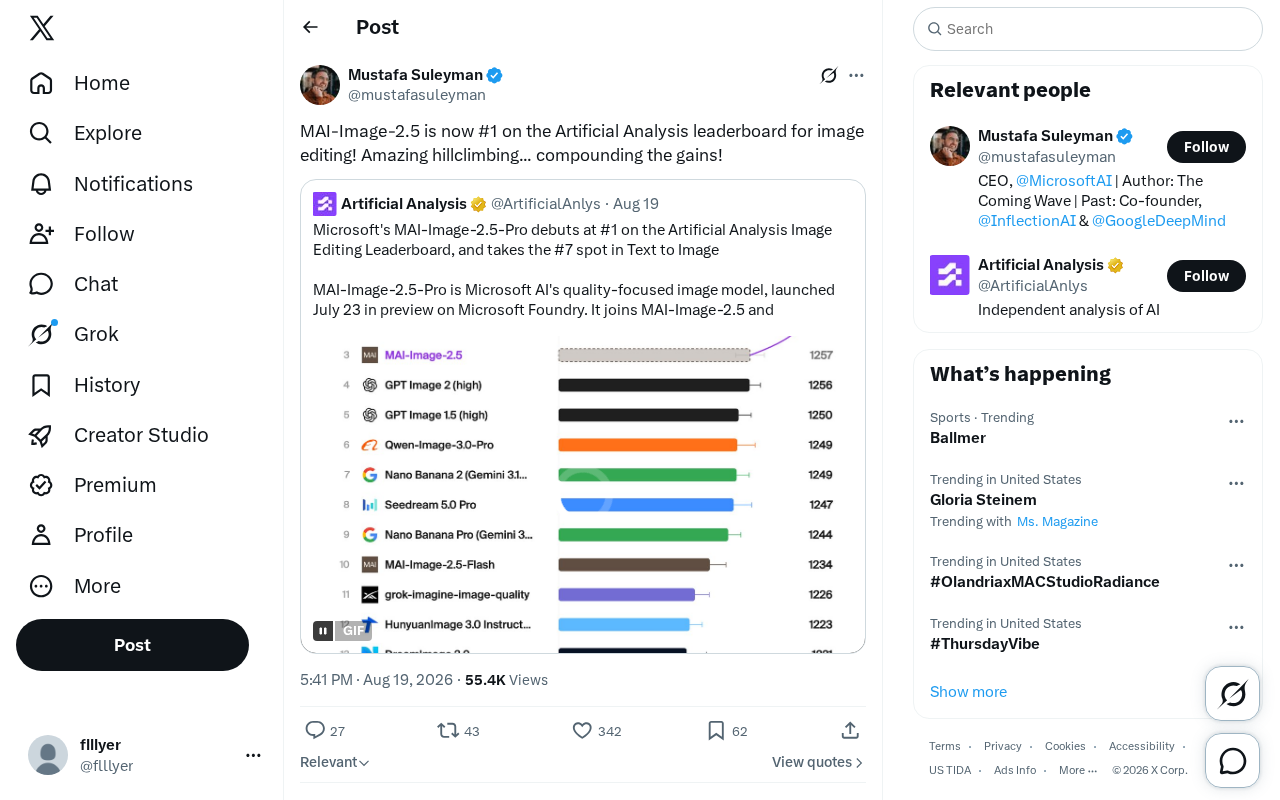
Microsoft's MAI-Image-2.5 claims #1 on the Artificial Analysis image editing leaderboard.
Microsoft's in-house image model MAI-Image-2.5 has topped the Artificial Analysis image editing leaderboard, demonstrating compounding technical iteration. This achievement signals Microsoft's growing independence from OpenAI and its ability to compete at the highest level in generative image AI, with major implications for product integration across its ecosystem.
Microsoft's In-House Image Model Reaches New Heights
Recently, the Microsoft AI team announced that its in-house image model MAI-Image-2.5 has claimed the #1 spot on the Image Editing leaderboard from Artificial Analysis, a well-regarded third-party evaluation platform. The team could barely contain their excitement on social media, describing the achievement as "amazing hillclimbing" and "compounding the gains" — suggesting that the model's iterative improvements are creating a powerful compounding effect.
For Microsoft — a company that has long relied on OpenAI's technology stack — this result carries special significance. It marks a substantive step forward for Microsoft's AI division (led by DeepMind co-founder Mustafa Suleyman) on the path to building proprietary generative models. And it's not just about large language models: Microsoft has now proven it can go toe-to-toe with top-tier players in the image generation and editing space as well.
Why the Artificial Analysis Leaderboard Matters
The Authority of an Independent Third Party
Artificial Analysis is an independent AI model evaluation platform that has gained significant traction in the industry in recent years. It conducts standardized benchmark tests for side-by-side comparison of various models across multiple dimensions, including large language models, image generation, and speech. Compared to vendors' self-reported marketing data, third-party leaderboards carry far greater credibility, which is why they are widely referenced in the AI community for model selection.
Image Editing Demands Far More from Models
It's worth noting a key detail: MAI-Image-2.5 took the crown in the Image Editing category, not just Text-to-Image generation. Image editing places much more demanding requirements on a model: it must not only understand natural language instructions from users but also make precise modifications while preserving the key content and structure of the original image. This involves complex operations like inpainting, object addition/removal, style transfer, and lighting adjustment — all of which demand exceptional semantic understanding and spatial consistency.
Topping this particular category demonstrates that MAI-Image-2.5 has achieved industry-leading performance in instruction following and image consistency preservation.
"Compounding" Technical Iteration: Why MAI-Image-2.5 Keeps Getting Better
The team's emphasis on "compounding the gains" deserves a deeper look. In model development, the compounding effect typically refers to:
- Data flywheel: A better model attracts more users, who generate richer feedback data, which in turn trains an even stronger model;
- Capability stacking: Small improvements across underlying architecture, training strategies, and data quality compound on one another, ultimately producing nonlinear performance leaps;
- Engineering reuse: Training infrastructure and lessons accumulated from previous model generations transfer directly to new versions, lowering the marginal cost of each iteration.
Judging from the version number (2.5) of the MAI-Image series, Microsoft has clearly gone through multiple rounds of refinement. This steady "hillclimbing" strategy is a hallmark of many successful AI products — rather than trying to reach the summit in a single leap, they accumulate momentum through continuous, incremental progress.
Deeper Strategic Signals for Microsoft AI
Reducing External Dependency on OpenAI
Over the past several years, Microsoft has been heavily tied to OpenAI for generative AI, with products like Copilot and Bing Image Creator built extensively on OpenAI's technology. The rise of the MAI (Microsoft AI) series of in-house models signals a strategic intent to build an independent technology stack. Owning proprietary models means stronger cost control, more flexible product integration, and greater leverage in negotiations with partners.
Vast Potential for Product Ecosystem Integration
Microsoft commands a massive product portfolio spanning Windows, Office, Azure, Designer, and more. A best-in-class image editing model can be deeply integrated across these scenarios — whether it's intelligent image suggestions in PowerPoint, one-click photo editing in Designer, or API capabilities offered to enterprise customers through Azure cloud services. Technical leadership is just the starting point; the real value lies in scaling deployment.
A Measured Perspective on Leaderboard Results
Of course, topping a leaderboard is worth celebrating, but it's important to view the achievement with some perspective.
First, leaderboard rankings are dynamic. Competition in the image generation space is fierce — Google's Imagen, Adobe's Firefly, and various open-source models are all iterating rapidly. Today's #1 ranking isn't guaranteed to last.
Second, benchmark scores don't fully equate to real-world experience. Leaderboards are typically based on specific evaluation datasets and scoring criteria, while actual users may have different experiences across diverse scenarios. Whether a model is truly useful still needs to be validated through broad market adoption.
Finally, this announcement primarily comes from Microsoft's official social media channels, and detailed technical information — including model scale and training methodology — has not been fully disclosed. The industry looks forward to Microsoft sharing more details so the significance of this achievement can be more comprehensively assessed.
Conclusion
MAI-Image-2.5's rise to the top of the image editing leaderboard is a powerful validation of Microsoft's in-house AI capabilities and an important milestone in its journey to reduce external dependencies and build an autonomous technology ecosystem. In the never-ending race of generative AI, "compounding" through continuous iteration may ultimately matter more than any single moment of leadership. The real test of Microsoft's AI strategy will be how effectively it translates this leaderboard advantage into tangible product value.
Related articles
AI Agent Cost Optimization in Practice: Engineering Wisdom That Saved $1 Million in One Hour
Databricks eliminated $1M/year in wasted AI Agent spend in just one hour. Learn the root causes of Agent cost overruns and key strategies like model tiering, context pruning, and caching.
How the FDA Is Building an AI-Ready Data Foundation on Databricks
Explore how the FDA leverages Databricks for Government to build a unified Lakehouse architecture and AI-ready data foundation while meeting federal security and compliance standards.
The Power of Security Collaboration: Why Vulnerability Discovery Cannot Do Without Human Intelligence
Explore how security collaboration outperforms tool dependency, the value of vulnerability stories, cross-team knowledge sharing practices, and building stronger defenses by investing in people and collaboration.