Microsoft Outlook/365 Outage Exceeds 12 Hours: Cloud Dependency Fragility Sparks Renewed Debate
Microsoft 365 and Outlook outage exceeds 12 hours, sparking debate on cloud centralization risks.
Microsoft 365 and Outlook services remained incompletely restored more than 12 hours after disruption, with officials posting updates via MSFT365Status but no clear full recovery timeline. The Hacker News thread drew 316 points and 222 comments. Discussion focused on single point of dependency risks from cloud centralization: when email, calendars, and document collaboration are all hosted by a few hyperscale providers, a single failure has broad impact and lacks local fallback options. Prolonged outages cause cascading effects like meeting rescheduling and approval delays. The event reminds teams to treat vendor unavailability as a mandatory rehearsal scenario and prepare alternative channels and degradation plans.
Microsoft 365 and Outlook services remained incompletely restored more than 12 hours after disruption, an event that has sparked extensive discussion on Hacker News with 316 points and 222 comments. When office collaboration relies heavily on the cloud, the cascading effects of a prolonged outage are far more complex than a single status update.
Outage Overview and Official Response
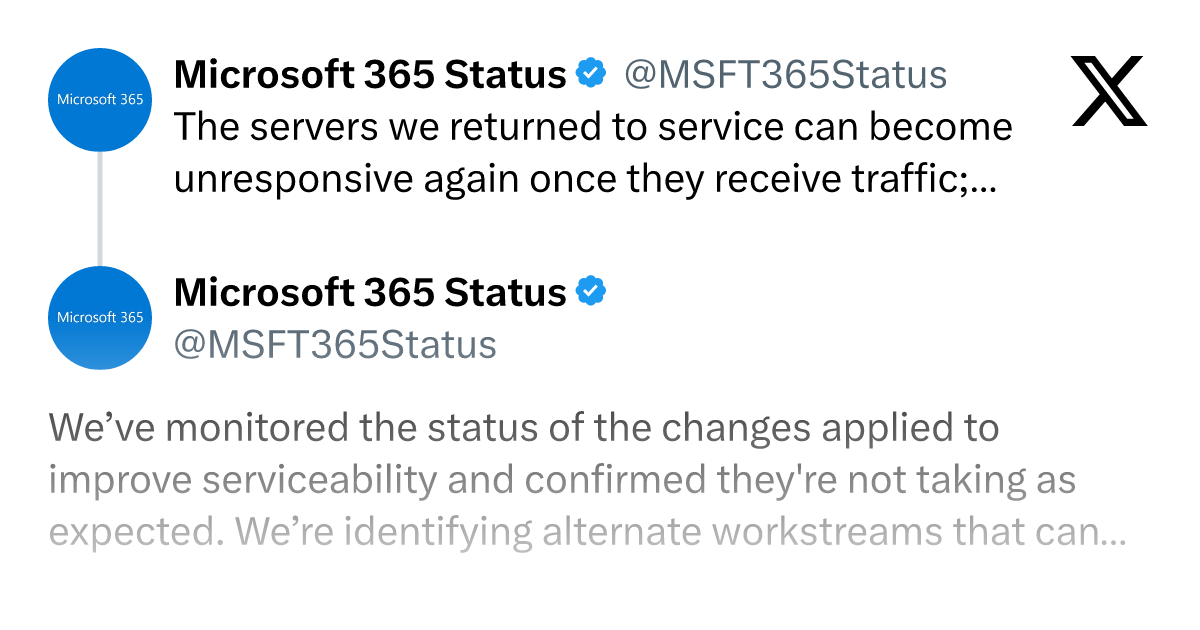
According to status updates posted by Microsoft's official account MSFT365Status on X, Microsoft 365 and Outlook services experienced disruption, and the issue persisted after approximately 12 hours. Users encountered access anomalies in the frequently used email and office suite, with impact affecting enterprises and individual users who rely on Outlook for daily communication and scheduling.
Officials continued to post updates via social media, but as of the time discussions gained traction, services had not been fully restored. The Hacker News thread accumulated 316 points and 222 comments, indicating that the event garnered considerable attention in the technical community—for a cloud service outage, this volume of discussion reflects users' sensitivity to prolonged downtime.
Technical Community Discussion Focus: Risks of Cloud Centralization
The 222 comments in the Hacker News thread centered not merely on "when will service be restored," but on renewed skepticism toward centralized cloud architecture. When email, calendars, and document collaboration are all hosted by a handful of hyperscale cloud providers, a single failure can affect a large number of organizations, and users have virtually no local fallback options.
This discussion emerges with every major cloud outage, but the 12-hour duration this time made the "single point of dependency" problem more prominent. For enterprises that have fully migrated critical business processes to SaaS, options during an outage are extremely limited: wait for official fixes or temporarily switch to alternative communication channels. A recurring viewpoint in the technical community is that architectural design should retain some offline or heterogeneous backup capability rather than entrusting availability entirely to a single vendor.
Single Point of Dependency in the cloud services context refers to an organization entrusting critical business capabilities entirely to a single vendor or single service instance, lacking redundant pathways. Unlike traditional Single Point of Failure (SPOF), which typically refers to the hardware level, single point of dependency here occurs at the service level: when Outlook or Microsoft 365 is unavailable, enterprises have no local mail server or heterogeneous office suite to switch to, and business continuity is directly tied to the vendor's recovery speed. Mitigation measures commonly suggested by the technical community include multi-cloud strategies, local caching of critical data, and maintaining backup channels for authentication and communication independent of the primary vendor.
Practical Impact of Prolonged Outages on Enterprise Collaboration
Outlook and Microsoft 365 carry not only email but also core workflows such as calendars, meeting scheduling, and document collaboration. A service disruption lasting more than half a day means a series of cascading effects including meeting rescheduling, approval delays, and blocked cross-team communication. For organizations that deeply integrate identity authentication with office suites, the failure may even affect other internal systems that depend on the same account system during the outage.
From an incident management perspective, posting status updates via social accounts is a common practice, but during prolonged failures, users care more about specific recovery time windows and lists of affected features. The sentiment reflected in Hacker News discussions stems partly from anxiety caused by information uncertainty, not just the service unavailability itself.
SaaS (Software as a Service) refers to a software model delivered over the internet and centrally operated by a vendor. Microsoft 365 and Outlook are typical multi-tenant SaaS: global users share the same backend infrastructure and identity system, so a regional failure can quickly escalate into widespread cross-organizational disruption. The convenience of SaaS lies in zero maintenance, automatic updates, and access from anywhere, but the cost is that users lack control over the underlying architecture, failure remediation pace, and data residency. When SaaS carries core workflows such as email, calendars, and documents, its availability effectively becomes part of enterprise business continuity—this is the structural reason why prolonged outages have broader impact than traditional software failures.
What Can Be Learned from This Event
For technical teams, this outage provides a real-world sample: when evaluating critical SaaS dependencies, "vendor unavailability for extended periods" must be treated as a scenario that requires rehearsal. Specific practices include identifying which businesses completely halt when Outlook is unavailable, preparing alternative communication channels, and clarifying information synchronization mechanisms during failures.
For cloud service providers, an outage not fully resolved in 12 hours directly erodes user trust. Transparency in status communication, timeliness of fault localization, and ultimate repair are equally important. The intensity of discussion in the technical community indicates that users' expectations for cloud service availability have not diminished with the proliferation of cloud computing—rather, they have become more stringent after critical businesses fully moved to the cloud.
The complete timeline for service restoration remains unclear, and subsequent developments warrant continued attention. For teams relying on Microsoft 365, this event is a reminder: the convenience of cloud services and the risks of centralization are two sides of the same coin.
Business Continuity Plan (BCP) and degradation plans are the core framework for enterprises to cope with prolonged vendor unavailability. For SaaS disruptions, degradation plans typically include: identifying the degree of dependency of critical businesses on specific services and prioritizing them; preparing alternative communication channels (such as backup email gateways, instant messaging tools, or phone trees); clarifying information synchronization and decision-making mechanisms during failures; and regularly rehearsing "primary vendor unavailable" scenarios. The technical community repeatedly emphasizes that the value of degradation plans lies not in completely eliminating outage impact, but in shortening the Recovery Time Objective (RTO) from "waiting for vendor repair" to a range the organization can control.
One-line Summary
Microsoft 365 and Outlook outage exceeds 12 hours, sparking discussion on cloud centralization risks.
Paragraph Summary
Microsoft 365 and Outlook services remained incompletely restored more than 12 hours after disruption. Officials continued to post updates via the MSFT365Status account, but the complete recovery timeline remains unclear. The Hacker News thread received 316 points and 222 comments, indicating significant attention. The technical community's discussion focused not merely on recovery time but on the single point of dependency risk posed by cloud service centralization: when email, calendars, and document collaboration are all hosted by a handful of hyperscale cloud providers, a single failure has broad impact and lacks local fallback options. Prolonged outages cause cascading effects on core enterprise workflows such as meeting rescheduling and approval delays. The event reminds technical teams to treat "vendor unavailability for extended periods" as a mandatory rehearsal scenario, prepare alternative channels and degradation plans, and recognizes that cloud vendors' status communication transparency and repair timeliness also affect user trust.
Related articles

Gemini 4 Hydrogen Released: A 2.5x Faster Everyday AI Model
Google releases Gemini 4 Hydrogen, claiming 2.5x the speed of Gemini 3.8 Flash, with four-tier thinking control, a million-token context, and Orchestrator multi-model collaboration. API pricing is $1.50 per million input tokens.

Gemini 4 Hydrogen Hands-On: Google's Fastest and Cheapest AI Model
Hands-on with Gemini 4 Hydrogen: the fastest, cheapest model in the Gemini 4 family. We break down the Carbon/Argon/Hydrogen split, API pricing traps, free-tier limits, and the cost trade-offs of four thinking levels—with a real bug-debugging demo.

Gemini 4 Hydrogen vs Sonnet Comparison Test: Uses Only 1% of Weekly Quota, Performance on Par
Hands-on test: Gemini 4 Hydrogen vs Sonnet on the same CRUD task—Hydrogen used only 1% weekly quota with comparable performance and better UI details, while Anthropic's model used 7%. Developer says daily tasks don't require expensive models.