Microsoft Outlook Hit by Major Two-Day Outage, Services Gradually Recovering
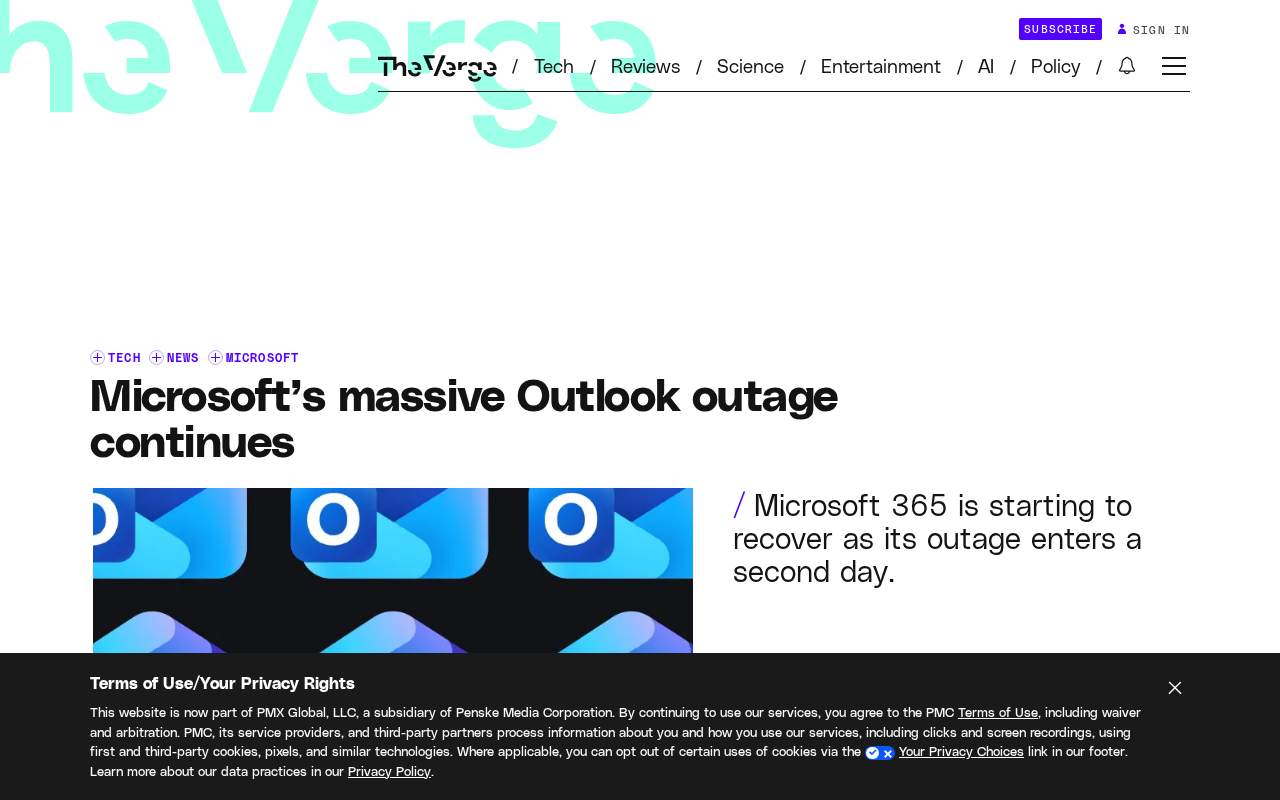
Microsoft Outlook and Microsoft 365 are gradually recovering after a nearly two-day global outage, with some features still degraded.
Microsoft Outlook and Microsoft 365 services are gradually recovering after a global large-scale outage lasting nearly two days. According to The Verge, some users can access their mailboxes again and mail flow is slowly recovering, but some apps and features remain in a degraded state, and the user experience is not yet fully normal. The disruption affected millions of users worldwide, with a particularly noticeable impact on enterprises relying on Outlook for communication. Microsoft has not yet disclosed the root cause, precise scope of impact, or a complete recovery timeline. The incident highlights the risk of single points of failure in large cloud services and the need for enterprises to establish redundancy and disaster recovery plans for critical communication tools.
Microsoft Outlook and Microsoft 365 services are gradually recovering after a global large-scale outage lasting nearly two days. According to The Verge, some apps and features remain in a degraded state, but some users—including Verge staff—can access their mailboxes again, and mail flow is slowly recovering.
Incident Recap: Nearly Two Days of Service Disruption
The outage affected millions of users worldwide and lasted nearly two days, making it one of the more serious Microsoft 365 service disruptions in recent years. As a core communication tool, Outlook's prolonged unavailability has significantly impacted both individual and enterprise users. The report notes that although services have begun to recover, not all features are returning simultaneously—some apps and features are still running in degraded mode, meaning the user experience has not yet fully returned to normal.
Microsoft 365 and Outlook's Cloud Service Architecture
Microsoft 365 is not a single application but a cloud-based subscription productivity suite encompassing Outlook, Exchange Online, Teams, SharePoint, and other services. Outlook's email capabilities primarily rely on Exchange Online, a hosted mail service, with users connecting via the web version, desktop client, or mobile app. Because these services share Microsoft's global data centers and identity authentication system (such as Entra ID), failures in underlying infrastructure often spread across products and regions. This explains why a single disruption can simultaneously affect mailbox access for millions of users and why recovery must proceed component by component rather than being restored all at once with a single restart.
Recovery Progress: Mailbox Access Returns First
According to testing by The Verge staff and user feedback, mailbox access has been restored first, and mail flow is gradually recovering. This recovery sequence follows the typical pattern for large-scale cloud service failures: prioritizing core communication capabilities before gradually repairing peripheral features. However, the report did not disclose the specific percentage of affected users, the root cause of the failure, or a complete recovery timeline, and the degraded service state may persist for some time.
What "Degraded Service" Means
In cloud service operations, degraded status means the service is still running but some features are missing or performance is reduced, which differs from a complete outage. Microsoft typically uses "degraded" to describe such situations in its service health dashboard. For Outlook, degradation may manifest as delayed email delivery, failed search or calendar sync, restricted attachment uploads, and similar issues. In a degraded state, the system is often still performing traffic scheduling, data backfilling, or isolating and repairing failed components, so users may experience inconsistent performance. This also means that "service recovery" does not equal "experience recovery"—complete mail flow processing and backlog data handling may require additional time.
Impact on Users and Enterprises
The nearly two-day outage has been particularly noticeable for enterprises that rely on Outlook for daily communication. Email disruptions can delay business communications and hinder collaboration workflows. For ordinary users, prolonged inability to access email may also mean missing important information. This incident once again highlights the risk of single points of failure in large cloud services and the necessity for enterprises to establish redundancy plans for critical communication tools.
Single Points of Failure and Redundancy Strategies in Cloud Services
A single point of failure refers to a situation where the failure of one critical component renders the entire system unavailable. Although large cloud services reduce risk through multi-region deployment, shared authentication, routing, or configuration management systems can still become de facto single points of failure. Common practices for enterprises to address such risks include: deploying backup email gateways or a second email domain, separating critical alert channels from primary communication tools, developing business continuity (BCP) and disaster recovery (DR) plans, and conducting regular drills. This incident reminds enterprises that they cannot assume cloud services are "always online" and should assess their dependence on a single vendor and prepare switchable alternatives for critical communication channels.
What to Watch Next
Microsoft has not yet disclosed the root cause of this outage. Although services are recovering, the feature limitations in degraded mode, the speed of processing the email backlog, and the preventive measures Microsoft will take remain focal points for users. For enterprise IT managers, this incident also provides an opportunity to review their own disaster recovery strategies.
(Note: This article is based on reporting by The Verge; the original source did not provide specific causes of the failure or precise impact data.)
Related articles

Gemini 4 Hydrogen Released: A 2.5x Faster Everyday AI Model
Google releases Gemini 4 Hydrogen, claiming 2.5x the speed of Gemini 3.8 Flash, with four-tier thinking control, a million-token context, and Orchestrator multi-model collaboration. API pricing is $1.50 per million input tokens.

Gemini 4 Hydrogen Hands-On: Google's Fastest and Cheapest AI Model
Hands-on with Gemini 4 Hydrogen: the fastest, cheapest model in the Gemini 4 family. We break down the Carbon/Argon/Hydrogen split, API pricing traps, free-tier limits, and the cost trade-offs of four thinking levels—with a real bug-debugging demo.

Gemini 4 Hydrogen vs Sonnet Comparison Test: Uses Only 1% of Weekly Quota, Performance on Par
Hands-on test: Gemini 4 Hydrogen vs Sonnet on the same CRUD task—Hydrogen used only 1% weekly quota with comparable performance and better UI details, while Anthropic's model used 7%. Developer says daily tasks don't require expensive models.