Microsoft Research: Cultural Alignment Evaluation of Multimodal AI Stories
Cultural alignment of multimodal AI stories must be evaluated per community; image misalignment is twice that of text; LLM judges are unreliable across cultures.
Researchers from Microsoft Research Africa and partner institutions explored how to evaluate the cultural alignment of multimodal AI-generated stories in a community-centered way. Covering five African communities and 19 cultural representatives, the study had participants make frame-level judgments and overall ratings of AI-generated healthy eating stories. Through focus groups, the study distilled five dimensions of cultural alignment (referential meaning, procedurality, situatedness, social geography, language register) and eight mechanisms of cultural misalignment, finding that images introduce nearly twice the cultural interference of text. When multiple multimodal large models acted as judges, correlation with human scores varied by community and was poor for Shangana and Xhosa. The conclusion: LLM judges cannot be assumed reliable across cultures, and abstract taxonomies should guide models' cultural reasoning rather than predefined lists of cultural elements.
Why do AI-generated stories "sound right" but "feel wrong"?
Generative AI can already write fluent, grammatically correct text and even generate plausible-looking images. But when this content is aimed at specific cultural communities, a subtle sense of mismatch often emerges: the language is correct, but the words used, the scenes described, and the implicit assumptions conveyed all make locals feel "this isn't our way of life."
Millie Sentu-Cheng and Philomeno Ali, researchers at Microsoft Research Africa, shared a study conducted in collaboration with Swansea University, Cornell University, and other institutions at a recent seminar: how to evaluate the cultural alignment of multimodal AI-generated stories in a community-centered way. The study covers five African communities and attempts to answer a core question—when AI generates healthy lifestyle advice for people from different cultural backgrounds, does it really "understand" these communities?
Cultural alignment: not national labels, but community experience
The research team defines "cultural alignment" as the degree to which generated content fits the real-life experiences and cultural expectations of the community it represents. The key to this definition is that culture cannot simply be equated with nationality.
Take Kenya as an example. The Luwo community in the west and the Kikuyu community in the center belong to the same country, but differ significantly in geography, language, and daily customs. If only "Kenyan culture" were used for evaluation, these distinctions—crucial to locals—would be erased. Therefore, the study treats the "community" as the unit of evaluation rather than the nation.
The evaluation scenarios were chosen around healthy eating, physical activity, and daily care practices related to type 2 diabetes. These areas are closely tied to what people eat, how they cook, how they exercise, and how they understand "care"—precisely where cultural differences are most subtle and most real.
Multimodal AI refers to artificial intelligence systems capable of processing and understanding multiple modalities of information simultaneously (such as text, images, and audio). In the context of this article, multimodal AI-generated stories contain both text paragraphs and accompanying images, which means cultural alignment evaluation must consider both textual and visual channels. Compared with text-only models, multimodal models may introduce additional cultural bias during image generation—for example, visual elements such as character appearance, clothing, and scene layout are more likely to expose stereotypes or cultural mismatches. Therefore, evaluating the cultural alignment of multimodal generated content is more complex than evaluating text alone, and better reflects the risks in real-world applications.
Five communities, 19 cultural representatives: how to quantify cultural perception?
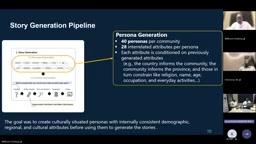
The study recruited 19 cultural representatives from five communities: Hausa in northern Nigeria, Kikuyu in central Kenya, Luwo in western Kenya, Xhosa in South Africa's Eastern Cape, and Shangana in southern Mozambique. All participants were born and raised in their respective communities and are native speakers of local languages.
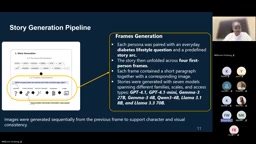
The evaluation materials were AI-generated multimodal stories, each consisting of four first-person paragraphs, with one image per paragraph. Cultural representatives were asked to judge at the frame level whether the text and images "connected" with their community's culture, and to annotate the specific text segments and image regions that influenced their judgments. Afterwards, they gave an overall alignment score from 0 to 100 for the entire story.
The study also organized two-hour focus group discussions in each community, allowing participants to explain their reasoning, points of disagreement, and what "cultural alignment" means to them.
How do communities understand culture? Five dimensions
Through thematic analysis of the focus groups, the study distilled five reasoning dimensions that cultural representatives use when judging cultural alignment:
- Referential meaning: specific cultural elements such as names, foods, places, objects, and institutions.
- Procedurality: how daily practices are performed, such as the way food is prepared.
- Situatedness: whether an element is appropriate for a specific setting, timing, or purpose. For example, in Shangana culture, wearing a hat in institutional settings is uncommon.
- Social geography: characteristics based on location and social-material conditions, such as housing types and whether there is a garden.
- Language register: language-level usage habits such as dialect, code-switching, and forms of address.
These five dimensions are more abstract than common "cultural labels" and better capture how culture operates in specific contexts.
Register is a sociolinguistic concept referring to the language variant that speakers choose in a specific situation based on the interlocutor, setting, and purpose. It encompasses word choice, sentence complexity, level of formality, and forms of address. In cultural alignment evaluation, register conflict means that generated text, while grammatically correct, uses expressions that do not match the habits of the target community. For example, a Portuguese-language story generated for a Mozambican community that includes Brazilian Portuguese or European Portuguese expressions would feel alien to local readers. The register dimension reminds us that linguistic correctness is not the same as cultural appropriateness—dialect, code-switching, and forms of address are all important signals of cultural alignment.
How does cultural misalignment occur? Eight mechanisms
The study identified eight mechanisms of cultural misalignment in multimodal stories:
- Substitution: inserting elements from other cultures into the target culture. For example, using Zimbabwean food names in an unrelated context.
- Omission: key cultural elements are missing, making the story appear generic.
- Forced insertion: the overall content is generic, yet a local name is awkwardly inserted, making it feel unnatural.
- Register conflict: mismatched language style. For example, a Portuguese-language story generated for a Mozambican community containing Brazilian Portuguese or European Portuguese expressions.
- Cross-modal inconsistency: the text says one thing while the image shows another. For example, the text says a certain dish is being cooked, but the food in the image does not match at all.
- Stereotyping: simplified or one-sided portrayal of the community.
- Hallucination: fabricating non-existent key practices or meanings.
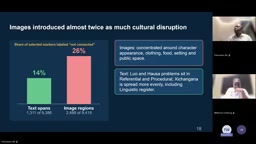
You may not have noticed that the study found images introduce nearly twice as much cultural interference as text. Character appearance, clothing, food, gender presentation, and scenes and public spaces are all concentrated areas of image misalignment.
A typical example comes from the Hausa community: an image of a woman in a market was judged as misaligned by cultural representatives because her way of dressing did not match local cultural expectations. Another example comes from the Shangana community: the text described cooking a certain local food, but the food shown in the image was completely different.
Cross-modal consistency refers to text and images semantically matching each other and jointly conveying the same information. In a multimodal story, if the text describes cooking a certain local food while the image shows food that does not match at all, this constitutes cross-modal inconsistency. Such misalignment not only undermines the credibility of the story but may also convey incorrect cultural information. Research shows that images introduce nearly twice as much cultural interference as text, indicating that the visual modality is more prone to errors in cultural expression—character appearance, clothing, food, gender presentation, and public spaces are all high-frequency misalignment areas. Therefore, when evaluating multimodal generated content, text and images must be examined as a whole for cultural consistency.
Can LLMs serve as cultural judges? Results are uneven
The study had multiple multimodal large models act as "judges," scoring stories using the same criteria as humans, and then compared the correlation between model and human scores.
The results showed that model performance varied by culture. In the Luwo, Hausa, and Kikuyu communities, the correlation between model and human scores reached moderate to strong levels. But in the Shangana and Xhosa communities, the results were unsatisfactory. Model scores for Shangana were notably more optimistic, giving higher scores than humans; and for Xhosa, because only two representatives participated, the data were insufficient to support reliable conclusions.
The researchers' explanation is that the Shangana stories themselves had very low cultural alignment quality, with human scores concentrated in a very low range, making fine distinctions difficult and causing large calibration deviations between models and humans.
The conclusion is clear: we cannot assume that LLM judges work reliably across different cultures. Each model has different knowledge reserves about specific cultures, and applying the same criteria across cultures is risky.
LLM-as-a-judge is a common automated evaluation method: having a powerful language model score or rank generated content according to given criteria to replace or supplement human evaluation. This approach is low-cost and scalable, but its reliability depends on the model's knowledge of the target domain. In cultural alignment evaluation, LLM judge performance varies by culture—correlation is moderate to strong for the Luwo, Hausa, and Kikuyu communities, but unsatisfactory for the Shangana and Xhosa communities. This shows that LLM cultural knowledge is unevenly distributed, and generalizing it across cultures carries risks. The study suggests using abstract taxonomies to guide model reasoning rather than relying on predefined lists of cultural elements, to improve the cross-cultural reliability of judges.
Next steps: using taxonomies to guide model reasoning
The research team believes that rather than relying on predefined cultural categories or element lists, the five-dimension taxonomy they distilled should be used to guide models' cultural reasoning. This provides an actionable direction for improving generation and evaluation: injecting community-perspective cultural dimensions into model context may help generate better-aligned stories and bring automated evaluation closer to human judgment.
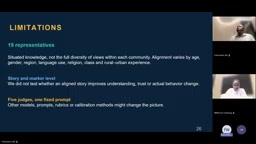
The study also explicitly lists limitations: participants represent specific perspectives within communities rather than all disagreements; and the study did not test whether culturally aligned stories actually improve understanding, trust, or behavior change. These are directions for future work.
The value of this work lies in turning "cultural alignment" from an abstract slogan into an operational, measurable, and discussable evaluation framework. It reminds us that AI's global capabilities do not automatically equal cultural sensitivity, and that true alignment must start from communities' own judgments.
Related articles

If The Office Premiered in 2026, Would It Survive Six Episodes?
Vergecast discussion: If The Office premiered in 2026, it would likely be canceled after six episodes due to immediate-return pressure. This article analyzes how streaming-era ROI anxiety stifles creative evolution, and why data-driven decisions need room for belief.

Moral Dilemmas at 30,000 Feet: Can Flying Make Us Better People?
From the moral landscape of first class versus economy, we explore how the flying environment mirrors everyday moral dilemmas—and whether mastering coexistence in flight can make us better moral people.

Muse 2 Pro vs DJI Pocket 4P: Image Quality Nearly Indistinguishable, But You Can't Buy It in the US
Muse 2 Pro vs DJI Pocket 4P pocket gimbal camera comparison: 10bit X-Log 3, handle rotation design, tripod mount differences. Image quality is nearly indistinguishable, but Muse 2 Pro isn't sold in the US—the key barrier for buyers.