Microsoft Restructures Communications: Brad Smith Takes Charge as Team Moves Under CELA

Microsoft moves its communications team under CELA, with Brad Smith taking direct oversight as CCO Frank Shaw departs.
Microsoft has announced a significant organizational restructuring: its communications team is being separated from marketing and placed under the Corporate, External, and Legal Affairs (CELA) organization, with Vice Chair and President Brad Smith taking direct oversight. Current CCO Frank Shaw will depart later this year as the company searches for a successor. The deeper rationale is that with AI regulation, data privacy, and antitrust scrutiny intensifying, external communications has become so intertwined with legal compliance and public policy that it can no longer be treated as a simple marketing function.
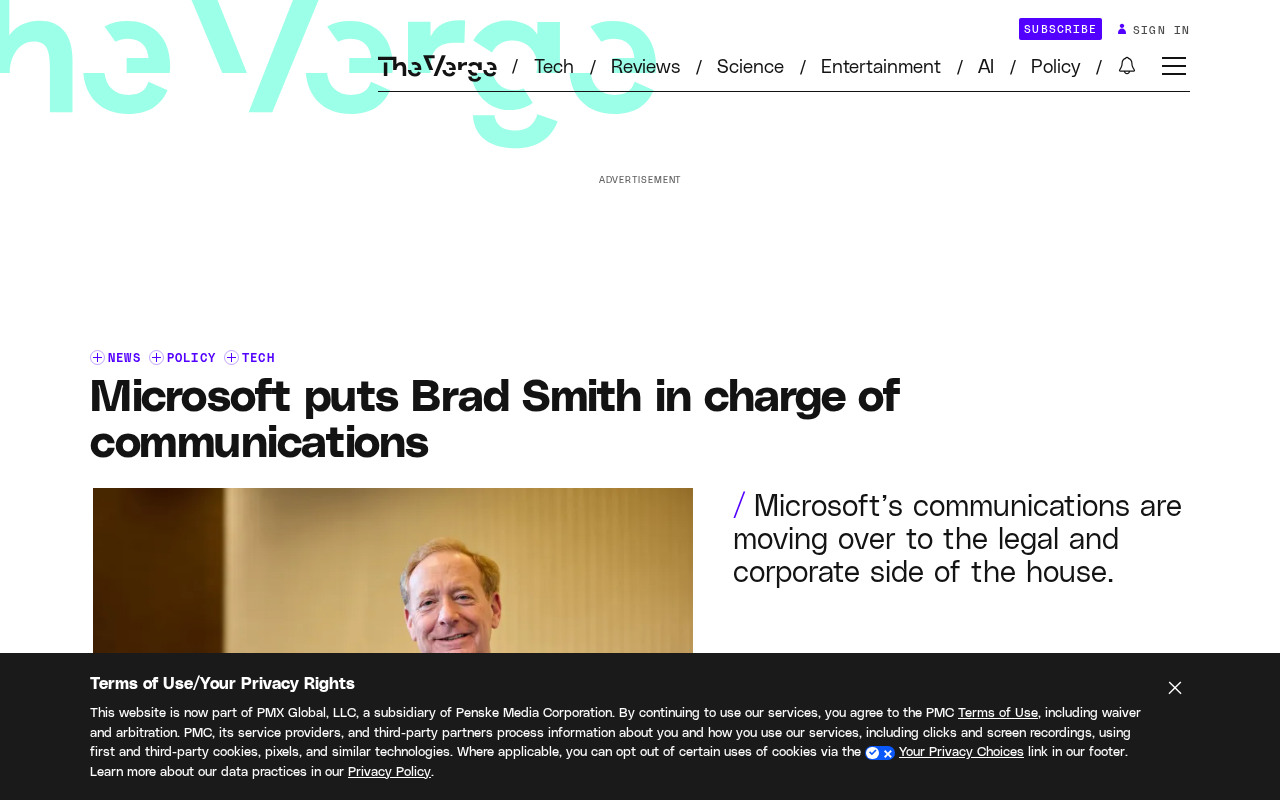
Microsoft has made a surprising organizational change: the company's communications group is being separated from marketing and moved under the Corporate, External, and Legal Affairs (CELA) organization. With this shift, Microsoft Vice Chair and President Brad Smith will directly oversee the company's communications function.
What's Changing
At the heart of this reorganization is a fundamental shift in where communications sits within Microsoft. Previously, the communications team fell under marketing, where it primarily served brand-building and product promotion goals. Moving it into CELA means communications will now be more tightly tied to corporate legal, policy, and external affairs.
At the same time, Microsoft's current Chief Communications Officer Frank Shaw will be departing later this year. The company is searching for his successor, and in the interim, Brad Smith is stepping in to oversee communications directly. As Microsoft's Vice Chair and President, Smith has long led the company's legal and public policy agenda. His taking over communications underscores Microsoft's intent to elevate external messaging to a strategic and governance-level function.
CELA (Corporate, External, and Legal Affairs) is Microsoft's core division responsible for legal compliance, government relations, corporate responsibility, and external policy affairs — long considered the company's brain when it comes to regulatory and public affairs matters. Smith has served as Microsoft's General Counsel since 2001 and was elevated to Vice Chair and President in 2021. He is Microsoft's primary representative in dealings with governments, regulatory bodies, and international organizations. He has led the company's response to EU antitrust investigations, championed policy advocacy around the Digital Services Act, and regularly spoken on behalf of the industry in AI regulation discussions. Bringing the communications team under his purview means Microsoft's external narrative will more directly serve its policy and legal strategy.
Why Communications Now Belongs Under Legal and Policy
Moving communications out of marketing and into CELA reflects how dramatically the external communications environment has shifted for large tech companies. For a company like Microsoft — under regulatory scrutiny, at the center of AI policy debates, and in the global public affairs spotlight — external messaging can no longer be neatly categorized as "marketing."
Merging communications with legal and policy functions allows the company to maintain consistent messaging when engaging regulators, government agencies, and the public. Smith has long been Microsoft's public face on policy and legal matters. Having him oversee communications signals that Microsoft wants its external statements to carry greater consistency and authority — particularly on sensitive topics like AI governance, data privacy, and competition regulation.
This trend isn't unique to Microsoft. In recent years, many large tech companies have been rethinking the role of communications. From Meta consolidating policy communications with PR, to Alphabet strengthening coordination between government relations and communications teams, the industry broadly recognizes that in an era of antitrust investigations, AI legislation debates, and data security controversies, "telling the story" and "litigating and lobbying" are fundamentally different fronts in the same battle. Traditionally, the Chief Communications Officer (CCO) reported to the CMO or CEO, with a focus on brand and media relations. But when communications reports directly to the head of legal and policy, the prioritization logic changes fundamentally — compliance risk and regulatory narrative carry more weight than product visibility and consumer image.
Internal Implications for Microsoft
This reorganization will have ripple effects on how Microsoft communicates and collaborates internally. Now that communications is separated from marketing, the team's focus may shift away from product launch narratives and more toward corporate reputation management, crisis response, and policy communications.
Frank Shaw's departure and the search for his successor also means Microsoft's communications leadership will take on a new character. The fact that senior leadership is managing the transition directly — rather than leaving a gap — signals the company wants to ensure this function doesn't lose momentum during the personnel change. For outside observers, the background and profile of whoever is ultimately named as successor will be a telling signal of where Microsoft's communications strategy is headed.
The Broader Signal
Organizational restructuring often reflects shifts in a company's strategic priorities. By elevating communications to report directly to the Vice Chair and President, and placing it within the corporate and legal affairs structure, Microsoft is signaling that in an era of increasing regulatory pressure and complex public affairs, corporate communications is no longer just a matter of messaging craft — it's a strategic imperative deeply intertwined with legal compliance and public policy.
For readers tracking tech industry governance and corporate communications trends, this is a development worth watching closely — especially who Microsoft ultimately names as its next Chief Communications Officer, and what positions the company takes in its subsequent AI policy messaging.
Related articles

Amphibious Transforming Drone: Beyond 100x Power Savings, What Are the Real Needs?
Is the amphibious transforming drone just a gimmick? Starting from the 100x power difference of the M4 Morphobot, explore real application scenarios and thesis topic ideas, analyzing boundary conditions where pure drones and pure ground robots both fail.

Warhound Raises $200 Million: Genetically Engineered "War Dogs" Paired with Anduril Gear
Warhound raises $200M, backed by Ben Lamm and Palmer Luckey, to genetically engineer dogs for military and law enforcement use and equip them with Anduril gear. This article analyzes its technology direction, funding logic, and ethical controversy.

Claude API Comes to Google Cloud: IAM Integration and SDK Access Guide
Anthropic hosts the full Claude API on Google Cloud with IAM-controlled permissions and unified billing. This guide covers the Vertex AI and Anthropic-hosted entry points, IAM role configuration, and SDK access.