Microsoft's AI Diagnostic System Beats Doctors? The Key Lies in the Underlying Model

Microsoft's AI diagnostic system beats GPs on hard cases, but gains come mainly from the underlying model, not the system.
Mustafa Suleyman claims Microsoft's AI diagnostic system outperforms GPs on complex cases and proposes "medical superintelligence." The Science study does show higher diagnostic accuracy on difficult cases, but original reporting notes most gains come from the underlying AI model, not Microsoft's system—an equally powerful base model might yield similar results. The narrative conflates model and system capabilities; the study covers only limited diagnostic scenarios, while real clinical practice involves multi-round consultations, test interpretation, treatment decisions, and communication. The industry should distinguish replicable model dividends from system engineering, data, and regulatory moats.
Title
Microsoft's AI Diagnostic System Beats Doctors? The Key Lies in the Underlying Model
Meta Description
Microsoft's AI diagnostic system outperformed general practitioners on complex cases in a Science study, but analysis shows the performance gains come mainly from the underlying AI model rather than the system itself. This article breaks down the gap between the "medical superintelligence" vision and reality, and explores evaluation and competitive moats in medical AI.
Article Content
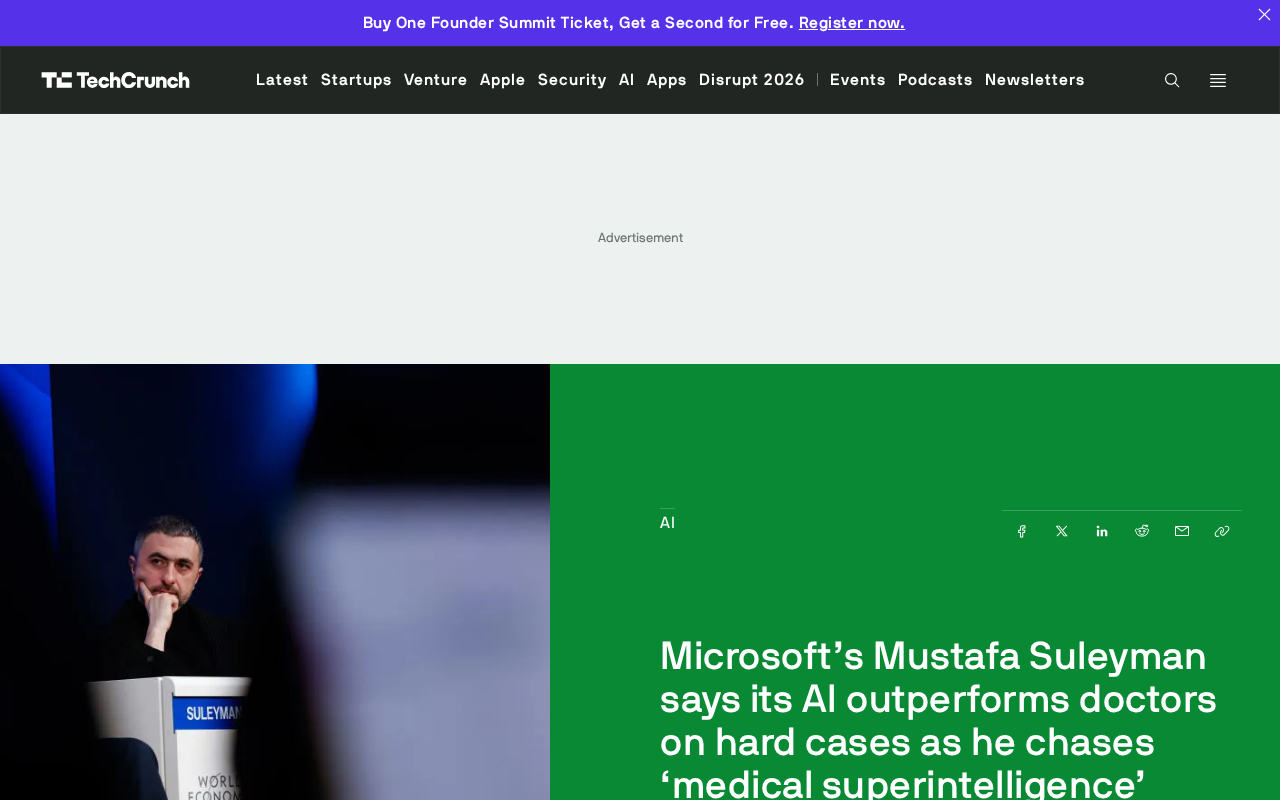
Mustafa Suleyman, head of Microsoft's AI division, recently claimed that his team's AI diagnostic system outperforms general practitioners on complex cases, and ambitiously proposed pursuing "medical superintelligence." The statement stems from a study published in Science magazine, but on closer inspection, the credit may not be as straightforward as the headline suggests.
What the Study Says: AI Wins on Complex Cases
According to the study published in Science, Microsoft's new AI diagnostic system exceeded ordinary general practitioners in diagnostic accuracy on difficult cases. Suleyman called the result an important step toward "medical superintelligence"—AI systems that comprehensively surpass human experts in medical cognitive tasks.
Such research attracts attention because medical diagnosis has long been regarded as one of the hardest domains for AI to conquer: overlapping symptoms, incomplete information, and hidden clues of rare diseases all make general-purpose models prone to errors. Microsoft's choice of "difficult cases" as the test scenario is itself a high-profile demonstration of capability.
"Medical Superintelligence" borrows the conceptual framework of "superintelligence" from the general AI field. In AI research, superintelligence usually refers to systems that far surpass the smartest humans in almost all cognitive tasks; with the "medical" qualifier, it means comprehensively surpassing human experts in diagnostic, treatment decision-making, medical knowledge integration, and other medical cognitive tasks. Note that this term currently has no recognized academic definition or evaluation standard—it is more of a visionary statement. By contrast, academia more commonly uses "expert-level performance" or "human-parity" to describe meeting standards on individual clinical tasks, and the two differ significantly in evidentiary requirements and regulatory implications.
The Real Hero: The Underlying Model, Not the System Itself
However, the original reporting points out an easily overlooked fact: most of the performance improvement appears to come from the underlying AI model rather than the diagnostic system Microsoft built itself. In other words, swapping in an equally powerful base model with a similar system framework might yield comparable results.
This is not to dismiss Microsoft's work—system-level engineering, prompting strategies, and clinical workflow integration all have value. But it reminds us that the "Microsoft AI beats doctors" narrative needs to be unpacked: model capability and system capability are being conflated.
A "foundation model" refers to a large model pre-trained on large-scale general data that can be adapted to various downstream tasks through fine-tuning or prompting. In medical AI products, there are usually three layers of capability: the foundation model's general reasoning and medical knowledge, the system layer's prompt engineering and workflow orchestration, and the institution's proprietary clinical data and validation. The so-called "performance attribution" problem is about determining which layer contributes most to the final result. If ablation experiments show similar results after replacing the foundation model with an equally capable one, it indicates the gains come mainly from the model dividend rather than system innovation. This is also an experimental design point worth watching when evaluating such research.
Medical Superintelligence: The Gap Between Vision and Reality
Suleyman's "medical superintelligence" phrasing is highly communicable, but the study itself only covers diagnostic comparisons in limited scenarios. Real clinical environments are far more complex than experiments: multi-round consultations, interpretation of test results, treatment decisions, doctor-patient communication—none of these can be captured by a single diagnostic accuracy rate.
More worth asking is: when the underlying model becomes the main contributor, where is Microsoft's differentiated advantage? If the foundation model comes from the general capability race, then the moat for medical AI may lie not in the system layer, but in data, clinical validation, and regulatory approval.
Clinical validation typically follows a phased path: retrospective offline evaluation, prospective controlled studies, randomized controlled trials, and ultimately regulatory review and post-market surveillance. Most AI diagnostic research stays at the first stage—offline comparisons using existing case data—which cannot reflect the process of gradually acquiring information and dynamically interpreting test results in real consultations. In addition, when "general practitioners" serve as the control group, their available resources, time constraints, and experience levels all affect comparability. Therefore, a single diagnostic accuracy metric is insufficient to support the conclusion of "beating doctors"; regulatory approval (such as medical device software clearance) is the key threshold for product deployment.
What It Means for the Industry
For the medical AI sector, this study sends two signals. First, large models have indeed crossed a meaningful threshold on complex diagnosis, and general practitioners should take this change seriously. Second, when evaluating AI medical products, one must distinguish "model dividend" from "system engineering"—the former is replicable, while only the latter constitutes a competitive moat.
For ordinary readers, the most practical reminder is: when you see a headline like "AI beats doctors," look at the study design first, then the performance attribution. Microsoft's step is a good one, but there is still a long road of clinical validation between it and the medical superintelligence Suleyman describes.
One-line Summary
Microsoft's AI diagnostic system beats general practitioners on difficult cases, but the performance comes mainly from the underlying model rather than the system itself.
Paragraph Summary
Mustafa Suleyman, head of Microsoft's AI division, claims his AI diagnostic system outperforms general practitioners on complex cases and proposes pursuing "medical superintelligence." The study published in Science does show the system's diagnostic accuracy exceeds ordinary general practitioners on difficult cases, but the original reporting points out that most of the performance improvement comes from the underlying AI model rather than the diagnostic system Microsoft built—swapping in an equally powerful base model might yield similar results. The article reminds us that the "Microsoft AI beats doctors" narrative conflates model capability with system capability; the study only covers diagnostic comparisons in limited scenarios, while real clinical practice involves multi-round consultations, test interpretation, treatment decisions, and doctor-patient communication. For the industry, it is important to distinguish replicable model dividends from system engineering, data, and regulatory approval capabilities that constitute competitive moats.
Related articles

WorkBuddy Full Tutorial: Build an AI Office Automation Agent from Scratch
A complete WorkBuddy tutorial: installation, three working modes, multimodal picture book video practice, expert team agent building, and workflow configuration for low-cost AI office automation.

WorkBuddy Agent Complete Guide: From Beginner to Automation in 7 Days
Based on Bilibili's 256-episode WorkBuddy masterclass, this systematically breaks down Tencent's AI office workbench core capabilities: Agent principles, Skill encapsulation, cross-platform connectors, scheduled automation, knowledge bases, and zero-code development, with learning path recommendations.

8 AI Accounts, 7 Failed: An Honest Review of Using AI to Get Work Done
Only 1 of 8 AI-run Bilibili accounts succeeded. We break down the real difference between "performing AI" and "using AI to get work done."