Midjourney V8.2 Editing Feature Hands-On | Google Video Continuation Model & Anthropic Physical AI Updates
Midjourney V8.2 editing, Google video continuation, and Anthropic physical AI mark key AI advances
Three major AI developments: Midjourney V8.2 introduces conversational image editing for controllable creation; Google's Gemini Omni 1.1 Flash achieves video continuation with 10-second context understanding and dual-mode 360P-to-4K workflow; Anthropic releases MHS standard to connect AI agents with physical hardware, extending from digital to physical intelligence.
Midjourney V8.2: A Critical Step from Generation to Editing
For a long time, Midjourney has held a strong position in the AI image generation field thanks to its exceptional artistic quality, but image editing capabilities have always been a weak spot—users struggled to make fine-tuned adjustments to generated images. With the release of the Midjourney V8.2 image editing model, this missing piece is finally falling into place.
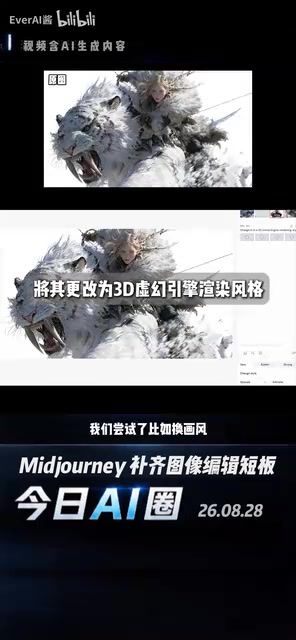
The core change in the new version is the introduction of conversational image editing: users can directly tell the model what modifications they want, and the model understands and executes them. Conversational Image Editing has been an important direction in multimodal large model development over the past two years. Its technical foundation lies in combining the natural language understanding capabilities of Large Language Models (LLMs) with the generation capabilities of image Diffusion Models, enabling the model to parse users' text-based editing instructions and precisely map them to pixel-level image transformations. Previously, Adobe Firefly, OpenAI's GPT-4o, and Google's Gemini have all explored similar paths. The core challenge of this capability is "controllability in local editing"—the model needs to accurately understand which regions and to what extent users want to modify, while keeping the rest of the image unchanged. This places high demands on the model's spatial understanding and semantic localization abilities.
According to hands-on testing by Bilibili creators, the currently supported operations are quite comprehensive, including common needs like changing art styles, modifying viewing angles, multi-image fusion, and enriching image elements.
However, it's important to be objective: this feature is still in its early stages and stability needs improvement. In actual testing, editing results don't always meet expectations. But considering Midjourney's deep expertise in image quality, once the editing capabilities mature, its complete "generation + editing" workflow will be highly competitive. This is why many creators remain optimistic about it.
Why Image Editing Capabilities Matter
For professional creators, a single generation rarely meets all requirements. Repeated regeneration not only wastes computing resources but also makes it difficult to ensure image consistency. Having editing capabilities means users can iteratively refine the same base image—this is the workflow that truly aligns with creative logic.
Before Midjourney, multiple technical approaches coexisted in the AI image editing field. Inpainting (local redrawing) was the earliest widely used solution, where users manually select regions for the model to refill; Instruct-Pix2Pix attempted to edit images directly through text instructions without manual region annotation. The Stability AI StableDiffusion community achieved conditional control over pose, depth, and other factors through plugins like ControlNet. However, these solutions either require high technical thresholds or have shortcomings in editing precision and image consistency. Midjourney's choice to integrate conversational editing into its native platform clearly aims to lower the barrier to entry, allowing non-technical users to complete fine-grained image iterations.
Midjourney filling this gap marks its evolution from a "gacha-style generation tool" to a "controllable creative platform."
Google Gemini Omni 1.1 Flash: A New Approach to AI Video Continuation
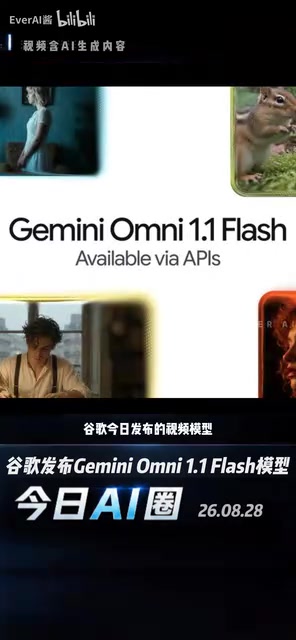
In the AI video generation race, Google's released Gemini Omni 1.1 Flash brings a standout capability—natural video continuation. Its core "specialty" is: given a video segment, the model can read approximately the first 10 seconds of footage and continue writing the subsequent plot.
Video Continuation/Extrapolation is recognized as a high-difficulty task in AI video generation. Unlike single-frame image generation, video requires strict consistency across the temporal dimension, including multiple layers such as character appearance, motion trajectories, physical laws, and scene lighting. Early video generation models (like Runway Gen-2, Pika, etc.) often exhibited character deformation and physical distortions when generating 3-5 second clips, let alone coherent continuation based on existing video. Gemini Omni 1.1 Flash's ability to read approximately 10 seconds of prior video and maintain continuation consistency relies on deep modeling of video temporal information and breakthroughs in multimodal Transformer architectures for long sequence understanding.
More noteworthy is the consistency performance during continuation. According to hands-on testing, character appearance, lighting conditions, environmental atmosphere, and even the overall narrative tone can be maintained relatively stable. This addresses the widespread pain point of "continuation equals collapse" in previous AI video generation. The official comparison with SD2.5—which likely refers to Stability AI's Stable Video Diffusion series models, widely used in the open-source community but still limited in long video consistency—demonstrates Gemini's clear advantages in generation quality.
Dual-Mode Design: Balancing Efficiency and Quality
Gemini Omni 1.1 Flash's workflow design is quite thoughtful, offering two modes for draft quick iteration and professional output:
- Draft mode: During the early creative refinement stage, use 360P low resolution for quick preview generation, significantly shortening feedback cycles;
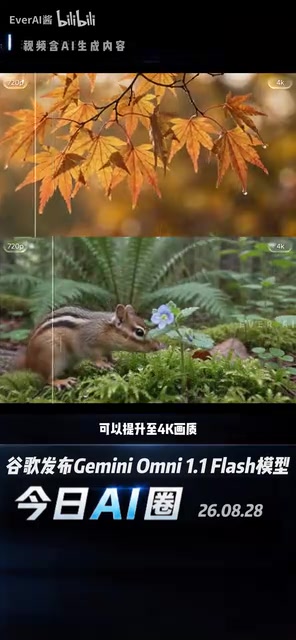
- Professional mode: Once the creative direction is confirmed, upgrade quality to 4K for production-grade output.
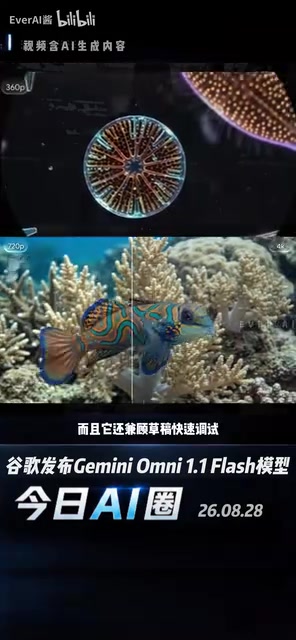
This layered rendering strategy has long been standard practice in CG production for film and gaming industries. For example, Pixar uses low-precision rendering (Playblast) during animation film production to quickly preview shot composition and character animation, confirming creative direction before investing in high-precision rendering (Final Render), where single-frame rendering time can be hundreds of times longer. Gemini Omni introduces this mature approach to AI video generation. The 360P draft mode essentially uses fewer computational resources to quickly validate creative feasibility, avoiding users wasting substantial GPU computing power and wait times on 4K high-quality generation. This design significantly reduces trial-and-error costs in AI video creation, particularly suitable for scenarios requiring frequent iteration like advertising, short videos, and concept previsualization.
Additionally, the model supports importing brief reference videos to guide generation direction, allowing AI to more precisely produce the visual style users expect. This "low-cost trial, high-quality delivery" layered design is clearly optimized for real creative scenarios.
Anthropic's Physical AI Strategy: MHS Hardware Standard Explained
Beyond developments in image and video domains, Anthropic has also announced entry into the physical AI track by releasing the MHS (Model Hardware Standard), a model hardware standard. Simply put, this is a unified interface protocol designed to connect AI agents with industrial and various physical devices.
MHS can be analogized as the "MCP protocol" (Model Context Protocol) for physical devices. MCP is an open protocol Anthropic previously launched for connecting AI models with software tools, while MHS extends this concept from digital tools to physical hardware. In industrial automation, device communication has always relied on multiple heterogeneous protocols like OPC-UA, MQTT, and Modbus, with different manufacturers' devices often requiring customized integration solutions. MHS attempts to establish an AI-native abstraction layer above these underlying protocols, allowing large language models to understand device capabilities in a unified way (such as sensor ranges and actuator precision), issue control commands, and receive feedback. This is similar to ROS (Robot Operating System) in the robotics field, but MHS emphasizes native integration with large model agents rather than traditional programmatic control.
Its value lies in bridging the communication barrier between AI and hardware: AI can identify each device's functional capabilities, issue commands to them, and even coordinate multiple instruments simultaneously. This means large model capabilities are beginning to extend from the digital world to the physical world, providing new possibilities for industrial automation, smart manufacturing, and other scenarios.
From Digital Intelligence to Physical Intelligence
If image and video generation represent AI's capability expansion at the "perception and creation" level, then the MHS standard represents AI's penetration into the "action and execution" level. A unified device interface standard could potentially become the infrastructure for agents to orchestrate the physical world in the long run, with strategic significance that cannot be overlooked.
Notably, Anthropic is not the only tech giant deploying physical AI. NVIDIA has vigorously promoted its "Physical AI" strategy since 2024, providing AI training and simulation environments for robotics and automation systems through its Isaac platform and Omniverse digital twin technology. Google DeepMind explores the possibility of large models directly controlling robots through its RT series (Robotics Transformer) models. OpenAI has also invested in humanoid robot company Figure AI. Anthropic's choice to enter through the standard protocol layer is taking the "infrastructure" route—rather than directly developing robots, it first defines communication specifications between AI and hardware. If this standard gains widespread adoption, Anthropic will occupy a key "connectivity layer" position in the physical AI ecosystem. The far-reaching implications of this strategic positioning deserve continued attention.
Summary
These three developments sketch out three clear paths of AI technology evolution: Midjourney V8.2 fills the image editing gap, moving toward controllable creation; Google Gemini Omni 1.1 Flash enhances the practicality of AI video generation through video continuation and dual-mode design; Anthropic's MHS standard attempts to bridge AI and physical devices. From images to video to hardware, AI is accelerating its implementation across multiple dimensions.
Key Takeaways
Related articles
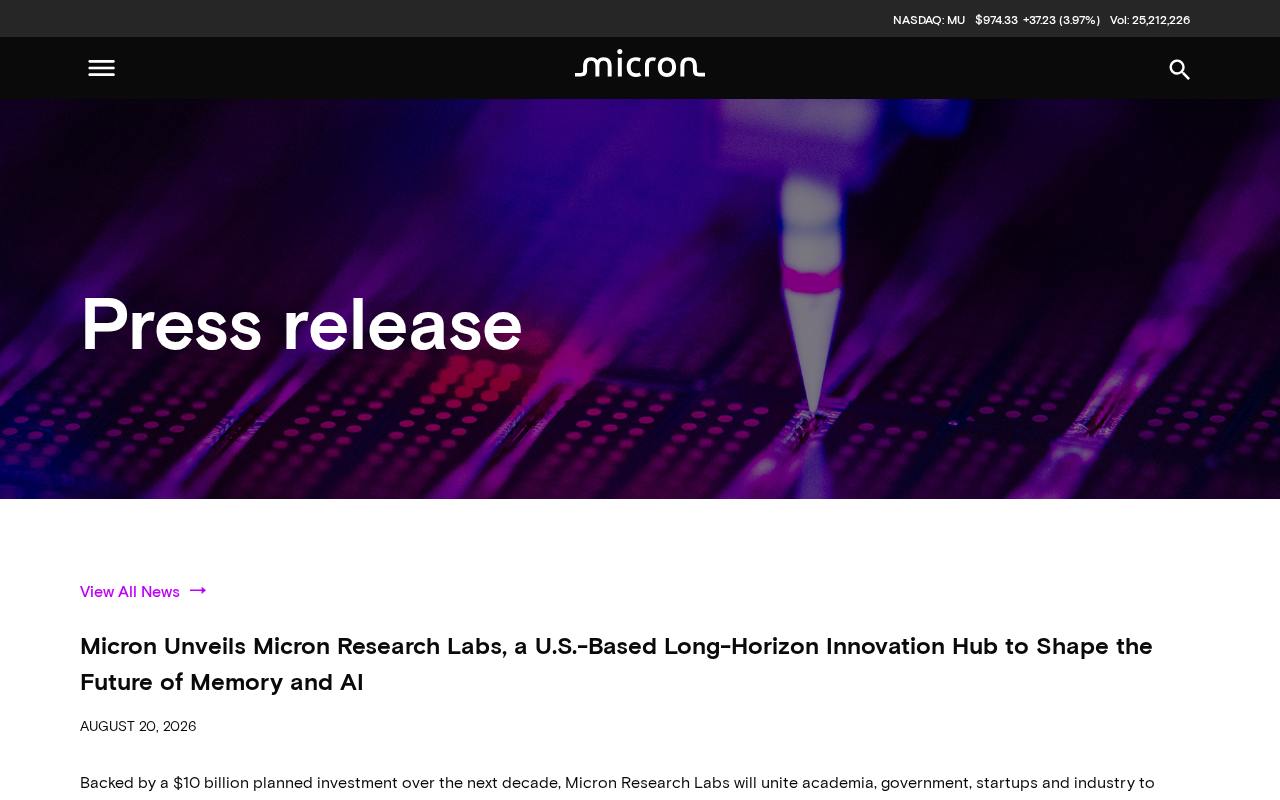
Micron's $10 Billion R&D Center in Boise: A Deep Dive into Its Strategic Significance
Micron announces a $10B R&D center in Boise focused on HBM and next-gen memory tech. We analyze the strategy, policy drivers, and impact on AI-era chip competition.
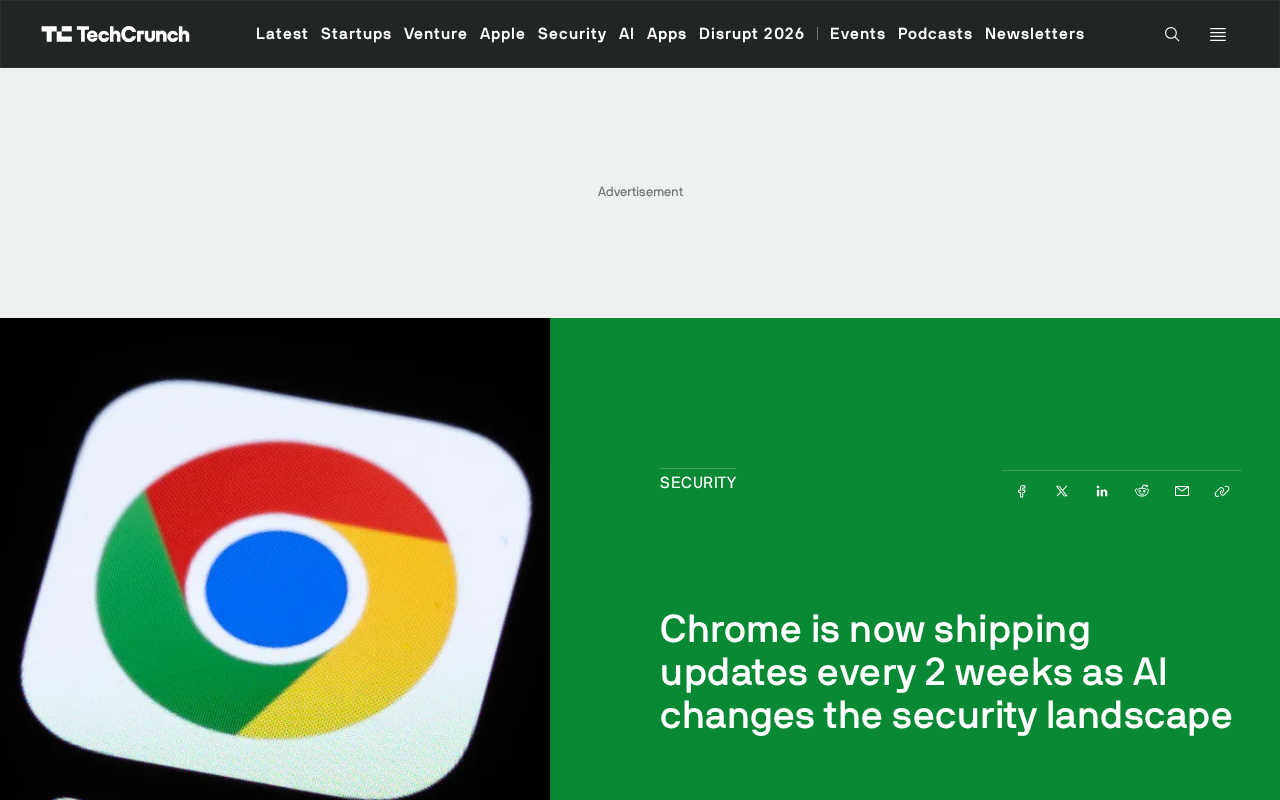
Chrome Updates Every Two Weeks: How AI is Reshaping Browser Security Strategy
Google Chrome shifts to biweekly updates to combat AI-accelerated cyberattacks. Deep dive into how AI is transforming security dynamics and the impact of faster release cycles.
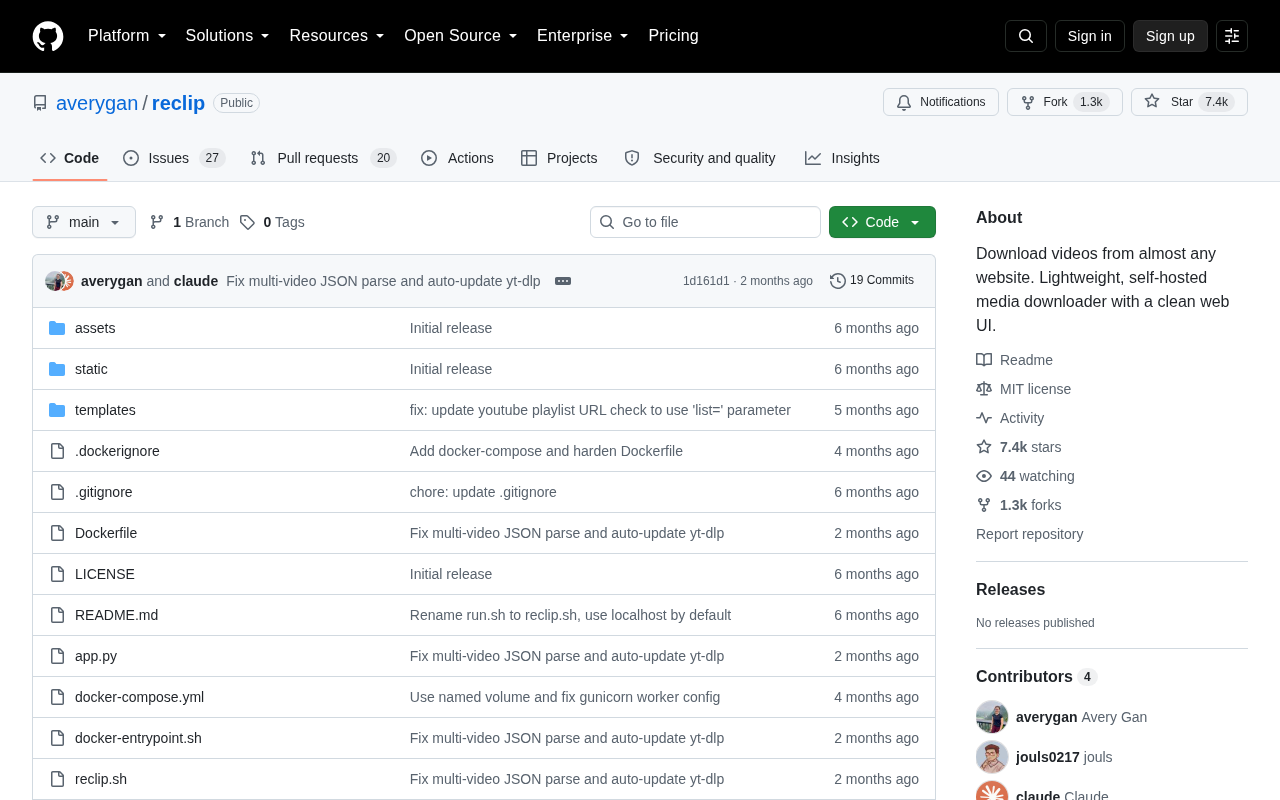
reclip: Self-Hosted Video Downloader with Clean Web UI as Command-Line Alternative
reclip is a lightweight self-hosted video downloader with a clean Web UI, built on yt-dlp to support downloads from almost any website. Easy deployment, privacy control, ad-free, ideal for NAS and VPS users.