Midterm Election Night Watch: Three Key Storylines — Senate, House, and Turnout

Senate control, redistricting effects, and turnout are the three variables deciding the U.S. midterm elections.
Based on a YouTube analysis video, the article identifies three key dimensions to watch on U.S. midterm election night. First, Senate control: Democrats were seen as long shots but now lead narrowly in polls across multiple states, including swing states like North Carolina and Georgia and red states like Texas, Kansas, Alaska, and Ohio, though a polling error or late Republican turnout surge could still reverse the results. Second, the House: Republicans solidified their majority through redistricting while Democrats countered with similar tactics without fully offsetting the gains, and the shift in South Texas's Latino districts is especially critical. Third, turnout: enthusiasm was unusually high for both parties in the Trump era, and if Republicans cannot match Democrats, a blue wave could emerge in unexpected areas. These dimensions are intertwined, and election-night data will test each hypothesis.
As voting day for the U.S. midterm elections arrives, what key signals are worth watching on election night? According to an analysis video published on YouTube, three dimensions will determine how tonight's races unfold: control of the Senate, the redistricting effect in House races, and the level of voter turnout.
Senate: From "Long Shot" to "Narrow Lead"
The video notes that at the start of this election cycle, Democrats were seen as the underdogs, since most key battlegrounds are in states Trump won by large margins. But current polling shows Democrats at least narrowly ahead in some races — not only in 2024 swing states like North Carolina and Georgia, but also in Texas, Kansas, Alaska, and Ohio, where Trump won by double digits. Both parties are even treating races in South Carolina, Nebraska, and Mississippi as competitive contests.
Still, most of these races are considered close. The video cautions that a slight polling error, a last-minute surge in Republican turnout, or an unexpected twist in states like Michigan or Maine could dramatically change the results — including control of the Senate.

Midterms and the Senate Re-election Mechanism
The U.S. Senate has 100 seats, with each state holding 2 seats regardless of population. Senators serve six-year terms, and roughly one-third of seats (33 to 34 this cycle) are up for election every two years. This staggered re-election means the electoral map differs each round: in one year Democrats may need to defend a large number of seats in "red states" Trump won by wide margins, while in another they may only compete in a few swing states. Senate seats are usually decided by a handful of states with margins of 1 to 2 percentage points, so a national polling lead has limited reference value — what really matters is the state-by-state error. In addition, the vice president casts the tie-breaking vote in a 50-50 Senate, which makes the control threshold (50 or 51 seats) a core variable in pre-election analysis.
House: The Double-Edged Sword of Redistricting
Republicans sought to preserve their House majority through redistricting, prompting Democrats to take similar measures in some areas, though these did not fully offset Republican gains. The video analysis suggests that if the polls are accurate, Democrats could even win some seats originally designed to favor Republicans.
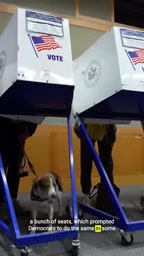
South Texas is particularly worth watching. Democrats hope to make major gains in the heavily Latino districts there, which shifted toward Trump in 2024.
Gerrymandering and Redistricting
The 435 seats in the U.S. House are apportioned among states based on the once-a-decade census, and state legislatures are responsible for drawing congressional districts within their states. Because the drawing power rests at the state level, the governing party often uses "gerrymandering" tactics — packing opponent voters into a few seats or dispersing and diluting them across multiple seats — to secure a structural advantage for itself. After the 2020 census, redistricting in Republican-controlled states like Texas, Florida, and Ohio clearly favored the GOP; Democratic-controlled states (such as Illinois and New York) adopted similar strategies as a counterbalance. This is the meaning of the "double-edged sword" mentioned in the text: redistricting can lock in a base, but it can also backfire when overall public opinion tilts toward the other side, producing seats "designed for Republicans that fall into Democratic hands."
Turnout: The Key Variable Determining the Scale of a "Blue Wave"
A major feature of the Trump era is exceptionally high turnout for both parties. The video notes that turnout in the first midterm election during Trump's presidency (2018) hit a historic high. Historically, there has never been a case where one side completely collapsed in turnout.

If Republicans cannot match Democratic enthusiasm, some "blue wave" scenarios could emerge, affecting areas entirely unexpected. That also means election-night results could be more dramatic than the polls suggest.
The above three dimensions are intertwined: Senate control hinges on narrow margins in a few key states, the House landscape is shaped by both redistricting and the shift of Latino voters, and turnout is the underlying variable that amplifies or diminishes the effects of the first two. Real-time data on election night will test these hypotheses one by one.
Midterm Turnout Patterns and the "Blue Wave"
U.S. presidential-year turnout is typically around 55% to 60%, while midterm turnout often drops to around 40%, because the core mobilizing factor — the presidential candidate — is absent. The turnout structure is asymmetric between the two parties: young voters, minorities, and lower-income groups that lean Democratic are more likely to stay home in midterms, while older, white, and rural voters turn out more reliably — one reason the governing party typically loses seats in midterms. The so-called "blue wave" refers to Democrats winning a large number of marginal seats beyond expectations when turnout is unusually high, as happened in 2018. Therefore, watching election night means not only looking at poll numbers but also at actual turnout in each district and the partisan composition of early voting.
One-line Summary
Senate control, the redistricting effect, and turnout are the three variables that will determine the course of the U.S. midterm elections.
Paragraph Summary
Based on a YouTube analysis video, the article identifies three key dimensions to watch on U.S. midterm election night. First, Senate control: Democrats were seen as long shots before the election but now lead narrowly in polls across multiple states, including swing states like North Carolina and Georgia and red states like Texas, Kansas, Alaska, and Ohio; however, a slight polling error or a last-minute Republican turnout surge could still reverse the results. Second, the House landscape: Republicans solidified their majority through redistricting, Democrats countered with similar tactics but did not fully offset the gains, and the shift in South Texas's Latino districts is especially critical. Third, turnout: enthusiasm was unusually high for both parties in the Trump era, and if Republicans cannot match Democratic enthusiasm, a "blue wave" could emerge affecting unexpected areas. These three dimensions are intertwined, and real-time election-night data will test each hypothesis one by one.
Related articles

AI Can Read Neural Network Weights Directly: Do Models Already Exceed Expectations?
A Reddit developer experiment shows language models can directly read neural network weights and infer their function. Astra, Opus 5.5, and Muse Spark 1.3 all passed the test, sparking discussion on model generalization and training sources.

India's Microdrama Market Explodes: EloElo Secures $80M Investment from NBCUniversal
EloElo secures $80M from NBCUniversal to boost StoryTV, its microdrama platform with over 33M monthly active users, as India's microdrama market draws global capital.

Acoustic Detection of Multi-Rotor UAVs: Fusing Handcrafted Features with Pre-Trained Embeddings
Study reveals data leakage from random splits in UAV acoustic detection, proposes source-disjoint protocol with stacked ensemble of handcrafted features and YAMNet embeddings, achieving 95.29% accuracy for low-cost drone detection.