MindView: A Multi-View Spatial Intelligence Generation Benchmark Where All 11 Models Fail
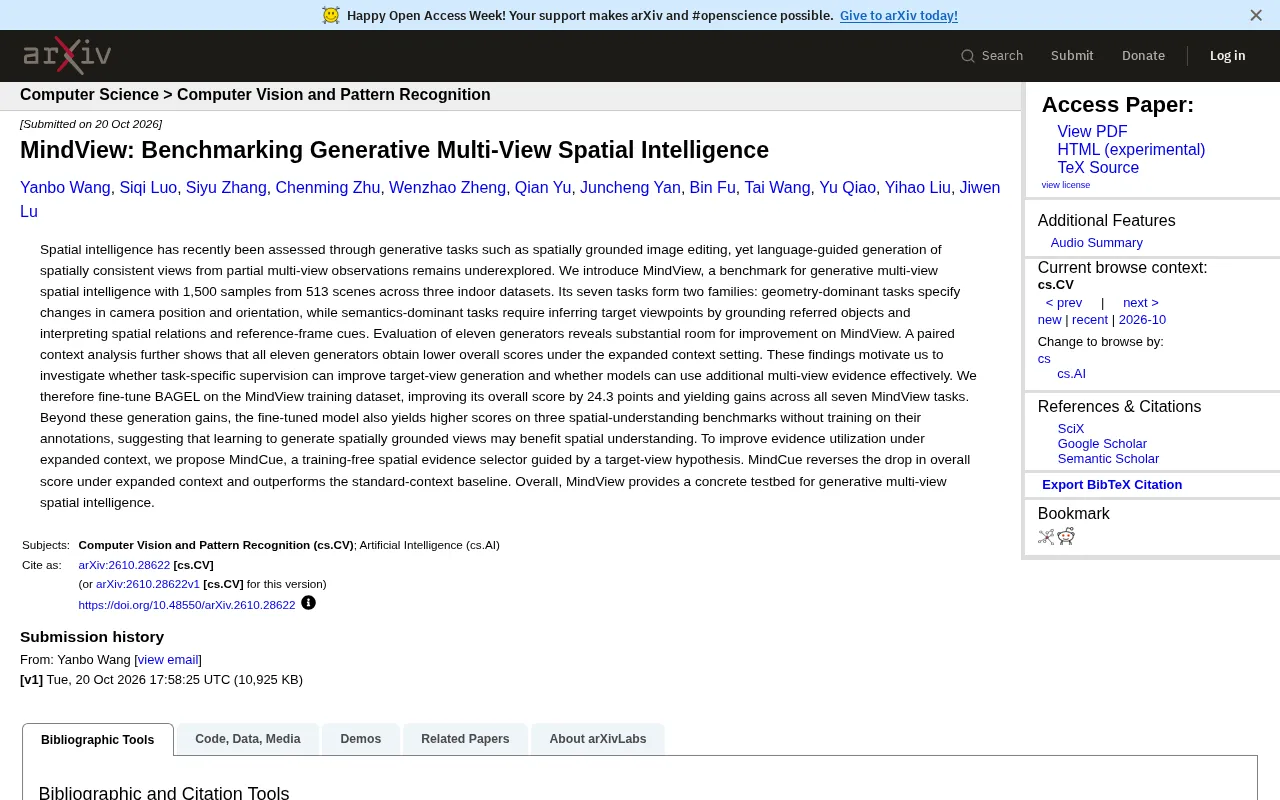
MindView benchmark reveals insufficient spatial consistency in multi-view generation; fine-tuning and evidence selection improve performance.
MindView is the first benchmark for systematically evaluating multi-view spatial intelligence generation, with 1,500 samples, 513 scenes, and seven geometry- and semantics-dominant tasks. Eleven generative models all fall short, and all degrade under extended context, exposing deficiencies in evidence filtering. Fine-tuning BAGEL improves the overall score by 24.3 and transfers to three spatial understanding benchmarks. The training-free MindCue selector reverses the extended-context decline by hypothesis-guided reference-view filtering.
Multi-view spatial intelligence is a key capability for AI to understand 3D environments, but existing evaluations mostly focus on single-image editing or static scene understanding. The recently proposed MindView benchmark fills this gap by systematically evaluating whether models can generate spatially consistent views from partial multi-view observations. The benchmark contains 1,500 samples from 513 scenes, covers three indoor datasets, and designs seven tasks divided into geometry-dominant and semantics-dominant categories. Geometry-dominant tasks specify changes in camera position and orientation and require the model to generate the corresponding view; semantics-dominant tasks require inferring the target viewpoint through referring objects, spatial relations, and reference-frame cues.
Seven Tasks and Evaluation Design
MindView's seven tasks span a spectrum from simple camera motion to complex semantic reasoning. Geometry-dominant tasks directly provide camera parameter changes, testing the model's ability to model 3D spatial transformations; semantics-dominant tasks are closer to human spatial reasoning—for example, instructions such as "move the camera to the left of the table and face the window" require the model to first locate objects, understand relative relations, and then infer the target viewpoint. This design moves evaluation beyond pixel-level generation quality and into spatial consistency and semantic grounding.
The Collective Predicament of Eleven Generators
The research team evaluated eleven mainstream generative models, and the results show that overall performance still has a significant gap from practical use. More critically, in the paired-context analysis, all eleven generators showed an overall score drop under the extended-context setting—meaning that when more reference views are provided, models find it even harder to use the information effectively. This finding points directly to the core bottleneck of current multi-view generation: models lack the ability to filter and integrate multi-source spatial evidence.
Extended Context here refers to the number of reference views a model receives when generating the target view exceeding the usual setting. Typically, multi-view generation models are trained with only a small number of reference views (e.g., 1–2), whereas MindView's evaluation gradually increases the number of reference views to simulate richer but more redundant input conditions. Theoretically, more reference views should provide more sufficient spatial information and help generate more accurate views; however, experiments find that all models score lower under extended context. This reveals that models generally lack the ability to filter and weight multi-source information and are easily disturbed by irrelevant or noisy views, leading to confused spatial reasoning. This phenomenon is similar to the "lost in the middle" problem in long-context language models, indicating that multi-view generation models also need effective evidence selection mechanisms.
The Dual Benefits of Fine-Tuning
To verify the value of task-specific supervision, the authors fine-tuned the BAGEL model on the MindView training set. After fine-tuning, BAGEL's overall score improved by 24.3 points, with gains on all seven tasks. More interestingly, the fine-tuned model also achieved higher scores on three spatial understanding benchmarks, despite not being trained with annotations from those benchmarks. This suggests that learning to generate spatially grounded views may in turn enhance spatial understanding ability, indicating positive transfer between generation and understanding.
BAGEL is a multi-view generation architecture based on diffusion models. Its core design treats multi-view generation as a sequential view synthesis process and uses attention mechanisms to pass information between views. BAGEL is trained on large-scale multi-view datasets and has a certain foundation in spatial consistency, but it still shows clear deficiencies in zero-shot evaluation. The MindView authors chose BAGEL as the fine-tuning target because it represents the mainstream paradigm of current multi-view generation and its open-source weights facilitate reproduction. After task-specific fine-tuning on the MindView training set, BAGEL not only learned to generate corresponding views based on camera parameters and semantic instructions, but also implicitly strengthened its modeling of 3D spatial relations. This positive transfer between "generative spatial learning" and purely discriminative spatial understanding tasks provides a new idea for spatial intelligence training of multimodal models.
MindCue: A Training-Free Evidence Selector
To address the performance drop under extended context, the researchers propose MindCue—a training-free spatial evidence selector guided by target-view hypotheses. MindCue filters the most relevant reference views by hypothesizing the target view, thereby reversing the score decline under extended context and surpassing standard context baselines. This method provides a lightweight solution for evidence utilization in multi-view generation.
MindView's contribution lies in building an actionable testbed that both exposes the deficiencies of current generative models in spatial consistency and demonstrates feasible paths to improve performance through fine-tuning and evidence selection. As application demand for multi-view generation grows in robotics, AR/VR, and other fields, such benchmarks will push models from "generating good-looking images" toward "generating spatially correct scenes."
Training-free methods refer to improving performance solely through inference-stage design without updating model parameters. The core idea of MindCue is: given a hypothesis of the target view (e.g., a rough camera pose or scene layout), compute the spatial relevance of each reference view to that hypothesis, and then weight or filter the reference views accordingly. Specifically, MindCue may use view features extracted by pre-trained models to evaluate the information content of reference views through attention or similarity measures, remove redundant or contradictory views, and retain the evidence most helpful for target-view generation. This "hypothesize first, then select" strategy can be embedded into existing generation pipelines without additional annotations or fine-tuning, significantly reducing deployment costs while providing an interpretable and lightweight solution for context management in multi-view generation.
One-line Summary
MindView reveals insufficient spatial consistency in multi-view generation models; fine-tuning and evidence selection can improve performance.
Paragraph Summary
MindView is the first benchmark to systematically evaluate multi-view spatial intelligence generation, containing 1,500 samples, 513 scenes, and seven tasks divided into geometry-dominant and semantics-dominant categories. The research team evaluated eleven mainstream generative models and found a significant gap from practical use overall, with all models scoring lower under extended context, exposing widespread deficiencies in multi-view evidence filtering and integration. To verify the value of task-specific supervision, the authors fine-tuned BAGEL, improving its overall score by 24.3 points with gains on all seven tasks, while also transferring to three spatial understanding benchmarks. To address the performance drop under extended context, the researchers propose the training-free evidence selector MindCue, which filters reference views via target-view hypotheses and successfully reverses the score decline. MindView provides an actionable testbed for multi-view generation, pushing models from generating good-looking images toward generating spatially correct scenes.
Related articles

No Python Required: How Cursor AI Coding Is Reshaping Automated Testing and Test Development
Test engineers can do automated testing without learning Python? This article examines how Cursor and other AI coding tools empower functional testing, automation scripts, test platform development, and performance tuning, compares the cost and access restrictions of mainstream domestic and foreign tools, and offers capability transformation advice for testers.

Nearly 5,000 Affected! AI Coding Plugin Found with Backdoor, Officials Urgently Remove It
Claude Code's VS Code extension version 2.1.313 was maliciously tampered with, implanting a backdoor for remote login and persistent control, potentially affecting up to 5,000 users. Officials have removed the malicious version; this article details the attack method and cleanup steps.

Codex and Cursor Localization and Model Switching, All Solved by One Small Tool
A Bilibili creator shares CCX Plus, a small tool that solves both localization and model switching for Codex and Cursor—install and forget, reliable connections, no garbled text, immediate effect.