Mindwalk: Replaying AI Coding Agent Behavior on a 3D Code Map
Mindwalk: Replaying AI Coding Agent Be…
Mindwalk uses 3D code maps to replay the full behavior trajectories of AI coding agents.
Mindwalk renders codebases as 3D spatial maps that visually replay the complete operation trajectories of AI coding agents like Claude Code and Cursor. This article analyzes its core concept, real-world use cases, current limitations, and how it fits into the broader rise of agent observability in the AI coding era.
When AI Coding Agents Become Black Boxes, Developers Need New Visualization Approaches
With the proliferation of coding agents like Claude Code, Cursor, and Devin, the way developers work is undergoing a fundamental shift. We no longer type code line by line—instead, we describe our intent to the AI, and the agent autonomously reads files, modifies code, and runs tests. This paradigm dramatically boosts efficiency, but it also introduces a new problem: what exactly is the agent doing in your codebase?
These coding agents are typically built on large language models (LLMs) equipped with tool use capabilities, enabling them to read and write to the file system, execute terminal commands, and call external APIs. Their core architecture follows the "ReAct" paradigm (Reasoning + Acting)—formally proposed by a Google research team in 2022. Its essence lies in organically combining an LLM's reasoning capabilities with external tool invocation: the model first generates "Chain-of-Thought" reasoning steps, then selects and executes tools accordingly, and finally incorporates the observations returned by those tools into the next round of reasoning, forming a closed loop. This paradigm addresses the limitation of pure language models that "can only talk but not act," as well as the rigidity of pure rule-based scripts that "can only act but not think."
It's worth understanding in depth that the engineering implementation of ReAct is not without cost. In each cycle, the model must re-input the complete historical context (including all prior reasoning steps, tool call results, and observations), causing the context window to grow linearly with the number of iterations. In a session involving 50 rounds of tool calls, each later LLM inference request may need to process tens of thousands or even hundreds of thousands of tokens, significantly impacting both response latency and API costs. Additionally, the problem of "error accumulation" in multi-step reasoning is equally prominent: a misjudgment at an early step (such as misunderstanding a file's contents) is inherited by all subsequent reasoning steps, and the model itself struggles to self-correct. This is precisely why "agent observability" has evolved from an engineering need into a security requirement. In systems like Claude Code and Devin, the ReAct loop may iterate dozens of times, with each cycle involving a complete LLM inference request—meaning a single agent session may involve dozens of rounds of reasoning and tool calls. Its complexity far exceeds that of traditional scripts or manual operations, and far exceeds a human developer's ability to track it in real time.
When an AI agent touches dozens of files and performs hundreds of read/write operations within a few minutes, human developers find it difficult to keep up with its train of thought. Traditional logs and diff views are linear and text-based, unable to intuitively display the agent's "movement trajectory" across the entire codebase. A recent Show HN project on Hacker News—Mindwalk—targets exactly this pain point.
What Is Mindwalk
The core concept of Mindwalk can be summed up in one sentence: replaying an AI coding agent's session on a 3D map of the codebase.
It renders the entire codebase as a visualized map in three-dimensional space—each file and each module is represented as a node or region in space. When the AI agent runs, every access, read, and modification it makes to a file is recorded in the form of a "walk." Afterward, developers can watch, like replaying a recording, how the agent traverses this 3D code space: which files it explored first, where it lingered, and where it ultimately made its modifications.
The "Mindwalk" metaphor is quite apt—it attempts to externalize the AI agent's invisible "thought path" into an observable spatial trajectory, helping developers build an intuitive understanding of agent behavior.
Why 3D Instead of Traditional Views
3D visualization here is not merely a display of technical flair, but has its own practical logic—and this choice is backed by cognitive science theory. According to the "Dual Coding Theory" proposed by psychologist Allan Paivio, the human brain possesses both a verbal coding system and a spatial/visual coding system, and encoding information in both spatial and verbal forms significantly improves memory retention and retrieval efficiency. George Miller's working memory research further shows that human working memory capacity is roughly "7±2 chunks," and spatialized information organization can effectively reduce Cognitive Load, allowing developers to focus their limited attention resources on understanding agent behavior rather than decoding the text logs themselves:
- Stronger spatial memory: Humans remember spatial locations far better than text lists. Mapping a codebase to a spatial map makes it easier for developers to remember "where the agent has been." This directly corresponds to humans' evolved "Mental Map" capability—we are naturally good at remembering "that building I saw last time in the top-left corner of the map," but struggle to remember what line 247 of a log said.
- Revealing relationships: A 3D layout can spatially cluster files that call and depend on each other, making it intuitive during replay to see whether the agent is jumping between related modules.
- Immersive replay: Watching a trajectory flow through 3D space makes it easier to spot anomalous patterns than reading logs—an agent repeatedly wandering between unrelated files often means it has "gotten lost."
It's worth noting that "CodeCity"-style 3D visualization is not a new concept—it was first systematically proposed by Richard Wettel and Michele Lanza at an IEEE software engineering conference in 2007. Its core idea is to map object-oriented software systems onto a three-dimensional cityscape: packages map to city blocks, classes map to buildings, the number of class attributes determines the building's footprint, and the number of methods determines the building's height. This visualization approach is intuitively appealing—humans possess spatial cognition abilities honed over millions of years of evolution, making it far more natural to identify "areas dense with tall buildings" (high-complexity modules) than to read numerical reports. However, CodeCity's adoption in industry has always been limited, with the core obstacles being: large codebases become extremely information-dense once rendered, leaving users unsure where to begin; and static structural displays lack a temporal dimension, unable to answer the dynamic question of "what happened." Mindwalk brings this framework into the domain of AI agent behavior analysis. By focusing on the dynamic trajectory of a single session, it effectively narrows the scope of information—it doesn't statically display code structure, but dynamically replays behavior trajectories, focusing on the more concrete scenario of "what happened during one session." This is a targeted, scenario-specific reimagining of the CodeCity approach that, to some extent, sidesteps the old problem of "too much information and no idea where to start."
The Real Problems Mindwalk Solves
Debugging the Agent's Wrong Decisions
When an AI agent produces incorrect changes, or takes a long roundabout path to complete a task, developers need to conduct a retrospective: at which step did it go astray? Did it misread a file, or overlook critical context? Linear logs struggle to answer this question, whereas spatial replay allows one to quickly pinpoint how the agent's "attention" shifted.
Improving the Auditability of Agent Behavior
When enterprises and teams adopt AI coding agents, one of their biggest concerns is controllability and auditability. A tool that can replay an agent's complete behavior trajectory is essentially an explainability tool—it transforms agent behavior from a black box into something auditable, with real significance for code review and security compliance.
In the field of AI safety and governance, interpretability research is typically divided into two levels. The first is Mechanistic Interpretability, which attempts to understand the inner workings of neural networks—for example, Anthropic's research team uses Sparse Autoencoders to decompose the model's activation space in an attempt to find interpretable neuron semantic features. This direction holds high academic value but is extremely difficult to implement in engineering. The second level is Behavioral Observability, which is not concerned with the model's internal mechanisms but systematically records and analyzes the model's external behavior—what was input, what was output, which tools were called, and what side effects were produced. For enterprise security compliance and engineering debugging, the practical value of the latter far exceeds that of the former: security teams care about whether the agent accessed files it shouldn't have, whether it introduced insecure dependencies, and whether it planted unexpected logic in the code. The behavior trajectory replay that Mindwalk provides is essentially building an audit log of agent behavior. This aligns closely with the mandatory system operation logging requirements of compliance frameworks like SOC2 Type II and ISO 27001, and represents the clearest value anchor in its commercialization path.
It's worth mentioning that the agent observability field already has several pioneering products: LangSmith from the LangChain ecosystem provides tracing and evaluation of LLM call chains; the open-source project Langfuse records the complete call tree of LLM applications using a structured Trace/Span model; and Weights & Biases' Weave combines model evaluation with production monitoring. However, these tools are generally aimed at LLM application developers (focused on prompt quality and model output) rather than file-level behavior trajectories at the codebase dimension—which is precisely the core of Mindwalk's differentiated positioning: using the codebase as the coordinate system, rather than the LLM call chain.
Accumulating Team Knowledge Assets
Replaying sessions also has a potential value: distilling excellent agent workflows into reusable assets. When an agent successfully completes a complex refactoring, team members can understand its path through replay, thereby learning how to design better prompts and task decompositions for the agent.
A Sober View: The Real Limitations of an Early-Stage Project
As a Show HN project, Mindwalk currently has limited traction, which reminds us to stay objective. This category of visualization tools has historically faced a recurring problem: stunning in demos, rarely used day to day. Early attempts at various "code city"-style 3D visualizations mostly remained at the conceptual level.
Whether Mindwalk can break free from this curse depends on several key points:
- Information density: 3D space easily becomes cluttered when displaying large codebases, and navigation costs may exceed the value of the insights gained. Take a medium-sized monorepo with 5,000 files as an example—how to effectively aggregate and layer the display in three-dimensional space while maintaining smooth interaction is a major engineering challenge. WebGL's rendering performance boundaries and browser memory limits become real constraints at this point.
- Integration experience: It needs to seamlessly connect with mainstream agents, automatically capturing session data rather than requiring developers to import it manually. The ideal state is a "one-line integration" experience similar to the OpenTelemetry SDK, rather than an intrusive approach that requires modifying the agent's runtime environment.
- Actionability: Merely "watching" the trajectory isn't enough. The ideal state is to be able to jump from the replay to the corresponding code diff with one click, forming a complete loop.
Agent Observability: A Must-Have Direction in the AI Coding Era
Setting aside the success or failure of any single product, the direction Mindwalk represents is clear and necessary: as AI agents take on more and more coding work, the demand for "agent observability" is rising rapidly.
This shares striking parallels with the rise of APM tools in the cloud-native era. The evolution of APM (Application Performance Monitoring) tools provides an excellent point of reference: when microservice architectures decomposed monolithic applications into dozens or even hundreds of independent services, traditional logging and error-checking could no longer track the complete path of a request through the system. Google's Dapper paper, published in 2010, laid the theoretical foundation for distributed tracing, giving rise to distributed tracing systems represented by Jaeger and Zipkin, as well as full-stack observability platforms like Datadog and New Relic. OpenTelemetry has further become the open standard unifying the three types of signals: Logs, Metrics, and Traces.
AI agents face a remarkably similar structural predicament: a single agent session is a "distributed call chain"—LLM inference is the core service, while the file system, terminal, and external APIs are downstream dependencies, and each round of the ReAct loop is a cross-service call. Its complexity already exceeds the boundaries of what the human brain can track directly. Introducing OpenTelemetry's tracing philosophy into the agent observability domain and building a standardized "agent tracing protocol" may be a necessary path toward engineering maturity in this direction. In fact, the OpenTelemetry community already has a Semantic Conventions for GenAI proposal, attempting to define standardized span attributes for LLM calls—but these proposals currently focus on single LLM calls and have yet to cover the tracing needs of file system operations within multi-step agent sessions. This standardization gap itself represents a considerable engineering opportunity. Mindwalk's 3D replay can be viewed as the visualization presentation layer on this chain.
Today we monitor the call chains of microservices; in the future we will likewise need to monitor the behavior paths of AI agents within codebases.
Mindwalk offers a bold answer with its 3D map. Whether it is the final form remains unknown, but the question it raises—how to enable humans to truly understand the AI agent's working process—is destined to be one of the core propositions of the AI coding era. For developers who follow the evolution of AI coding tools, this kind of exploration is worth continued attention.
Key Takeaways
Related articles

iPhone 18 Pro Camera Upgrades: The Value Hidden in the Details
iPhone 18 Pro's camera update focuses on subtle experiential improvements. This analysis examines Apple's shift from bold design leaps to incremental refinement, and the role of computational photography on a mature hardware platform.
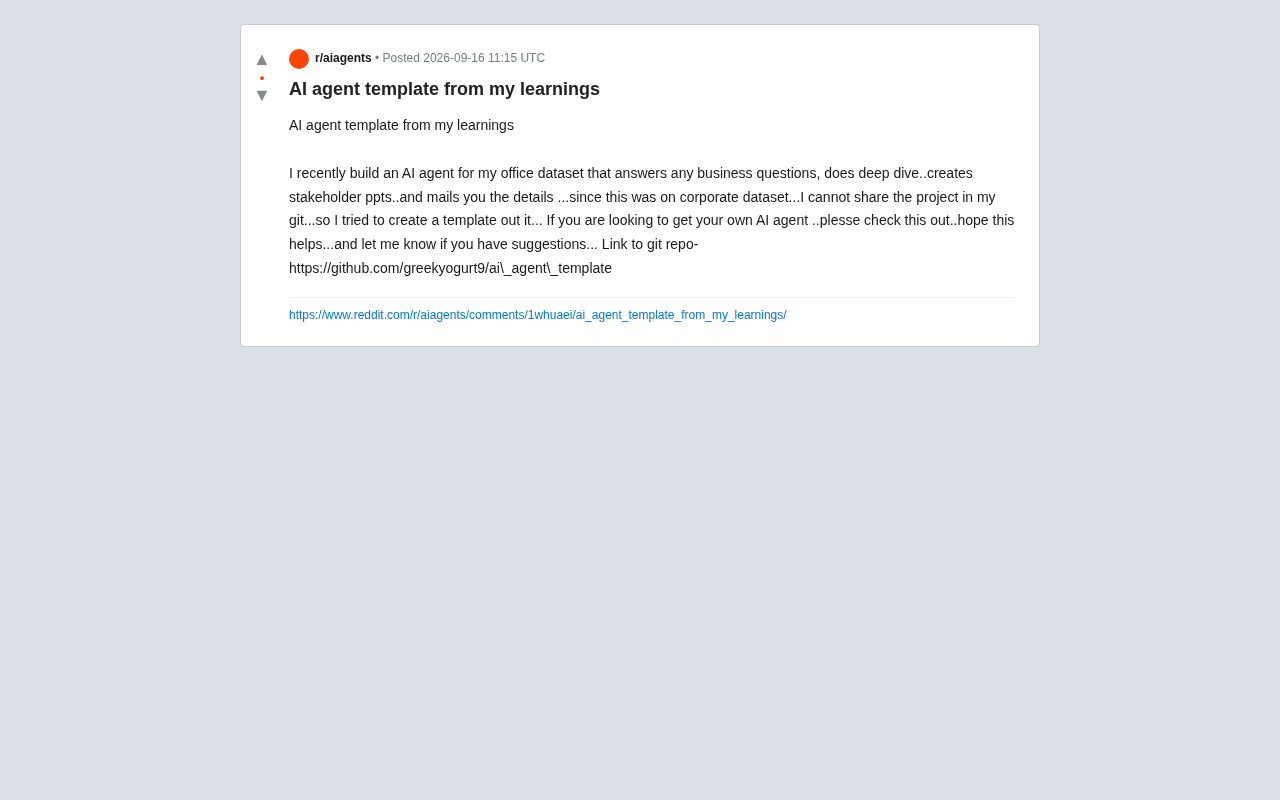
From Enterprise Practice to a Reusable Template: Lessons from Building an AI Agent
A developer shares an open-source AI Agent template built from an enterprise project, covering natural language data Q&A, analysis, auto-generated PPTs, and email distribution.

Nintendo's Open-World Design Evolution: Breaking Down Fire Emblem Fortune's Weave
Nintendo brings the open-world design philosophy of Breath of the Wild to Fire Emblem with the massive Switch 2 title Fortune's Weave. Here's what it means.