Ming-3-TTS-0.5B: Local Voice Cloning and Design on 2GB VRAM, audio.cpp Bundle Hands-On Test

Hands-on test of a 0.5B open-source TTS model: zero-shot cloning plus one-sentence voice design, runs locally on 2GB VRAM.
This article introduces the open-source Ming-3-TTS-0.5B model from Bailing, which with only 0.5B parameters supports both zero-shot voice cloning (3-10 seconds of reference audio, Chinese similarity 0.758) and one-sentence natural-language voice design, outputs 44.1kHz audio, and covers 7 languages plus dialects such as Sichuanese and Cantonese. Official tests show a Chinese zero-shot WER of 0.8%, English 1.58%, voice design 72.29% (claimed to surpass 7B models), and Cantonese at 98%. The accompanying audio.cpp bundle, after Q8 quantization, runs on about 2GB of VRAM; GPU mode uses Vulkan and is compatible with AMD/NVIDIA cards, while CPU mode works without a discrete GPU. The API is compatible with OpenAI TTS clients. The article also notes limitations: complex emotions and long-text stability are weaker than large models, 8-bit quantization occasionally has background noise, and voice design is sensitive to how the description is written.
Ming-3-TTS-0.5B is an open-source TTS model from Bailing that supports both zero-shot voice cloning and one-sentence voice design with only 0.5B parameters. The accompanying audio.cpp local API bundle lets it run on both CPUs and ordinary GPUs — after Q8 quantization it needs only about 2GB of VRAM, outputs 44.1kHz audio, and covers 7 languages plus dialects such as Cantonese. Below, based on the UP host's hands-on walkthrough, we break down its capability boundaries, official benchmark data, and how to use the bundle.
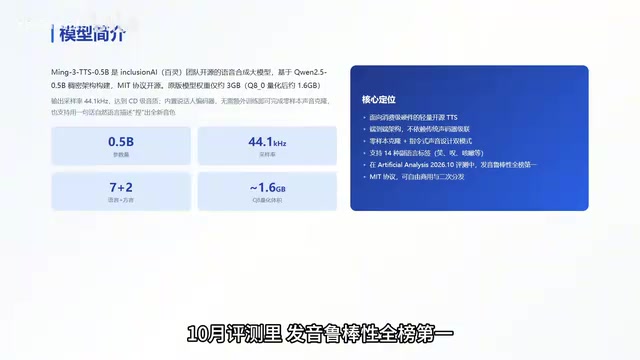
What 0.5B Parameters Can Do: Cloning, Design, and Multilingual
Ming-3-TTS-0.5B is based on the original full-weight model of roughly 0.5B parameters; after Q8 quantization its size shrinks noticeably. The official output spec is 44.1kHz audio, with language coverage of 7 languages plus dialects such as Sichuanese and Cantonese. Voice cloning requires only a single sentence, a 3-10 second reference audio clip; the official Chinese similarity score is 0.758. Voice design uses a one-sentence natural-language description of the timbre and supports control over dimensions such as speaking rate and emotion, and ships with 14 paralinguistic tags, gas-language tags, and two dialect tags.
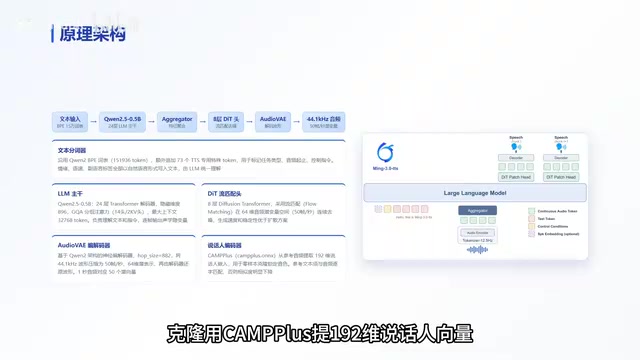
Architecturally, it uses tokenization plus 73 control tokens, 24 layers of text segmentation, a 0.5B backbone using GTOA to produce frame-by-frame features, then 8 layers of DiT performing flow-matching denoising in a 64-dimensional shallow space, and finally an Odo VAE to reconstruct 44.1kHz waveforms; the cloning part uses CamPlus to extract 192-dimensional speaker vectors. This combination is a fairly complete localization solution at the 0.5B scale.
Zero-shot Voice Cloning means the model can replicate a target speaker's timbre and synthesize new speech from just a few seconds to a dozen seconds of reference audio, without any additional training for that speaker. The technical key is extracting a fixed-dimensional speaker embedding from the reference audio and using it as a conditioning input to guide the acoustic model. The CamPlus mentioned in the article is such a speaker encoder, outputting a 192-dimensional vector. Compared with few-shot approaches that require fine-tuning, zero-shot cloning has extremely low deployment cost, but the similarity ceiling is affected by reference audio quality, duration, and signal-to-noise ratio — typically 3-10 seconds of clean, dry voice with no background music works best.
Voice Design differs from cloning in that it does not rely on reference audio; instead, it uses natural-language descriptions of the target timbre (e.g., "low, husky male voice, slightly slow speaking rate"), and the model maps the text description into acoustic space. The difficulty lies in the weak alignment between text descriptions and acoustic features, so the more specific the description and the closer it is to common expressions in the training data, the more stable the result. This also explains why hands-on testing recommends "the simpler and more direct the description, the more stable."
Official Benchmark Data: Zero-Shot WER and Voice Design Performance
The most noteworthy part of the official tests is zero-shot performance: Chinese word error rate 0.8%, English 1.58%, already approaching 1.5B models; voice design 72.29%, reportedly surpassing 7B models; paralinguistic Chinese single-tag CR 2.7, PCR 22.8, Sichuanese 2.27%, Cantonese 98%. At the 0.5B parameter scale, these metrics indicate fairly comprehensive performance in pronunciation stability and controllable voice dimensions; the official description calls it first in the full-weight ranking for open controllable voice dimensions and first on the overall leaderboard for pronunciation robustness.
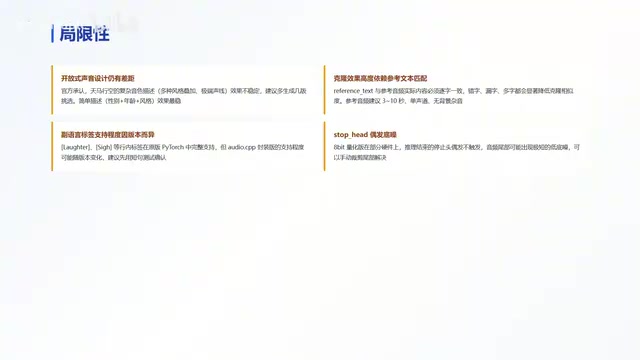
Note that these are official benchmark results; actual performance depends on reference audio quality and how the description text is written. In hands-on testing, the UP host also noted that voice design descriptions are more stable when simple and direct, that reference test is better suited for verbatim matching of reference audio, and that paralinguistic tags should be tested with short sentences first; the 8-bit version occasionally has background noise at the tail, which can simply be trimmed.
Word Error Rate (WER) is a core objective metric for speech synthesis intelligibility: the synthesized speech is transcribed by an independent ASR system and then compared word-by-word with the original text, computing the proportion of substitution, deletion, and insertion errors relative to the total number of reference words. Lower values mean more accurate pronunciation and closer to a real person. In zero-shot scenarios, WER also reflects the model's generalization ability to unseen speakers, so a Chinese score of 0.8% is quite impressive at the 0.5B scale.
Paralinguistic tags refer to speech features that do not change the literal content but carry emotion and tone information, such as laughter, sighs, pauses, and stress. The abbreviations CR and PCR in the article are evaluation metrics for such controllable dimensions, used to measure whether the model can reliably produce a specified tone on command. This capability is highly valuable for character dubbing and audiobooks, but it is also the most sensitive to how the text description is written.
Getting Started with the Bundle: Runs on CPU and Ordinary GPUs
After downloading, the bundle must be placed in a path containing only English characters. GPU mode uses Vulkan, so both AMD and NVIDIA cards work; if there is no discrete GPU, use CPU mode. Double-click the corresponding BAT file for the desired mode; it listens on port 9883. After successful initialization, open 127.0.0.1:9283 in a browser to use voice cloning and voice design features on the web page. The Q8 version runs on about 2GB of VRAM — this is its most practical advantage over large-model TTS: low-barrier local deployment.
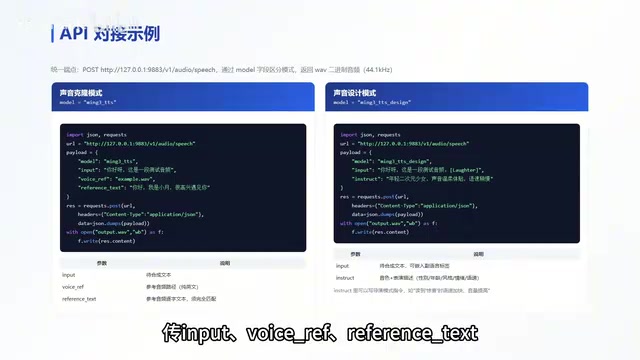
The API uses endpoints like /v1/audio/speech, with POST returning WAV. In cloning mode, set Model to "Ming-3-TTS" and pass input, voice, and reference_text; in design mode, set Model to "Ming-3-TTS-Design", use input for the description, and you can also insert tags such as Loft. Python calls work after changing the path, and it can also connect to an OpenAI TTS client, making migration from existing TTS workflows relatively low-cost.
Vulkan is a cross-platform graphics and compute API maintained by the Khronos Group. Unlike CUDA, which only supports NVIDIA GPUs, Vulkan can run inference compute on AMD, NVIDIA, Intel integrated graphics, and other hardware. The bundle uses the Vulkan backend precisely to achieve hardware independence — "both AMD and NVIDIA cards can run." The trade-off is that optimization levels vary across vendor drivers, so actual speed differs.
Quantization means representing model weights with lower bit widths (e.g., 8-bit, 4-bit) to trade a small amount of accuracy for large reductions in VRAM and bandwidth. Q8 in the article means 8-bit quantization, compressing the original FP16 weights by about half so that the 0.5B model needs only about 2GB of VRAM. Higher quantization saves more resources but may introduce background noise and loss of detail — which is why the article mentions occasional background noise at the tail of the 8-bit version.
Hands-On Listening Impressions and Use Cases
In hands-on testing, the UP host repeatedly synthesized and listened to the sentence "Hello, this is synthesized speech, take a listen and see how it sounds," and the overall assessment was "game complete" — the pipeline works and the results are usable. Combined with the official metrics, it is better suited to these scenarios: localized, privacy-sensitive voice cloning; quickly building multilingual dubbing prototypes; character voice design using natural-language timbre descriptions; and setting up TTS services on low-VRAM devices.
The limitations are also clear: the 0.5B capacity means its ceiling for complex emotions, long-text stability, and extreme timbres is lower than that of large models; 8-bit quantization occasionally has background noise; and voice design is relatively sensitive to how the description text is written. It is more reasonable to treat it as a low-cost, offline-capable, API-friendly entry-level TTS base.
FAQ
Q: Can I use it without a discrete GPU? Yes, the bundle provides a CPU mode; just double-click the corresponding BAT file as needed.
Q: How much VRAM is required? The Q8 quantized version runs on about 2GB of VRAM; the official original full-weight model is larger, and the size drops significantly after quantization.
Q: Which languages are supported? 7 languages plus dialects such as Sichuanese and Cantonese; in official tests, Cantonese performance is particularly strong.
Q: Can it connect to existing TTS clients? The API is compatible with the OpenAI TTS client format; on the Python side, just change the path to call it.
One-line Summary
Hands-on test of a 0.5B open-source TTS model: zero-shot cloning plus one-sentence voice design, runs locally on 2GB VRAM.
Paragraph Summary
This article introduces the open-source Ming-3-TTS-0.5B model from Bailing, which with only 0.5B parameters supports both zero-shot voice cloning (3-10 seconds of reference audio, Chinese similarity 0.758) and one-sentence natural-language voice design, outputs 44.1kHz audio, and covers 7 languages plus dialects such as Sichuanese and Cantonese. Official tests show a Chinese zero-shot WER of 0.8%, English 1.58%, voice design 72.29% (claimed to surpass 7B models), and Cantonese at 98%. The accompanying audio.cpp bundle, after Q8 quantization, runs on about 2GB of VRAM; GPU mode uses Vulkan and is compatible with AMD/NVIDIA cards, while CPU mode works without a discrete GPU. The API is compatible with OpenAI TTS clients. The article also notes limitations: complex emotions and long-text stability are weaker than large models, 8-bit quantization occasionally has background noise, and voice design is sensitive to how the description is written.
Related articles

Deleted Reddit Post Sparks Debate Over AI Content Moderation
A Reddit post removed with only a 'Removed by Reddit' notice highlights AI content moderation's transparency gaps, misjudgment risks, and appeal challenges for platforms and creators.

DSH + Ollama Local LLM Deployment in Practice: Free Chat with Da Fei Yu
Bilibili creator tests DSH + Ollama local LLM deployment end to end: Ollama install, Xunlei-accelerated downloads, ModelScope GGUF model import, DSH custom API address setup, and a comparison of Qwen 3.5 4B, 8B, Gemma, and other models on 8GB VRAM, with advice on choosing local deployment vs. API calls.

Tested: A $899 Mac Mini vs. a $200/Month AI Subscription
Real-world test of whether an M4 Mac mini can replace a $200 AI subscription: 16GB can't fit large models, and both speed and quality fall short—but privacy, no caps, and near-zero running costs make it an ideal host for an always-on agent. Includes buying advice per configuration and money-saving strategies.