Mini Server Gashapon at Taipei City Mall: A Tiny Surprise for Tech Geeks

Miniature server gashapon machines in Taipei City Mall are delighting tech geeks at just $3 a pull.
A tech enthusiast discovered server chassis-shaped gashapon machines in Taipei City Mall, priced at roughly $3 each. While ordinary shoppers see odd plastic trinkets, ops engineers and backend developers recognize an emotional connection to the machines that define their daily work. The piece explores geek hardware culture, the psychology of gacha's randomized collecting mechanic, and how online communities give niche enthusiasts a place to belong when no one around them understands the excitement.
A Server Obsession Packed into a Gashapon Machine
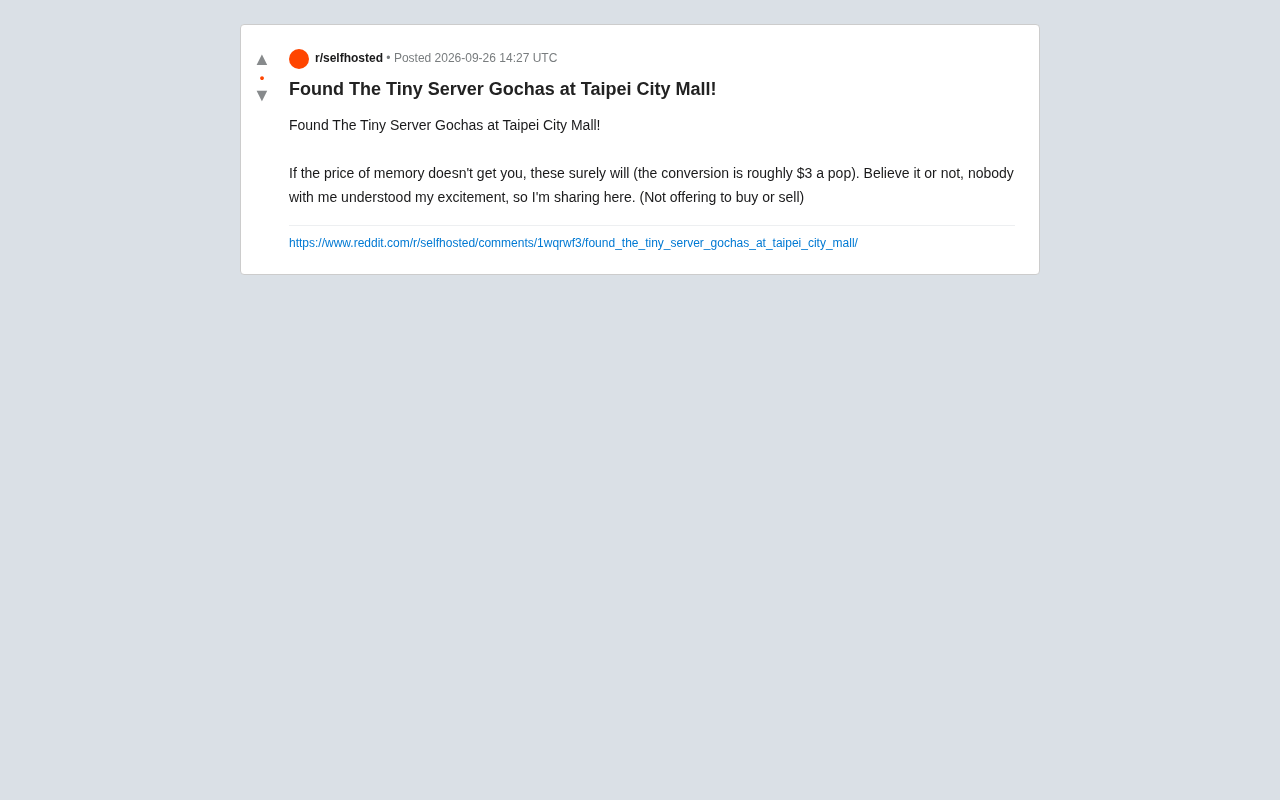
Deep in Taipei City Mall (台北地下街), a tech enthusiast stumbled upon something unexpected: a Gacha machine stocked not with anime figurines or cartoon characters, but with miniature server chassis models. To most passersby, these might look like oddly shaped plastic trinkets — but to anyone familiar with data centers and server room operations, they hit a very specific, very satisfying nerve.
The person who posted about it joked: "If RAM prices haven't scared you off, these gachas definitely will (roughly $3 each)." The quip is both a self-deprecating nod to volatile hardware prices and a perfect encapsulation of what makes this kind of merch appealing — for a tiny investment, you get a moment of pure geek recognition.
Why Server Models Get Geeks Excited
The poster noted something telling: "No one I was with could understand my excitement." That's a remarkably accurate snapshot of hardcore tech culture. Rack servers, blade servers — these machines normally live in noisy, climate-controlled rooms, invisible to most people. But for those in ops, backend engineering, or cloud infrastructure, they carry real memories and emotional weight.
Shrinking these cold, industrial machines down to palm-sized collectibles is essentially a way of making tech culture tangible. This kind of thing is far from unusual in geek communities — from custom mechanical keyboard keycaps to chip-shaped keychains to miniature replicas of classic computers, hardware fetishism has always been a cornerstone of tech subculture. These mini server gachas tap directly into that niche sentiment, and wrap it in the randomized, surprise-driven format that makes Gacha so compelling.
Rack servers and blade servers are the two most common form factors in modern data centers. Rack servers slot horizontally into standard cabinets in 1U/2U increments, balancing density with thermal management. Blade servers take a more modular approach, integrating compute, storage, and networking onto a backplane for large-scale horizontal expansion. For ops engineers, the visual details — front-panel LED arrays, hot-swap drive bays, cable management rails — are deeply tied to the muscle memory of daily troubleshooting and inspections. Miniaturizing these devices and giving them collectible status works on the same psychological level as a military enthusiast collecting tank models or an aviation fan picking up die-cast aircraft: the model becomes a physical symbol of professional experience and identity, its emotional value far exceeding its material cost.
When Gacha Culture Meets Tech Merch
Gacha, a vending format that originated in Japan and spread across East Asia, runs on two core mechanics: randomness and the drive to collect. Taiwan has one of the most developed gacha machine cultures anywhere, covering everything from mainstream cartoon IPs to wonderfully obscure novelty items. The appearance of server-themed gachas signals that tech aesthetics are genuinely beginning to bleed into mainstream consumer culture.
At roughly $3 a pull, there's almost no barrier to entry. Unlike high-end models that require tracking down specialty retailers, the low price and element of chance make it easy to keep feeding coins into the machine. For a tech enthusiast, assembling a complete set of different miniature server models to display on a desk is both decoration and identity statement.
The Gacha mechanism traces its roots to 1960s American gumball machines, later refined by Japanese toy companies like Bandai through tie-ins with anime and game IPs, eventually maturing into a sophisticated collectibles economy. Taiwan took this further, developing an extraordinarily diverse gacha culture — Taipei alone has hundreds of gacha machine clusters in malls and underground shopping streets, covering everything from popular IP figurines to local street food models and architectural miniatures. The underlying sales logic — small batches, random draws, series completion — is fundamentally the same as the blind box economy: both exploit uncertainty to drive repeat purchases, a mechanism psychologists call Variable Ratio Reinforcement, which makes it more habit-forming than fixed-price goods. The emergence of server-themed gachas suggests this commercial logic has begun penetrating tech subculture, converting niche hardware passion into mass-producible, tradeable consumer goods.
The Community Value of Niche Hobbies
What's perhaps most moving about the original post isn't the gachas themselves — it's the line "no one around me got it, so I came here to share." That's exactly why vertical communities exist. When the people in your daily life can't relate, online communities become the refuge for enthusiasts to connect. A humble server gashapon can spark intense resonance within the right group, and that sense of belonging is something no product can manufacture on its own.
It's worth noting that this is a single-source personal account. The post doesn't include the specific brand, series name, or any purchase links, and the poster explicitly stated they are "not selling or buying." The details in this article are therefore based on the original post's description, and specifics about the product itself remain unverified.
Closing Thoughts: The Beauty of Tech Lives in the Details
From hyperscale data centers to palm-sized plastic models, server gachas bring the serious world of technology into everyday consumer culture in the most lighthearted way possible. They remind us that tech isn't only a productivity tool — it can also be a vehicle for culture, emotion, and genuine fun. Next time you walk past a gacha machine, take a closer look. You might just find your own little piece of "technical romance" waiting inside.
Related articles

Amphibious Transforming Drone: Beyond 100x Power Savings, What Are the Real Needs?
Is the amphibious transforming drone just a gimmick? Starting from the 100x power difference of the M4 Morphobot, explore real application scenarios and thesis topic ideas, analyzing boundary conditions where pure drones and pure ground robots both fail.

Warhound Raises $200 Million: Genetically Engineered "War Dogs" Paired with Anduril Gear
Warhound raises $200M, backed by Ben Lamm and Palmer Luckey, to genetically engineer dogs for military and law enforcement use and equip them with Anduril gear. This article analyzes its technology direction, funding logic, and ethical controversy.

Claude API Comes to Google Cloud: IAM Integration and SDK Access Guide
Anthropic hosts the full Claude API on Google Cloud with IAM-controlled permissions and unified billing. This guide covers the Vertex AI and Anthropic-hosted entry points, IAM role configuration, and SDK access.