MiniMax Code CLI Goes Open Source: How Does It Differ from DeepSeek Harness?

MiniMax Code CLI open-sources as an integrated terminal workbench, contrasting with DeepSeek Harness's composable framework approach.
MiniMax has open-sourced its Code CLI on GitHub, sparking comparisons with DeepSeek Harness. MiniMax Code CLI is an all-in-one terminal workbench with built-in code editing, file operations, test running, and multimodal tool support — though the desktop client and some media tools are not included. DeepSeek Harness takes a composable framework approach where every component, including the agent loop, is replaceable, and includes dedicated prefix caching optimizations for long-context agent systems. The two tools represent different product philosophies: one prioritizes out-of-the-box efficiency, the other deep customization and control.
MiniMax has officially open-sourced its Code CLI tool on GitHub, which has naturally prompted the developer community to compare it with DeepSeek's Harness. While both tools focus on integrating large language models into real coding workflows, they take two distinctly different approaches in design philosophy. Drawing on related analyses, this article breaks down the core differences to help you decide which one fits your development needs.
MiniMax Code CLI: An All-in-One Terminal Workbench
MiniMax Code CLI's primary focus is on delivering a complete terminal workflow experience. It bundles the most common command-line development tasks — reading code, editing files, running tests — into a ready-to-use toolkit. These high-frequency operations are built in as standard actions, requiring almost no additional setup to get started.
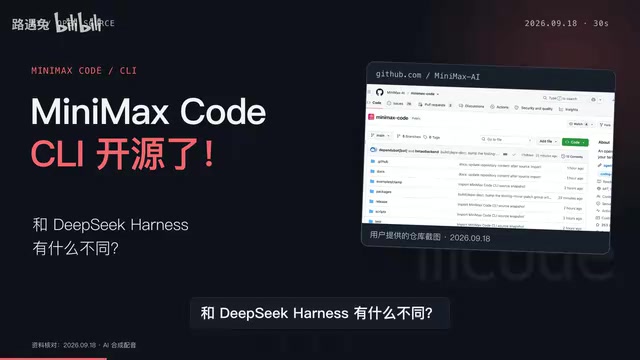
This design positions it more as an integrated workbench: it prepares the common tools and processes for you, so you can issue commands in the terminal and let the model handle a complete read-write-verify loop within your codebase. For teams that want to quickly bring AI into their daily development without spending time scaffolding infrastructure, this all-in-one approach significantly lowers the barrier to entry.
Multimodal Tool Integration Is a Standout Feature
Beyond traditional code operations, a notable highlight of MiniMax Code CLI is its ability to integrate image, audio, and video tools. This means its scope isn't limited to plain text code — it can handle richer multimodal assets, opening up possibilities for engineering scenarios that involve media resources.

One important caveat: this open-source release is not the "full package" — MiniMax's desktop client and certain media tools are not included in this release. In other words, what you get on GitHub is the core terminal component, and the full multimodal capabilities may still depend on proprietary components that haven't been open-sourced. Make sure you understand the boundaries of what's been released before drawing conclusions about its full capabilities.
DeepSeek Harness: A Composable Framework Where Everything Is Replaceable
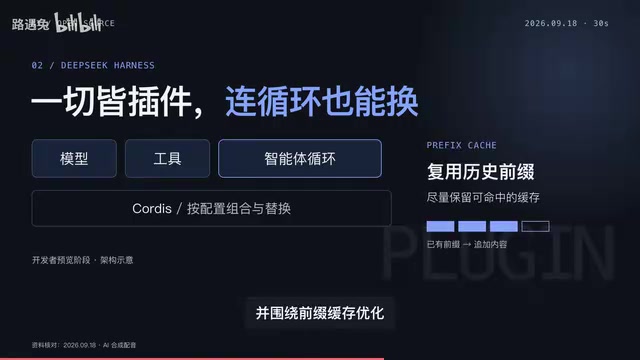
In contrast to MiniMax's "integrated workbench" approach, DeepSeekAd Harness follows the path of a composable framework. Its core philosophy is "everything is a plugin" — from tool integrations to the agent loop, almost every component can be swapped out and customized.

In other words, Harness doesn't rush to make decisions for you — it hands control to the developer. You can connect your own plugins, write your own agent logic, and even replace the entire loop mechanism. This highly modular design is especially appealing to advanced users who need deep customization and maximum flexibility.
In addition, Harness includes dedicated engineering-level optimizations around prefix caching. This optimization effectively reduces inference overhead and improves response efficiency in multi-turn conversation and repeated-context scenarios — a meaningful performance bonus for framework users.
Prefix caching is a large model inference acceleration technique: when multiple requests share the same context prefix (such as system prompts, codebase context, or long conversation history), the model server can save the KV Cache (key-value cache) for that prefix and reuse it in subsequent requests without recomputing it. This is especially critical in multi-turn agent interactions — each round carries the full history of previous turns, and without caching, inference time and token costs can grow linearly or even quadratically as the conversation grows. Harness's targeted optimization for this scenario means that when building long-context agent systems, both overall call costs and response latency can be significantly reduced.
The agent loop is the core execution mechanism of AI coding tools — it refers to the iterative process a model goes through to complete a task: "think → call a tool → observe the result → think again," repeating until the task is complete or a termination condition is met. Different frameworks implement this loop very differently: some hard-code a fixed loop strategy (such as a maximum number of steps or a fixed tool-calling order), while others allow developers to fully customize the loop logic. Harness designs the entire agent loop as a replaceable module, meaning developers can plug in custom planning strategies, error recovery logic, or multi-agent collaboration schemes without being constrained by the framework's built-in implementation — which is especially important for building complex automation pipelines.
Two Philosophies: How Do You Choose?
When placed side by side, the trade-offs are fairly clear:
- MiniMax Code CLI leans toward "out-of-the-box," offering a highly integrated terminal workbench suited for developers who want a quick start and value multimodal support.
- DeepSeek Harness leans toward "free assembly," providing a fully composable framework where everything can be replaced — ideal for advanced users who need deep customization of agent logic and care about performance optimization.
One paves the road for you; the other gives you a complete set of building blocks. The former wins on convenience; the latter wins on flexibility. Which one to choose ultimately comes down to whether you need ready-to-use efficiency or depth through full control.
For most teams that simply want to get AI into their coding workflow as quickly as possible, MiniMax's all-in-one solution has a faster onboarding curve. For developers building complex agent systems who need to customize every component, Harness's composability and caching optimizations will deliver more value.
Conclusion
The open-sourcing of MiniMax Code CLI adds another noteworthy option to the landscape of terminal AI coding tools. It's not a simple replacement for DeepSeek Harness — rather, the two represent different product philosophies. Understanding the core distinction of "integrated workbench vs. composable framework" allows you to evaluate their respective use cases more clearly. That said, hands-on experience is still the best judge — a tool's true worth ultimately depends on whether it can fit naturally into your real workflow.
Related articles

Random Pruning of the DPO Computation Graph: 1.4x Training Speedup and Lower Peak Memory
DPO training too slow and memory-hungry? This paper proposes a random pruning framework for the DPO computation graph, sampling independently across position, sequence, and branch dimensions; branch pruning achieves a 1.426x step-time speedup and cuts training time by about 30%, with in-depth attribution of memory and time gains.

Why Does JEPA Underperform MLM in Longitudinal EHR Representation Learning?
New study compares JEPA and MLM for longitudinal EHR representation learning on MIMIC-IV: three JEPA variants train stably without collapse but underperform MLM; target size, not heterogeneity, drives prediction error.

Transfer Learning + Visible Light Communication: A New Approach to Energy-Efficient Indoor Positioning
A study proposes a transfer learning-based visible light communication indoor positioning method, achieving 47% accuracy improvement on the BOSCH factory dataset, 67.5% model efficiency under high noise, and introducing the ME composite metric for energy-efficient positioning in energy-constrained industrial IoT scenarios.