MiniMax Code Practical Guide: Zero-Code AI for Legal Research, Data Analysis & Work Reports

Practical guide to MiniMax Code: zero-code AI for legal research, data analysis, and work reports.
MiniMax Code is an AI Agent tool optimized for office scenarios, enabling users without coding backgrounds to dramatically boost productivity. Through built-in professional plugins like Chinalawinfo for legal work and Hundsun database for finance, combined with Office suite integration, it automates tasks from generating evidence-based legal reports to financial analysis and visual HTML presentations. The tool leverages RAG technology to ensure accuracy in professional domains while maintaining low barriers through one-click plugin installation and intuitive interaction design.
For professionals drowning in documents, spreadsheets, and summary reports daily, repetitive tasks often consume valuable time. With the maturation of AI Agent tools, even liberal arts graduates with no coding background can leverage intelligent assistants to multiply their office efficiency. Based on practical tutorials shared by a Bilibili content creator, this article breaks down the core features and real-world performance of MiniMax Code—an AI tool optimized for office scenarios.
An AI Agent refers to an AI system capable of autonomously perceiving its environment, formulating plans, and executing tasks, distinct from traditional question-and-answer chatbots. It can automatically break down user goals into subtasks, invoke external tools (such as APIs, plugins, databases), and complete complex workflows through multi-step reasoning. Since 2024, AI Agents have become the core direction for large model application deployment, with giants like OpenAI, Anthropic, Google, as well as domestic players like Zhipu, Dark Side of the Moon, and MiniMax actively building Agent ecosystems. Against this industry backdrop, Agent tools designed for office scenarios are becoming accessible to everyday users.
Why Choose MiniMax Code as Your AI Office Assistant
While numerous AI Agent products exist in the market, most target developers or complex workflows, presenting high barriers for ordinary office users. According to the content creator's comparative experience with multiple Agents, MiniMax Code offers more streamlined optimization for office scenarios, with its core advantage being ready-to-use out of the box.
It features a complete built-in office plugin ecosystem, including the entire Office suite (Word, Excel, etc.), along with professional plugins for various vertical industries—such as "Chinalawinfo" (Peking University Law Database) for legal work and financial analysis suites for the finance sector. Users don't need to search and download from GitHub one by one; they can install and invoke plugins with a single click. The platform also pre-loads various popular Skills (capability modules), further lowering the barrier for novice users.
From a usage logic perspective, the entire operation is simplified into four steps: "Select plugin → Describe task → Choose model → Send." The tutorial demonstrates using the latest MiniMax M3 large model with thinking mode enabled. This "large model + professional plugin" combination is key to ensuring output quality. The underlying logic of this combination involves RAG (Retrieval-Augmented Generation) technology architecture—before generating answers, the large model first retrieves relevant information from external professional knowledge bases, injects it as context into prompts, and allows the model to reason and generate based on real data. This architecture effectively addresses two major pain points of large models: outdated information due to knowledge cutoff dates, and the hallucination problem of "confidently making things up." Vertical domain plugins essentially use professional databases as RAG retrieval sources, achieving "evidence-based" professional outputs.
Legal Scenarios: Using AI to Generate Well-Founded Research Reports
Legal work demands extremely high accuracy, and AI's biggest risk is "fabricating" regulations. This is where general-purpose large models are most prone to failure in professional scenarios.
The tutorial uses a lawyer receiving client consultations as an example: after installing the plugins, select the "Chinalawinfo" plugin on the main interface, add the Word plugin, and hand over the question description to AI for processing. Within minutes, a structurally complete research report is generated—including abstract, core conclusions, legal basis, detailed interpretation, and case analysis.
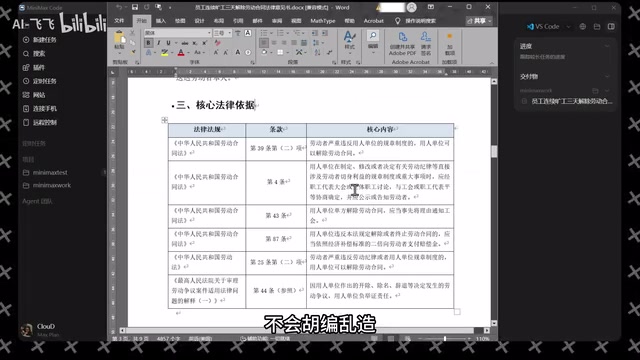
What deserves attention is the accuracy of legal references. Here we must introduce the background of "Chinalawinfo"—it's one of China's most authoritative legal information retrieval systems, created by the Legal Information Center of Peking University, founded in 1985. It covers dozens of sub-databases including laws and regulations, judicial cases, legal journals, English translations, etc., with over ten million entries. It's used as a core retrieval tool by most domestic courts, law firms, and law schools. AI integration with Chinalawinfo means that when the model cites legal provisions, they are verifiable, fundamentally solving the most fatal "hallucination" problem of large language models in legal scenarios—namely, fabricating non-existent legal provisions. For this reason, the legal provisions cited by AI in the tutorial are word-perfect and well-founded, avoiding the risk of generic models fabricating laws.
This also confirms a trend: the value of AI applications in vertical domains lies not only in model capabilities but also in reliable professional data sources behind them. Additionally, the formatting automatically completed by the Word plugin is quite neat, and the report can be sent directly to supervisors or clients.
In terms of cost, generating such a report in the tutorial consumed only about 1% under the ¥119 package (5 hours of credits), and with the 400 points awarded daily for logging in, routine tasks can be essentially covered for free.
Financial Data Analysis: AI Auto-Collects and Organizes, Eliminating Manual Work
Data collection and organization is one of the most time-consuming aspects for finance professionals. MiniMax Code's financial analysis suite connects to the professional Hundsun database and, combined with the Excel plugin, can significantly compress this workload.
Hundsun Technologies is a leading enterprise in China's financial IT sector, with data services covering securities, funds, futures, insurance, and other financial sub-industries. The Hundsun database provides financial data including market data, fundamental data, financial statements, macroeconomic indicators, etc., characterized by high timeliness and standardization. It serves as a foundational data source for many domestic quantitative trading teams and financial analysts. AI tools connecting to such professional-grade data sources ensure analysis is built on real, timely market data rather than outdated historical snapshot data from model training.

The tutorial demonstrates the task of "analyzing Kweichow Moutai's fundamentals over the last 120 trading days, providing specific data, ratings, and outputting an Excel spreadsheet." After completion, AI automatically organizes a wealth of rich data with multiple complex technical indicators for market judgment reference. For users who frequently perform fundamental analysis, this automated data collection can save substantial repetitive labor.
What needs rational perspective is that AI-generated data and ratings are more suitable as starting points for auxiliary decision-making. Professionals still need to combine their own judgment for secondary verification, especially in high-risk scenarios like investing.
Work Reports: One-Click Generation of Visual Presentation Pages
Creating presentation displays often requires significant time searching for materials and making charts. MiniMax Code, through the "Industry Research" skill combined with the Super Design plugin, can directly produce visual HTML presentation pages.
Compared to traditional PPT or PDF reports, HTML presentation pages have natural interactive advantages: they support dynamic charts (such as charts rendered based on frontend visualization libraries like ECharts, D3.js), responsive layouts (automatically adapting to different screen sizes), and require no specific software installation—they can be opened directly through browsers. AI directly generating HTML pages means skipping the traditional workflow of "content creation → design layout → repeated adjustments," compressing report material production from hours to minutes.
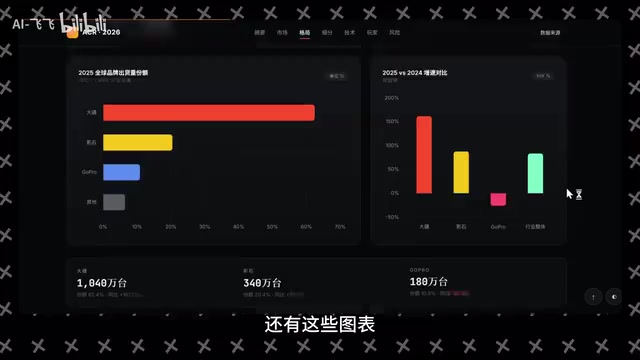
The tutorial uses "Action Camera Industry Research Report" as an example, requesting AI to generate an HTML page with data and charts. After about ten minutes (consuming roughly 4% of credits), a display page containing multiple data comparisons, tables, and charts is completed, maintaining a high visual aesthetic standard suitable for direct use in presentation scenarios.
Two Practical Features for Boosting Efficiency
Beyond content generation, MiniMax Code has two useful auxiliary capabilities:
-
Annotation (Comment) Function: After opening an HTML webpage in Edit, the traditional modification method requires precisely describing to AI "which line, which words." The annotation function allows users to directly select target areas and add comments. In the tutorial, selecting a line of text and requesting it turn red takes AI only 13 seconds to precisely locate and complete the modification, with interaction experience approaching visual editing. This "what you see is what you edit" interaction mode significantly reduces the communication cost for non-technical users collaborating with AI—you don't need to understand HTML code structure, just indicate modification intent as you would annotate in Word.
-
Remote Control Function: Supports using a phone to take over complex tasks running on the computer, eliminating the need to stay in front of the screen. This means fragmented time like walking the dog or taking a stroll can become work time, liberating people from the "must sit at computer" state. The practical significance of this feature is that AI Agents executing complex tasks (such as calling multiple plugins, processing large amounts of data) often require several minutes or longer. Remote control allows users to check progress and add instructions anytime, converting waiting time into mobile office time.
Summary: How AI Agents Are Reshaping Office Productivity
The essence of what this tutorial demonstrates is that AI Agents are evolving from "chat tools" to "productivity workbenches." Its value chain is clearly visible: low-barrier one-click installation reduces usage costs, vertical industry databases ensure professional accuracy, while visual editing and remote control optimize actual workflows.
From a more macro perspective, this evolution represents an important shift in AI applications—from general conversational capabilities to deep integration in vertical scenarios. Early AI tools were more like "jack-of-all-trades assistants that can chat about anything but aren't professional enough in anything." Current Agent tools, through plugin mechanisms, modularly assemble capabilities like professional databases, office software, and visualization components, forming complete solutions for specific work scenarios.
For ordinary professionals, the biggest takeaway is perhaps: the key to AI office efficiency enhancement is no longer learning to write complex prompts, but finding tools that combine "large model capabilities + reliable professional data + smooth interaction design." Of course, AI-generated content still requires human oversight, especially in high-risk domains like law and finance. Tools are levers for efficiency, but final judgment should remain in the hands of users.
Related articles

Stanford AI Course: Three Feedback Mechanisms That Enable Agents to Self-Evolve
Deep dive into Stanford's AI Agents Lecture 4: how ReAct, RLEF execution feedback, and Constitutional AI self-critique create three feedback loops driving LLM agent self-evolution.
CGI: The First Open-Source GPU Compute Pricing Index, Making Compute Pricing Transparent
Computable GPU Index (CGI) is the first open-source GPU compute pricing index, denominated in USD per GPU-hour, calculated from a fixed provider panel with mathematical rigor and full verifiability. This article analyzes CGI's core features, the importance of compute pricing indices, and the potential for compute financialization.
OpenAI Claims Breakthrough on Millennium Problem: The Truth and Controversy Behind Navier-Stokes Progress
OpenAI claims its AI system achieved a breakthrough on the Navier-Stokes equations Millennium Problem. This article analyzes what the claim really means, the difference between partial progress and complete proof, and AI's rise in mathematical proof.