MiniMax M3.1 Flash Review: Breakthroughs in Both Agent Performance and Cost

MiniMax releases M3.1 Flash, targeting scalable Agent deployment with million-token context and low pricing
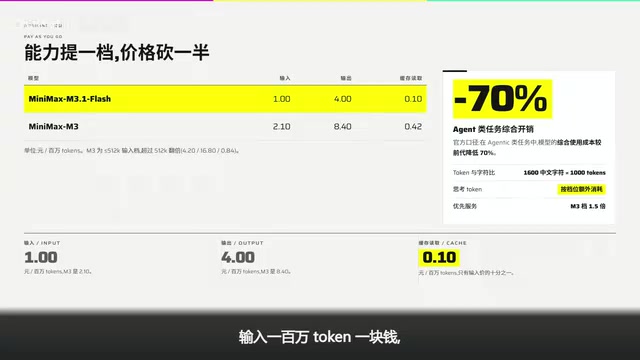
MiniMax has updated M3.1 Flash, positioning it as a cost-effective model for Agent scenarios. It offers a 1M-token context window, native multimodal input, and five adjustable thinking-depth levels, with thinking that cannot be disabled, forcing the model to retain reasoning steps in Agent tasks. It scores 73.7% on the complex coding benchmark Deeps V1.1 and 61.7 on the computer-operation benchmark Oathworld, with output exceeding 200 TPS—nearly three times faster than the previous generation; yet it ranks first in only 3 of 15 official benchmarks, placing in the top four in the rest, making it a balanced top-tier model rather than an all-around champion. On cost, input is 1 yuan per million tokens, output 4 yuan, and cache reads 0.1 yuan, with official claims of a 70% reduction in overall Agent overhead. M2.5 and M2.7 will be retired on November 18, with subscriber requests automatically forwarded to the new model.
Title
MiniMax M3.1 Flash Review: Breakthroughs in Both Agent Performance and Cost
Meta Description
MiniMax M3.1 Flash review: 1M context, native multimodal, five adjustable thinking-depth levels, 73.7% on complex coding benchmark, 200+ TPS output, 70% lower overall Agent cost, just 1 yuan per million input tokens.
Article Content
MiniMax has updated M3.1 Flash, with an official headline that directly targets "redefining Agent performance and cost." According to public figures, it scores 73.7% on the complex coding benchmark Deeps V1.1, achieves 61.7 on the computer-operation benchmark Oathworld, and delivers output speeds exceeding 200 TPS—nearly three times faster than the previous generation. For developers building Agent applications, these numbers mean two things: faster responses and lower per-task cost.

1. Core Specs: 1M Context and Native Multimodal
M3.1 Flash offers a 1-million-token context window, supports native multimodal input, and provides five adjustable thinking-depth levels—a capability that cannot be disabled. This means the model operates in "thinking" mode by default, with no extra toggle required. For Agent scenarios that need to process long documents, complete codebases, or large-scale logs, the 1M context significantly reduces the problems of chunked processing and information loss.
The five-level adjustable thinking depth lets developers trade off between speed and reasoning quality based on task complexity. Simple tasks can use a lower level for fast returns, while complex planning tasks can use a higher level to obtain a more complete reasoning chain. The official emphasis that it "can't be turned off" effectively forces the model to retain reasoning steps in Agent tasks, avoiding the sacrifice of task success rates for cost savings.
2. Performance Positioning: Top Tier, But Not an All-Around Champion
The official release includes a comparison table of 15 benchmarks, in which M3.1 Flash ranks first in only 3 and places in the top four in all the rest. This distribution is telling: it is not an "all-around champion" that excels in every category, but it has no obvious weaknesses either. In other words, the model sits in the top tier across most dimensions while keeping cost and speed under control.
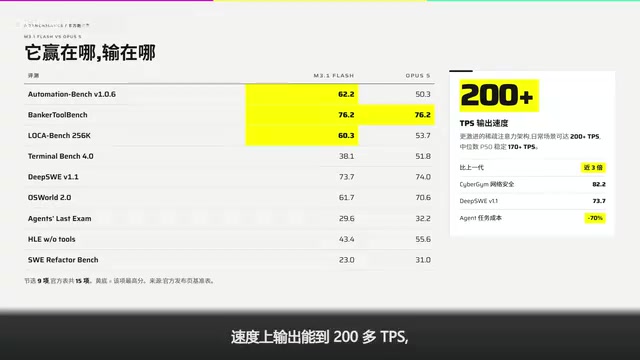
From the practical needs of Agent applications, this balanced positioning is often more useful than a single-category champion. Agent tasks typically involve planning, tool calling, code generation, and multi-turn correction—a failure in any one link affects overall success rates. M3.1 Flash reaching 73.7% on the complex coding benchmark Deeps V1.1 and 61.7 on the computer-operation benchmark Oathworld shows it delivers stable performance on both key task types: code and operation.
On speed, output exceeds 200 TPS, nearly three times faster than the previous generation. For Agents that require multi-turn interaction, output speed directly affects user experience and task completion time—this improvement is considerable.
TPS (Tokens Per Second) is a common metric for measuring the inference speed of large language models; a higher value means the model generates text faster. For Agent applications, TPS affects not only user waiting time but also directly relates to the completion efficiency of multi-turn tool-calling tasks—an Agent task often involves dozens of model calls, and a few hundred milliseconds of extra latency per response adds up to significantly longer overall task duration. 200 TPS means roughly 200 tokens per second, approximately equivalent to over 100 Chinese characters per second, already approaching or exceeding the speed of rapid human reading. Note that vendor-reported TPS is typically peak throughput under ideal conditions; in practice it is affected by concurrency, input length, thinking-depth level, and other factors. Especially when a high thinking level is enabled, the model performs internal reasoning before output, so end-to-end latency may be noticeably higher than the stated value.
3. Cost Structure: Overall Agent Overhead Down 70%
The official pricing is: 1 yuan per million input tokens, 4 yuan for output, and 0.1 yuan for cache reads. According to the official statement, the overall overhead of Agent-type tasks has dropped by 70%. This reduction comes mainly from two aspects: first, the unit price itself is low; second, the cache-read price is extremely low, which suits the working pattern in Agent scenarios where the same context is referenced repeatedly.
The pricing of 1 yuan per million input tokens, combined with the 1M context window, means developers can put an entire codebase or a large knowledge base directly into the context without complex retrieval and chunking. For applications like code Agents and document-analysis Agents, this directly lowers engineering complexity and calling costs.
Prompt Caching is a key optimization mechanism in current large-model APIs: when multiple requests contain the same prefix context (such as a fixed system prompt, an entire codebase, or a knowledge base), the server caches the computation results of that portion, and subsequent requests only need to read the cache at a price far below normal input rather than recomputing it. For Agent scenarios, this is particularly important because Agents often repeatedly perform multi-turn tool calls and reasoning on the same long context, resulting in a high cache hit rate. In the article, "0.1 yuan for cache reads" versus "1 yuan for input" means the cost of cache-hit input is only one-tenth of normal input—one of the important sources of the 70% reduction in overall Agent overhead. When using it, developers should place stable, unchanging content at the front of the request and variable content at the back to maximize the cache hit rate.
4. Migration Arrangements: M2.5 and M2.7 Are Being Retired Soon
Existing users should pay attention to the version switch. M2.5 and M2.7 are no longer available to new users and will be officially retired on November 18. Subscribers do not need to modify their code; requests will automatically be routed to M3.1 Flash. The official announcement also mentions that pay-as-you-go will open later, and a Pro version is on the way.

Automatic forwarding reduces migration costs, but developers still need to verify how their existing prompts and tool-calling logic perform under the new model. The change that thinking depth cannot be disabled may affect legacy applications that rely on fixed output formats or low-latency responses, so a round of regression testing before retirement is recommended.
Regression Testing refers to re-running existing test cases after a model or system change to confirm that existing functionality has not been broken. In large-model version migrations, regression testing is especially important because model behavior is probabilistic—even if the interface and parameters remain unchanged, the output format, tone, and tool-calling decisions may change. For applications that rely on fixed output formats (such as JSON structures) or are latency-sensitive, the change that thinking depth cannot be disabled may cause extra reasoning content to appear in outputs or slower responses, which should be caught early through regression testing. Developers are advised, before M2.5 and M2.7 are retired, to compare the outputs of the old and new models using representative real-task samples, focusing on three metrics: structured-output parsing, tool-calling parameter correctness, and end-to-end latency.
5. Who Should Use It
M3.1 Flash's positioning is clear: it targets Agent scenarios, trading balanced performance and significantly lower cost for greater call volume. If your application needs long context, multi-turn tool calling, code understanding, or computer-operation capabilities, and you also need the new model's multimodal support and adjustable thinking depth, it is an option worth evaluating. But if your tasks have extremely high demands on a single capability, the fact that it ranks first in only 3 of the official 15-benchmark table is a reminder that you need to test it against your own scenarios rather than looking only at the overall leaderboard.
With a context that can hold an entire codebase and a pricing strategy sold at half price, MiniMax has focused this round of competition on the cost of scaling Agent deployment. For developers, this means running more Agent tasks on a lower budget—provided you choose the right scenarios and do proper migration validation.
One-line Summary
MiniMax releases M3.1 Flash, targeting scalable Agent deployment with million-token context and low pricing
Paragraph Summary
MiniMax has updated M3.1 Flash, positioning it as a cost-effective model for Agent scenarios. It offers a 1-million-token context window, native multimodal input, and five adjustable thinking-depth levels, with thinking capability that cannot be disabled, forcing the model to retain reasoning steps in Agent tasks. In terms of performance, it scores 73.7% on the complex coding benchmark Deeps V1.1, 61.7 on the computer-operation benchmark Oathworld, and delivers output speeds exceeding 200 TPS—nearly three times faster than the previous generation; however, it ranks first in only 3 of the official 15 benchmarks, placing in the top four in all the rest, making it a balanced top-tier model rather than an all-around champion. On cost, input is 1 yuan per million tokens, output 4 yuan, and cache reads 0.1 yuan; officially, overall overhead for Agent-type tasks is down 70%. M2.5 and M2.7 will be retired on November 18, with subscriber requests automatically forwarded to the new model.
Related articles
 Tech Frontiers
Google Omni 1.2 Flash: 15-Second AI Video at Just $0.07 per Second
Google DeepMind releases Gemini Omni 1.2 Flash: 15-second video, 720p at $0.07/sec (30% cheaper), multi-turn editing without regeneration, draft upscaling to 4K.
 Tech Frontiers
No AI Ghostwriting: Writer's Quarter Reinvents Novel Writing with a Visual Workbench
The Writer's Quarter is an AI-free novel writing and planning tool that unifies character building, story planning, and manuscript writing in one visual workbench. This article analyzes its positioning, target users, and differentiated value amid the rise of AI writing tools.
 Tech Frontiers
Fleeep: A Unified Inspiration Collection Notes App for Creatives
Fleeep is a notes app for creatives that unifies screenshots, bookmarks, saved posts, and inspiration into one calm, cross-device, offline-capable space. This article analyzes its positioning, differentiation, and target users.