minimi 2.0: A Personal AI Assistant That Manages Your Life Through 'AI Cats'

minimi 2.0 packages AI memory and task tracking into adoptable cat personas for proactive personal intelligence.
minimi 2.0 is a personal AI assistant that anthropomorphizes AI capabilities into adoptable cat characters, earning 105 upvotes on Product Hunt and cracking the day's top ten. Its core concept is a proactive experience — anticipating needs before users express them — addressing the reactive, context-repeating friction common to most AI tools. Cotton continuously builds a personal context layer so users never have to re-introduce themselves, while Melody uses that context to actively track commitments and close open loops. The character-based design lowers the learning curve, builds emotional connection, and provides a clear framework for future expansion. Key challenges remain: the privacy implications of continuous personal data collection, and whether the "proactive understanding" promise can be accurately delivered in practice.
While most AI assistants race to expand their general-purpose capabilities, a product called minimi 2.0 takes a different path — wrapping "personal intelligence" into a lineup of adoptable AI cats. It earned 105 upvotes on Product Hunt and ranked #7 on the day's leaderboard. Its core proposition is ambitious: the AI understands you before you even say a word.
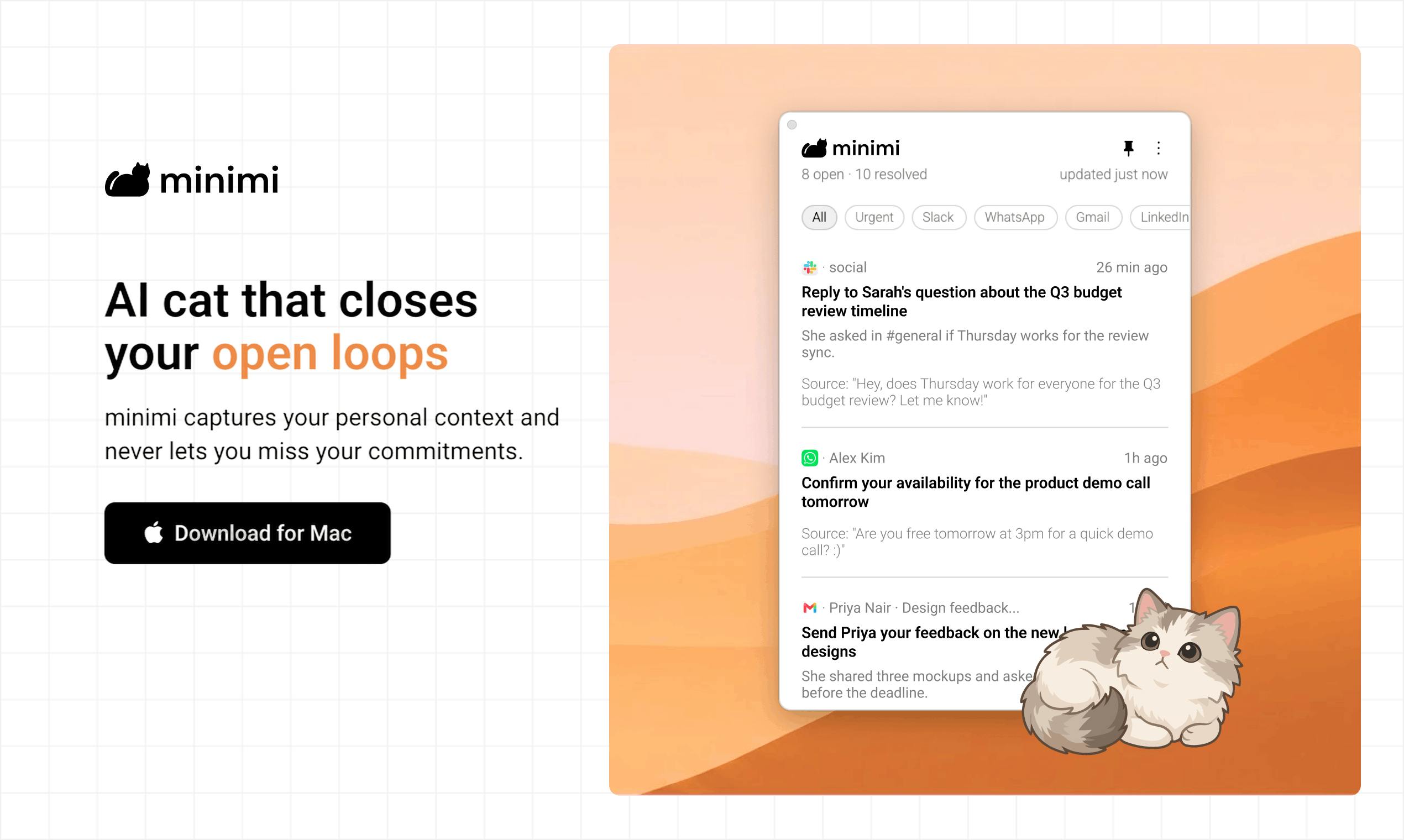
Product Positioning: Giving 'Personal Intelligence' a Face
minimi defines itself as "personal intelligence that comes to you." Unlike most AI tools that require users to initiate every interaction, minimi emphasizes a proactive experience — one where it anticipates your needs before you articulate them, handles the mundane work of managing your life, and frees you to actually live it.
This positioning speaks directly to a major pain point with current AI assistants: there are plenty of tools, but most are reactive. Users still bear the cognitive burden of describing their needs, providing context, and following up on tasks. minimi attempts to lower the barrier to entry — and foster a sense of ongoing companionship — through the emotionally resonant form of AI cats.
Core Mechanic: Adopt Cats with Different Specializations
minimi's most distinctive design choice is splitting AI capabilities into adoptable cat characters, each responsible for a clearly defined category of tasks:
Cotton: Capturing Personal Context
Cotton's job is to continuously record and accumulate the user's personal context. Its core selling point: "you'll never have to explain yourself to an AI again." This directly addresses the repetitive labor inherent in current AI interactions — every time you switch tools or start a new conversation, you have to re-introduce yourself from scratch. Cotton acts as a dedicated memory layer, preserving user preferences, habits, and background information over time.
The "memory layer" is one of the hottest technical frontiers in AI assistants right now. Because mainstream large language models are stateless — each conversation starts from zero — developers must build separate mechanisms to store and retrieve user memory outside the model itself. Common approaches include compressing conversation history into structured summaries, storing preference data in vector databases, and dynamically injecting relevant context at the start of each session via RAG (Retrieval-Augmented Generation). What Cotton does — "continuously capturing personal context" — is precisely this type of capability. Essentially, it shifts the maintenance of a user profile from manual input to automatic AI accumulation. The challenge lies in deciding what information is worth retaining long-term, handling outdated or conflicting data, and retrieving the right context at the right moment without introducing noise.
Melody: Making Sure You Never Miss a Commitment
Building on the personal context that Cotton accumulates, Melody focuses on ensuring you "never miss any commitments." Think of it as a context-aware intelligent reminder and follow-up system — not just setting an alarm, but proactively helping you "close" those unresolved open items based on what it knows about you. This maps directly to the product's tagline: closes your open loops.
The team has also teased more cat characters in the future, hinting at an expandable capability matrix — each new cat introduced equals a new specialized AI module.
The concept of "open loops" comes from David Allen's time management methodology, GTD (Getting Things Done). GTD holds that every known-but-unfinished item continuously occupies working memory, creating hidden cognitive load — and that systematically capturing and closing these loops is central to improving productivity and reducing anxiety. Melody's design logic resonates with this directly: it's not just a calendar reminder, but an active tracker of loose ends scattered across conversations, commitments, and plans, nudging users to follow through at the right moment. For this to work effectively, the AI needs semantic understanding across time and context — recognizing implicit commitments like "I'll check on that next week" and triggering a reminder at the appropriate time, rather than relying on the user to manually create a task.
What the Product Gets Right
Breaking down complex AI capabilities into character-based cats is a clever product narrative. It delivers value on at least three fronts:
- Lower cognitive overhead: Everyday users don't need to understand concepts like "memory layers" or "task orchestration" — they just need to know that Cotton handles memory and Melody handles reminders.
- Emotional connection: Anthropomorphized pet characters naturally evoke a sense of companionship, which helps with long-term retention and engagement.
- Modular expansion: Extending functionality by "adopting a new cat" is far more intuitive than stacking menu items, and it gives the product a clear narrative framework for future iterations.
Looking at its category tags — Productivity, User Experience, and Artificial Intelligence — minimi clearly isn't pure technical showmanship. The emphasis is on experience design: how to weave AI naturally into everyday life.
Questions Worth Watching
Products built around "proactive personal intelligence" inevitably face two real-world challenges.
The first is privacy and trust. Cotton's continuous capture of personal context means it needs access to a wide range of private information. Whether users are willing to hand over that breadth of personal data to an AI pet depends heavily on how the product handles data storage, encryption, and transparency around usage — none of which can be assessed from the current public-facing descriptions.
The second is the difficulty of actually delivering on "proactive understanding." "Understanding you before you speak" is an extraordinarily high promise. Its real-world effectiveness hinges entirely on how accurately the context modeling works. If predictions are frequently off, the experience becomes an annoyance rather than an aid. The success or failure of proactive assistants like this often comes down to that fine line between helpful and intrusive.
Closing Thoughts
minimi 2.0 represents one direction personal AI assistants could evolve toward: not a cold input box, but a character-driven, emotionally engaging design that deconstructs "memory" and "task closure" into adoptable cats. Its reception on Product Hunt suggests this kind of narrative resonates with at least some users. Whether it can truly deliver on the vision of an AI that understands you first remains to be seen — it will come down to how well the product executes on contextual accuracy and earns user trust on privacy.
Related articles

WorkBuddy Full Tutorial: Build an AI Office Automation Agent from Scratch
A complete WorkBuddy tutorial: installation, three working modes, multimodal picture book video practice, expert team agent building, and workflow configuration for low-cost AI office automation.

WorkBuddy Agent Complete Guide: From Beginner to Automation in 7 Days
Based on Bilibili's 256-episode WorkBuddy masterclass, this systematically breaks down Tencent's AI office workbench core capabilities: Agent principles, Skill encapsulation, cross-platform connectors, scheduled automation, knowledge bases, and zero-code development, with learning path recommendations.

8 AI Accounts, 7 Failed: An Honest Review of Using AI to Get Work Done
Only 1 of 8 AI-run Bilibili accounts succeeded. We break down the real difference between "performing AI" and "using AI to get work done."